
A fictional community museum is drafting a response to a grant applicant who asks whether volunteer training costs are eligible when a special exception applies to a regional project. One broad search can find the main spending rule while overlooking the exception that changes the answer. Amazon Bedrock Knowledge Bases offers query decomposition for complex prompts, but splitting a question is not itself proof that all qualifying clauses were retrieved. The workflow below shows how to connect each sub-question to the right policy edition before a human makes an eligibility decision.
Define the two-part grant question
Write the applicant’s question as two explicit checks: what the current general rule says about training costs, and whether a named regional exception changes that rule. Include the grant program, funding year and policy revision as structured fields outside the natural-language prompt. The proposed answer must not omit the exception merely because the main rule appears first in the search ranking.
In a teaching example, a general clause permits staff training but a separate exception restricts reimbursement for travel. Do not invent that rule for a real program: both passages are fictional placeholders. Store a source identifier, section number and effective date for each claim. A fluent summary without that provenance is insufficient for any grant advice that could affect a budget.
Enable decomposition in orchestration
Amazon’s Knowledge Bases documentation describes query decomposition in the test configuration and through the orchestrationConfiguration.queryTransformationConfiguration.type field, with the supported value QUERY_DECOMPOSITION. The configuration belongs to the supported RetrieveAndGenerate workflow; it is not a universal setting for every API operation. Confirm the chosen model, region and endpoint support before adding it to your production request.
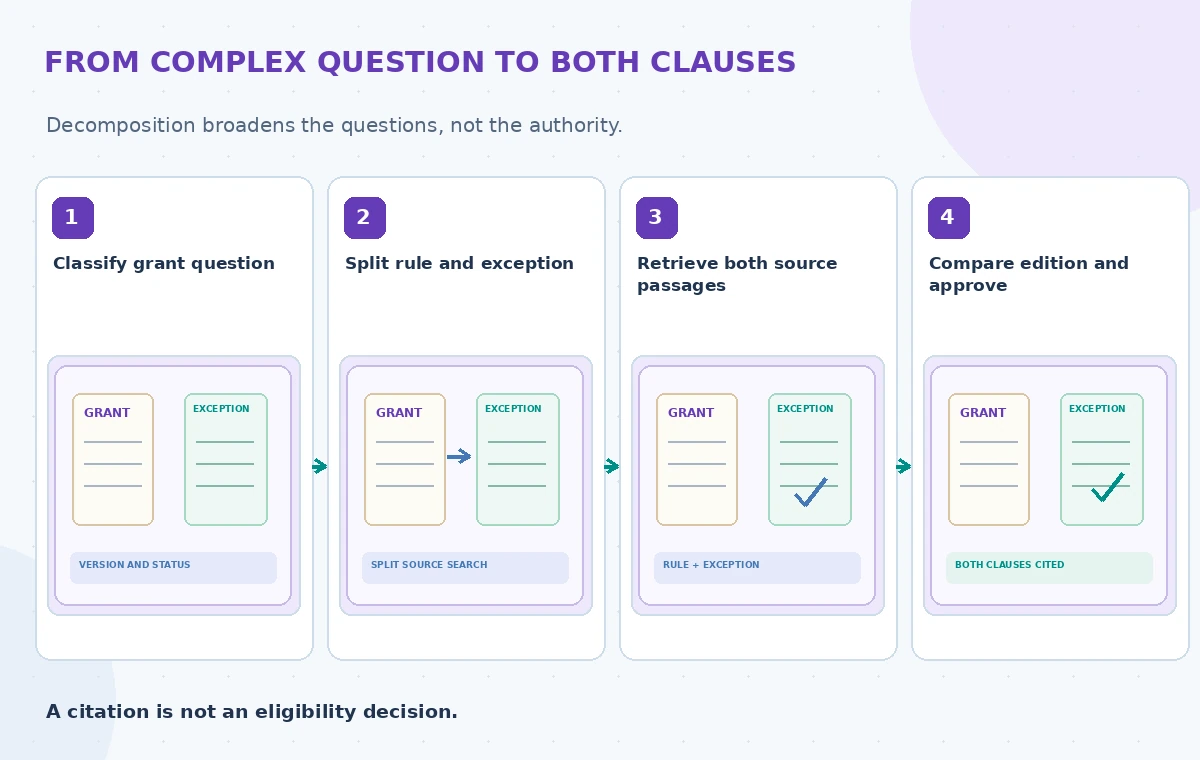
Separate that orchestration option from vectorSearchConfiguration, filters and reranking. Decomposition can generate several sub-queries; retrieval settings determine which indexed chunks those queries can see. A good diagram therefore shows one complex question branching to rule, exception and revision checks, then converging on a reviewer. Do not represent model-generated sub-questions as authoritative legal facts.
Design metadata boundaries before retrieval
Tag each indexed policy with program ID, document status, source edition, effective date, publication scope and owning department. When the index mixes approved policies and drafts, apply authorization and revision constraints before text is used to answer. Bedrock’s query decomposition increases search coverage, but it does not independently enforce organizational rules about who may inspect a draft or an embargoed appendix.
Create a synthetic regression case in which a high-scoring obsolete policy contradicts the current document. The application should exclude obsolete material from the answer or mark it as historical context after checking source provenance. An empty result must not be converted into ‘no exception exists.’ A more accurate response is that the required exception passage was not verified in the approved source set.
Inspect the retrieved sub-questions and citations
For each component question, track the text of the generated query where exposed by the integration, the retrieved source records, and the claims later placed in the draft answer. The combined response may have citations, but a citation is only useful when the linked passage actually supports the sentence. Check both the primary rule and its qualifying language against the original policy PDF or webpage.
Set an editorial expectation: an exception is not adequately handled unless its conditions are quoted or faithfully summarized with scope and date. If one source supplies a threshold and another defines an exemption, keep the two claims separate. Never cite an unrelated section merely because it uses the same term ‘training.’ The diagrams use imaginary clauses rather than tested Bedrock output.
Compare a broad search with a complete review
Three states matter: a broad question that locates only the top-level rule, a polished but incomplete draft that treats the absence of an exception as a finding, and a reviewer-approved response linking both clauses. The middle state should look plausible to explain the real risk: stylistic quality can hide a missing condition. The final state includes a visible unresolved marker if one source cannot be found.

Do not report invented recall improvements or claim that decomposition always retrieves more useful evidence. It can create extra retrieval work, irrelevant branches and additional model cost. Choose success metrics around the percentage of required clauses cited, the rate of wrong-policy editions and reviewer corrections. Keep the original input question so staff can see whether the model drifted into a different issue.
Contain access, latency and additional costs
Multiple sub-queries can increase retrieval work and response time. Record the configured knowledge base, input length, model choice and source filters, then establish a bounded budget and failure path. Sensitive applicant records should not be indexed simply to improve search convenience. Keep public rules separate from private case files or enforce strict application permissions that cannot be rewritten by model output.
Use an internal question ID instead of applicant names in diagnostic logs. Limit logs to query categories, source IDs and validation outcomes whenever possible. Model explanations are not a substitute for checks enforced outside the model. If a retrieved clause is under review or permission-restricted, the answer should stop and identify the need for a qualified human reviewer rather than exposing or silently ignoring that clause.
Build a source-coverage test set
Prepare fictional questions with one rule, two exceptions, a superseded edition, a missing attachment and an ambiguous jurisdiction. For each one, maintain an expected evidence inventory independently of the model. Run the same questions with and without decomposition in a nonproduction environment, then compare source coverage and reviewer decisions. A single tidy demo answer cannot establish that the retrieval design works reliably.

Test the counterexample where decomposition asks about a related grant program and retrieves a convincing but irrelevant policy. Score that as a failure even if the summary is grammatically correct. Document the index revision and retrieval configuration for reproducibility. This guide presents no live benchmark numbers; all depicted paths are conceptual instructions for a future test, not measurements already performed.
Approve only a traceable grant explanation
Before staff sends an answer, they should open every cited policy section, confirm the effective date, verify the exception scope and check that no private case information escaped. The result may be a supported explanation or an explicit request for more evidence. It should never be an automated award decision or a promise that expenses will be reimbursed. Keep a record of who reviewed the wording.
Recheck the vendor’s supported orchestration fields, region availability, query pricing and source attribution behavior during deployment. A source-backed summary still cannot interpret a contract beyond the organization’s authority. Reserve human judgment for disputed conditions, exceptional grants and any application with financial consequences. The complete workflow is designed around evidence, not a fabricated success rate.
How We Research
We researched this November 2026 article from official documentation: AWS: Configure and customize knowledge base queries; AWS: OrchestrationConfiguration API reference; AWS: Retrieve information from knowledge bases. We compared the vendors’ documented fields, feature boundaries, and relevant support conditions with one hypothetical community organization workflow. The diagrams are original fictional teaching art, not product screenshots, measured benchmarks or verified customer cases. We did not submit API requests, run a service, process real personal files or test search accuracy. Implementers must verify current API versions, models, region support, costs, data handling and source permissions; a qualified staff member must confirm factual or safety-critical outcomes.
Frequently Asked Questions
It can split a complex knowledge-base question into smaller retrieval queries; it does not certify the accuracy of the final answer.
Do not assume so. Check support and place the setting in the documented orchestration configuration for the chosen workflow.
No. Apply document permissions, status and edition constraints separately from model-driven retrieval.
No. Evaluate source coverage against a human-maintained test set and flag missing evidence.
No. Financial eligibility and approval require the governing policy and an authorized human decision.