
A museum borrows an artwork for a short exhibition. The agreement contains a pickup deadline, an exhibition opening date, and a return deadline in different sections. A quick AI summary may combine them into a single schedule, but the person arranging transport needs the exact clause and its page. Claude API citations can connect answers to supplied documents; that connection is a review aid, not a guarantee that every interpretation is right.
The scenario and diagrams here are illustrative. We did not submit a real loan agreement to Claude or test model accuracy. The workflow focuses on using citation blocks, reopening the original PDF, and distinguishing a genuine deadline from a date appearing nearby in unrelated text.
Prepare a reliable document set
Gather the executed loan agreement, the approved amendment, and the transport schedule if one has been formally accepted. Give each file a clear internal name and date. A draft contract with the same object title must not silently outrank the signed version. If the PDF is a photograph of paper, inspect whether its words and page boundaries remain legible before asking the API to reason about them.
Restrict the files to the minimum information required. A loan agreement may contain staff phone numbers, insurance details, or signatures unrelated to a shipping-date question. Determine the organization’s approved data handling path first. Removing unnecessary private attachments is not merely an optimization; it reduces the chance that a summary repeats a sensitive detail.
Enable document citations in the API request
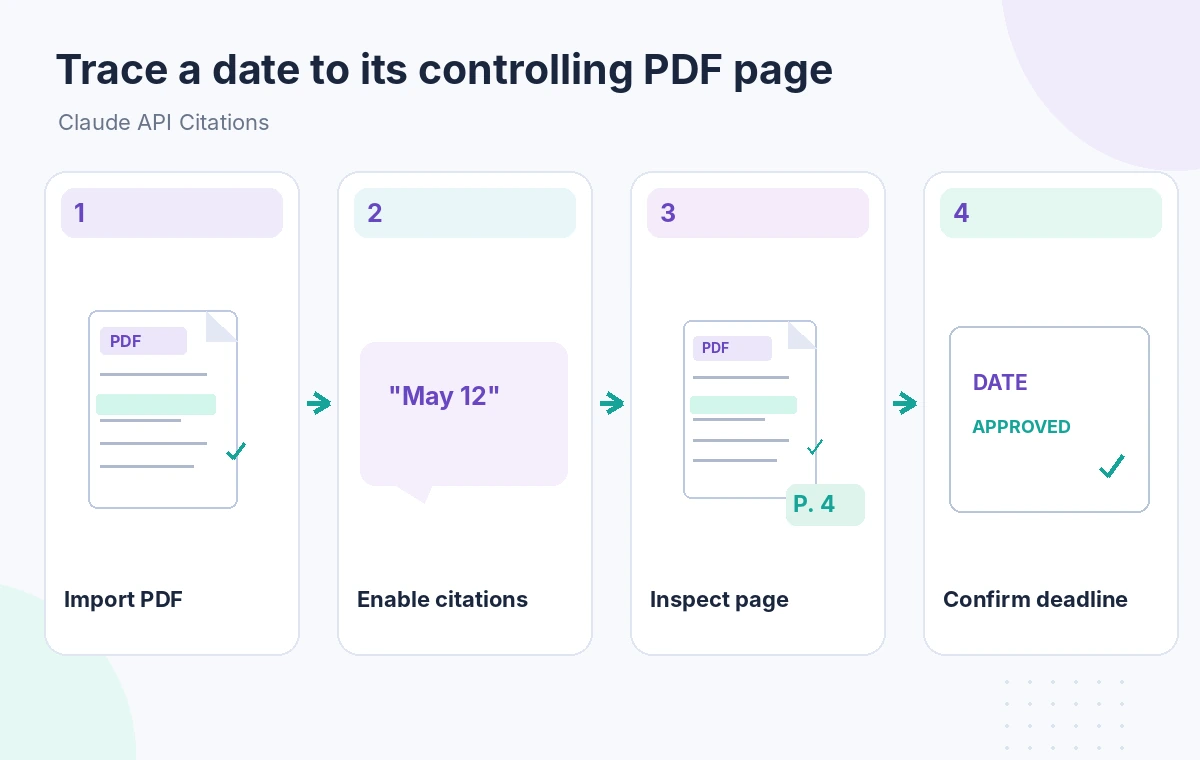
Anthropic’s Citations documentation describes setting `citations.enabled` to true for supplied document content. Supported source types include PDFs, plain text, and custom content documents. The documentation also notes that citation settings must apply consistently across documents within the request. Check the current model and endpoint before adopting a code sample as a production integration.
Ask a narrow question: “What is the latest contractual date for collection, and which signed source supports it?” Do not ask for an invented consensus across conflicting documents. Cite the specific answer and say when the source does not establish one. Good prompting directs the reader to evidence; it cannot turn an unsigned draft into a binding amendment.
Understand what a PDF citation can locate
Claude’s citation output for PDFs can identify a page-number range; the documented numbering is one-indexed. That is especially useful when a PDF contains an early timeline table and a later cancellation section. The API cites text extracted from PDFs. Anthropic states that image citations are not supported, so a visual annotation in a photograph should not be presented as a properly cited image-based assertion.
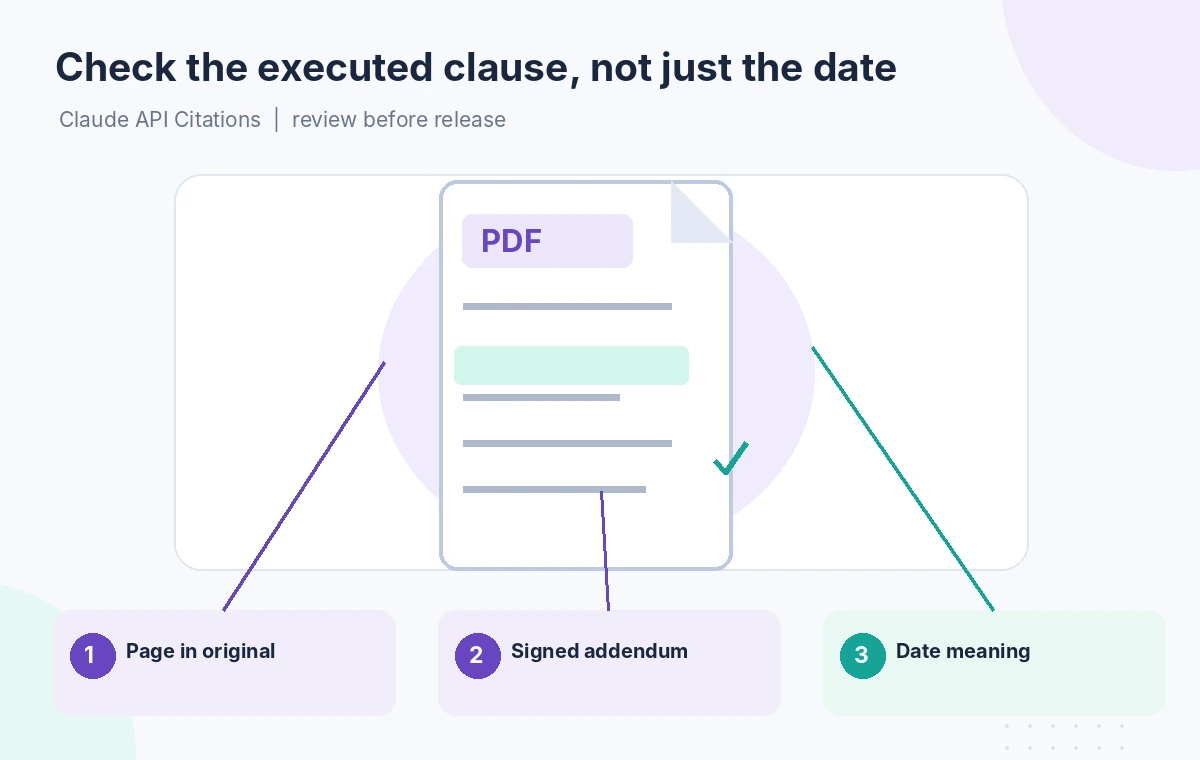
Open the cited page in the original document, not merely the model’s quotation. Confirm the paragraph header, date, applicable party, and nearby exception clauses. For example, “October 16” on a delivery note might be a requested arrival date, while “October 19” in an executed amendment might be the operative return deadline. The reader must inspect context rather than only the matching number.
Resolve conflicting documents by authority
Suppose the signed agreement says pickup occurs on May 12, and a later email proposes May 14. The email is not automatically a contractual amendment. Ask for a citation to the signed clause and separately to the message. Present the comparison as “signed requirement” versus “unconfirmed proposal,” then ask the authorized coordinator whether the parties accepted a change.
Never tell an AI system to choose whichever date appears latest unless the contract actually establishes that rule. The comparison illustration shows a wrong answer that uses an uncountersigned note as the controlling deadline alongside a carefully labeled answer tied to a signed page. Both are educational examples, not quotations from real contracts.
Handle citation formats and compatibility carefully

Anthropic describes citation location formats that vary with source type: PDF page ranges, plain-text character ranges, and custom content block ranges. A reference to character position is not a PDF page reference. Preserve source type and document identity in your application so a reader can inspect the correct location, especially after files have been renamed or re-exported.
There is also a documented compatibility restriction: citations cannot be combined with the API’s strict structured-output format in the same request. For field extraction with cited evidence, Anthropic recommends natural-language lines with citations and parsing those lines downstream. Do not claim that a valid JSON schema and native citation blocks can always be produced together.
Create an evidence table without inventing missing fields
For each required date, record the exact field meaning, proposed value, source filename, cited page, and review status. Separate collection, opening, deinstallation, and return. If the PDF does not give a return deadline, write “not specified in reviewed documents” instead of borrowing the exhibition closing date from another section.
Keep any inferred date clearly marked as an inference and outside approved logistics fields. A curatorial database should not fill blank cells with a confident model guess. In a practical workflow, the person responsible for the loan has to confirm transport obligations with the other party and retain the signed source supporting any change.
Inspect edge cases before distribution
Propose a test set with a rotated scan, a footnote that changes a date, two versions of the same contract, an appendix with different pagination, and a scanned signature page. These are evaluation ideas, not results measured here. Verify that each output shows the correct document and page and that the interface makes unsupported statements conspicuous.
Check whether citations quote enough context to justify the field name. A precise page range can still lead to the wrong interpretation if the model calls a requested date an approved deadline. Ask a second human reviewer to read the actual clause. Citation accuracy and contractual meaning are related but distinct checks.
Approve the schedule outside the model
Before booking transport, the loan coordinator should compare the cited clause with the original signed PDF and any accepted amendment. Record which date controls and who approved it. Keep the generated answer as a research aid and avoid pasting it directly into the official agreement or issuing an instruction to a carrier without verification.
The strongest benefit of Claude citations is traceability: reviewers can move from a model sentence to the original text quickly. That advantage disappears when a team treats citation presence as automatic proof. A defensible schedule is built from the correct document, an accurately read clause, and a human decision.
How We Research
For this November 2026 editorial review, we read the named official materials: Claude Platform: Citations, Claude Platform: PDF support. We compared the documented user actions, feature restrictions, supported source types, and security or data limitations against the illustrative scenario. We did not access a live account, run a controlled experiment, measure vendor accuracy, inspect real contracts, or verify fictional artwork as a product screenshot. Interface labels, eligibility, availability, and pricing may change; revisit the cited documentation and get the appropriate local authorization before deployment.
Frequently Asked Questions
Yes. Anthropic documents page-range citations for PDFs, using one-indexed page numbers that should be checked in the original file.
Anthropic says native citations currently support text, not images. Visually inspect signatures, stamps and diagrams separately.
Not with the documented strict structured-output feature; Anthropic says that combination returns an error. Use cited text and downstream parsing instead.
No. It locates source text. Staff must identify signed versions, amendments and applicable clauses.
Mark the field unresolved and ask the responsible parties. Do not convert the exhibition opening date or an email suggestion into an approved pickup deadline.