
An AI SQL generator can translate a plain-language question into a query, but it cannot guarantee that the database relationships or business definitions are correct. A plausible SELECT statement might double-count orders after a join, omit refunds, or read far more data than expected. The SQL may execute successfully while answering a different question than the one the analyst asked.
This guide focuses on two documented enterprise-data workflows: Gemini assistance in BigQuery and Snowflake Cortex Analyst, which Snowflake increasingly positions alongside Cortex Agents. Instead of publishing an unsupported accuracy ranking, we provide a worked imaginary dataset, a validation checklist and a practical selection framework. The example queries are teaching examples, not output copied from either vendor.
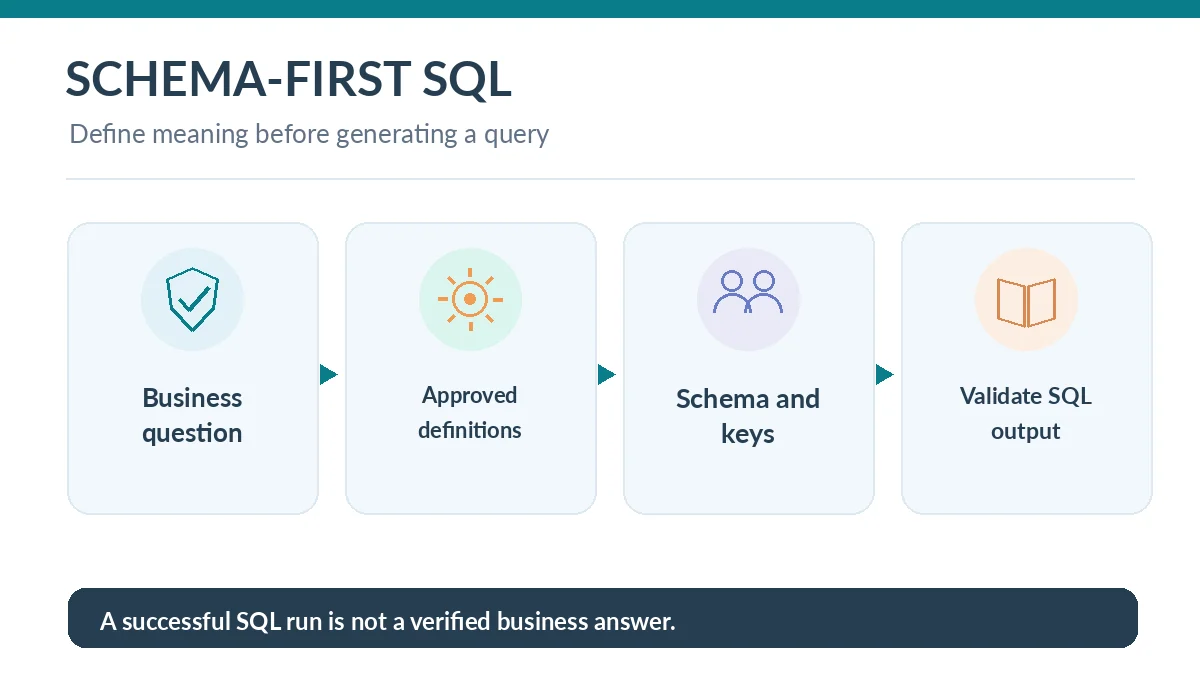
Translate the business question into measurable definitions
Suppose a store manager asks, “How many completed orders did we have last month?” Before generating SQL, define completed, choose the relevant timezone and specify whether returns, test orders or canceled purchases count. Also define whether the result is a count of orders or a count of customers. The AI cannot infer company accounting policy from ordinary English with certainty.
Write the expected output shape: one row containing month, completed order count and perhaps a comparison with the preceding month. Ask an analyst to approve the definitions before anyone compares models. If the business needs revenue instead of order count, clarify currency, tax treatment, discounts and refunds; these are not interchangeable measures.
Provide tables, columns and relationships deliberately
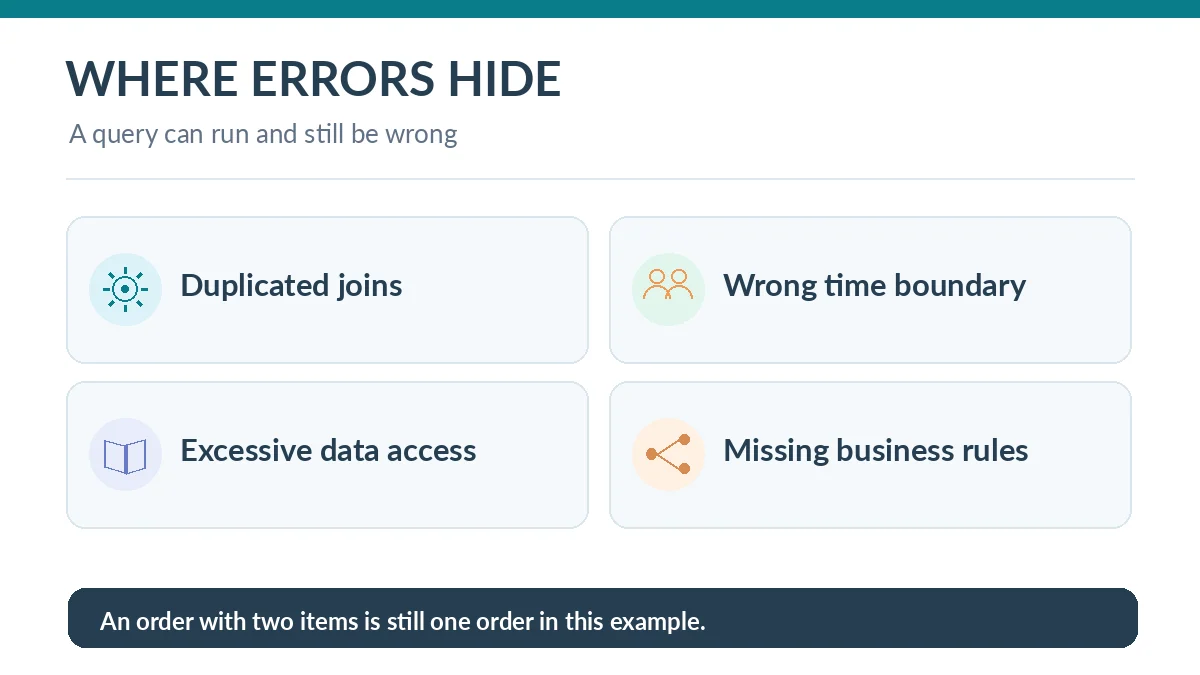
Imagine a synthetic orders table with order_id, placed_at, status and customer_id, plus an order_items table with multiple items per order. An AI assistant might join them to filter products, accidentally multiplying the number of order rows. The correct design uses distinct order identifiers where required and joins only when the question needs item-level attributes.
Share only necessary schema descriptions and approved sample values, not entire customer datasets. Record the join keys and cardinality: one order can have many items. When tables have similar names, explicitly identify the authoritative one. A generated query that compiles does not prove that its joins preserve the business unit of measurement.
Compare Gemini in BigQuery and Snowflake Cortex workflows
Google documents SQL generation, explanation and error-fixing capabilities for Gemini in BigQuery, with role requirements and a warning that AI output may be plausible but wrong. Snowflake describes Cortex Analyst as a natural-language interface to structured warehouse data, supported by semantic views and access controls. Current Snowflake documentation recommends moving toward Cortex Agents for new agentic implementations.
Choose the workflow that already fits your warehouse, permissions and semantic definitions. BigQuery users may benefit from generating or explaining a query in their existing editor. Snowflake teams building governed conversational analytics should investigate semantic views and Cortex Analyst through its supported agent workflow. Do not compare their accuracy without the same verified questions and authorized dataset.
Review query shape and access boundaries before execution
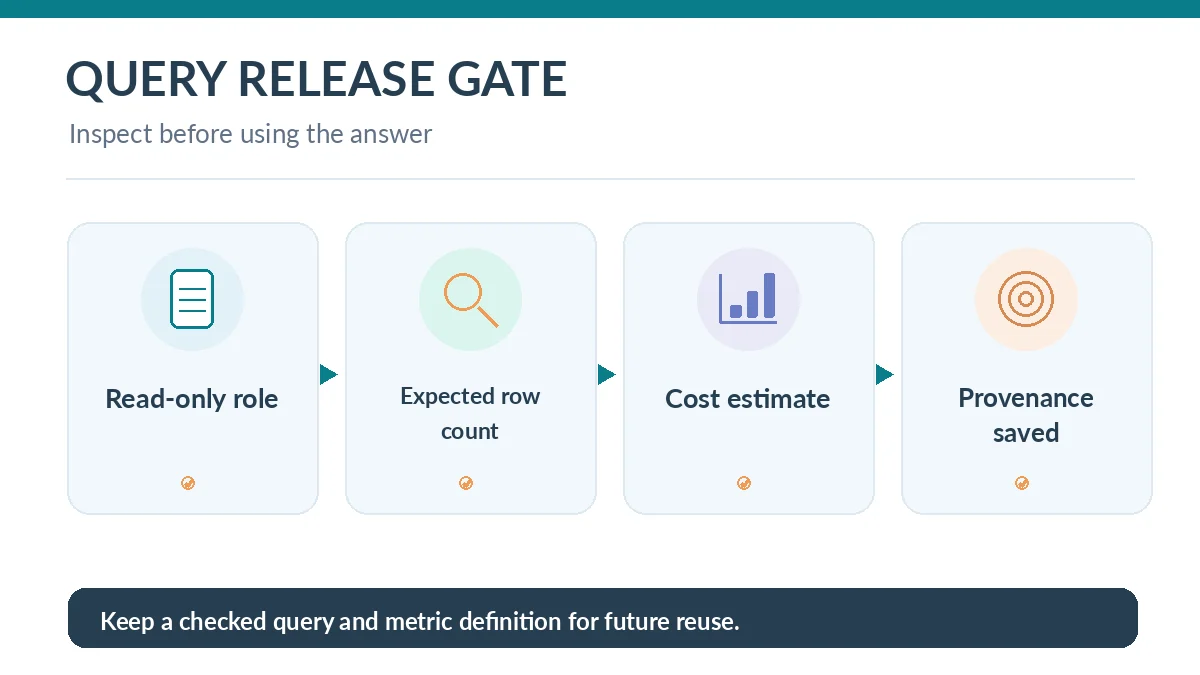
Start with a read-only role and examine the proposed SQL. Confirm the tables belong to the approved dataset, the query is not modifying data, and sensitive columns are not selected unnecessarily. Use a limited result preview where available. Review JOIN conditions, WHERE filters, grouping, time boundaries and whether the requested output can accidentally expose individual records.
Do not put credentials directly into a prompt or run generated statements with administrator rights simply to avoid permission errors. A permission denial may correctly indicate that the user is not authorized to access a table. Escalate access requests through normal governance instead of asking the model to find a workaround.
Check row counts with a tiny known-answer dataset
Create a toy dataset of five fictional orders: three completed, one canceled and one refunded, with one completed order containing two items. The exact expected completed-order count is three under this exercise’s chosen definition. If a generated join produces four rows, the assistant has confused item rows with orders. The toy example checks reasoning, not any vendor’s reliability.
Use a second independent query or manually reviewed reference SQL for the same synthetic records. Then test dates at month boundaries and a missing-status case. Keep these verified questions as reusable checks. Snowflake documents evaluation approaches using verified queries and semantic views; their governance should be considered when building recurring natural-language analytics.
Estimate execution cost and preserve query provenance
Read the warehouse query plan or cost estimate before running an expensive scan. Where available, inspect bytes processed, partitions touched and warehouse size; a LIMIT clause may restrict returned rows without reducing all work. Use table filters and sample data safely, and ask someone familiar with the warehouse to review high-cost proposals. Model or feature charges can also depend on the account and service.
Record the natural-language question, approved metric definition, generated SQL, manual edits, author, dataset version and validated result. This trace allows another analyst to reproduce the answer after a schema change. A chatbot response without a reviewable query and definition is a fragile basis for a business decision.
Decide when natural-language analytics is the wrong interface
For recurring board reports or regulated accounting totals, favor a governed metric or trusted dashboard with tested logic instead of generating fresh SQL each time. When a one-off exploratory question has low sensitivity, an AI generator can be a drafting aid. Complex nested permissions, unstable schema names and ambiguous financial rules increase the need for expert review.
A useful success measure is not whether the agent produces SQL quickly. It is whether an authorized analyst can explain the result, reproduce it and show that the query respects both business definitions and data permissions. If that evidence is absent, treat the output as a draft hypothesis rather than a business fact.
How We Research
We used Google Cloud’s Gemini in BigQuery query-generation guide, Snowflake Cortex Analyst documentation, Snowflake Cortex Agents documentation and Snowflake’s verified-query evaluation guidance. The toy orders and example counts are constructed for education, not observed model outputs or a benchmark. Reviewed October 26, 2026; role and feature availability may vary.
Frequently Asked Questions
It can draft plausible syntax, but table relationships, business metric definitions and permissions must be supplied and checked for the output to be dependable.
The practical choice depends on the warehouse, approved semantic definitions, editor workflow, access policies and your verified evaluation questions.
No. Incorrect joins, filters and counting logic can return valid-looking numbers that do not match the business question.
Use synthetic records, read-only permissions, explicit expected counts and an independently reviewed reference query before touching sensitive tables.
Prefer governed and tested metrics for high-stakes recurring reports; any generated SQL must be independently reviewed and its definitions preserved.