
AI software testing tools can generate scenarios, help write test steps or investigate failing browser flows. They do not automatically know what the application must do. A test that passes because it asserts the wrong outcome may create more confidence than doing no test at all. The important choice is how the tool handles expected behavior, observable failures and ongoing test maintenance.
This comparison looks at the documented workflows of Playwright Test Agents, mabl and Tricentis Testim. They are not identical products: Playwright is a developer-oriented automation framework with agent tooling; mabl provides a managed testing workflow; Testim offers browser automation and AI help with custom JavaScript steps. We did not perform independent pass-rate benchmarks or verify current prices for every account.
Write acceptance behavior before prompting an AI test generator
Describe the feature in terms a user can verify. For a subscription checkout example, an eligible account should submit a valid purchase, a missing payment method should trigger a clear error, and an unauthorized user should not view another person’s invoice. Include one or more expected outcomes for both success and failure. Those requirements become an oracle: the generated test must compare reality with a specified result.
Avoid a circular workflow where the same AI builds the feature, invents the test and declares both correct. Have a product owner or engineer confirm what success means. An agent can propose additional cases, but those cases should be reviewed against actual business rules rather than silently accepted as coverage.
Understand the three practical tool models
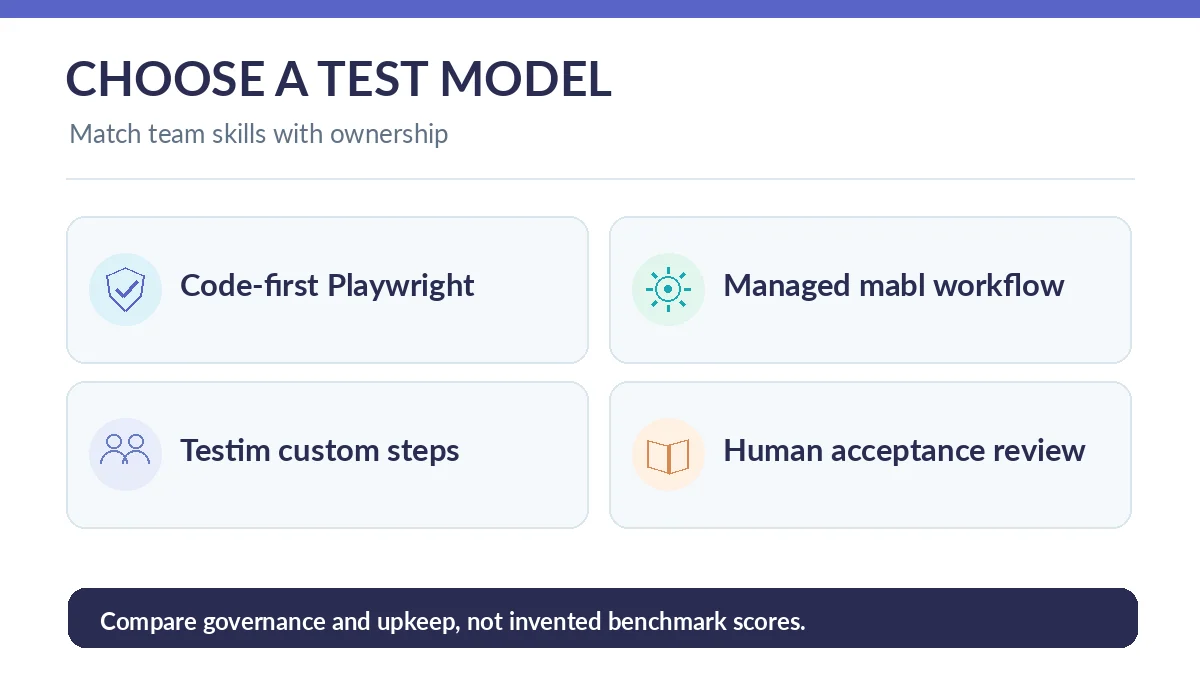
Playwright provides browser automation, assertions, traces and a test generator; its documented Test Agents include planner, generator and healer roles. The agents can help create or repair tests, but a team still maintains test code and environment. mabl documents agent-oriented tooling and a CLI for test authoring and debugging. Testim documents a Copilot Coding Assistant for custom JavaScript steps, including generating, explaining and fixing code.
Choose Playwright when developers want version-controlled test code and cross-browser control. Investigate mabl when the team values a managed authoring and maintenance environment and can validate the platform’s governance and integrations. Investigate Testim when existing test flows require supported custom JavaScript capabilities. These are editorial selection criteria based on documented positioning, not measured rankings.

Create one reproducible trial flow
Use a disposable app or sandbox tenant. Create a test user, a stable data fixture, a login step, a meaningful form submission and a read-back check that proves the record persisted. Repeat using an invalid input and confirm that the application rejects it. Run the exact scenarios through candidate workflows while recording how much manual correction and setup each tool requires.
Do not use real card details, personal records or live production accounts. If the test generates or heals a selector, review whether it targets the intended element rather than whatever currently happens to match. The cost of a test tool includes maintaining these fixtures and isolating the environment, not just creating the first script.
Distinguish genuine failures from flaky timing
A flaky test sometimes fails when the product behavior is correct. Common causes include ambiguous selectors, shared test state, delayed network responses and assumptions about execution order. Playwright documents auto-waiting, assertions and trace viewing; these help engineers understand what happened. A healing agent may repair an obsolete locator, but it must not rewrite a business assertion merely to turn a failed run green.
For every repaired test, preserve the previous expected outcome and review the generated diff. If the app genuinely stopped enforcing a required error message, changing the assertion to accept the new text might conceal a regression. Run the test multiple times in clean environments and record the specific reason for any intermittent result.
Keep security and access testing separate from happy-path automation
A chatbot that generates navigation steps may overlook authorization, data isolation and dangerous state-changing operations. Include distinct negative cases that confirm a signed-out user cannot access a private route and a low-permission user cannot edit another user’s records. Make sure the assertion checks the backend result, not just whether a button is hidden from view.
Use test identities and an approved secrets store. Review vendor permissions for connecting repositories, browser recordings and test artifacts; screenshots and logs can contain personal data. For payment or healthcare applications, organization policies may require additional compliance review. No generic AI testing feature makes an application legally or technically compliant.
Measure maintenance over several changes
Take the same small app through a label change, a harmless layout change and an intentionally broken validation rule. Observe which tests remain useful, which need locator maintenance, and whether an AI assistant incorrectly “repairs” away a failure. A short trial that ends before the application changes reveals little about the work a team will face over a year.
Capture human minutes spent inspecting changes, number of useful failures, time needed to reproduce them and accessibility of traces or screenshots. Do not convert a tiny convenience trial into generalized assertions that one platform is faster or more reliable. Discuss ongoing plan limits, parallel execution, environment management and test ownership with each vendor.

Adopt a layered testing strategy with human ownership
Keep deterministic unit and integration checks near the code, use browser end-to-end tests for the most important user journeys, and reserve manual exploratory work for ambiguous or high-impact experiences. AI generation may speed up proposing tests but cannot replace a defensible acceptance specification. Assign an owner to flaky-test triage, fixture refresh and reviewing generated repairs.
Review the suite after every material release. Remove redundant checks only after confirming the underlying risk is already covered. If an AI tool recommends skipping a failing check to make CI green, investigate the failure rather than accepting the shortcut. The best tool is the one that makes real regressions easier to detect and explain.
How We Research
We evaluated the feature boundaries in Playwright Test Agents, Playwright’s test generator, the mabl documentation for CLI and AI agents and Tricentis Testim’s Copilot Coding Assistant. The checkout-flow test protocol is a reader exercise, not a vendor test LabFin ran. We have not independently established test success rates, plan pricing or security compliance. Checked October 26, 2026.
Frequently Asked Questions
No. They may target the wrong element or assert the wrong outcome. Review expected behavior and inspect the test before trusting results.
No. It is a browser automation and test framework that also provides documented tooling for AI agents and test generation.
A repair that changes an assertion to accept broken behavior can hide a real regression; locator fixes and expected-outcome changes need separate review.
Use sandbox data and dedicated test identities. Real credentials, payments and personal data add avoidable privacy and operational risks.
Evaluate repository ownership, managed authoring needs, custom-step support, test evidence, governance and maintenance in an identical approved sample workflow.