
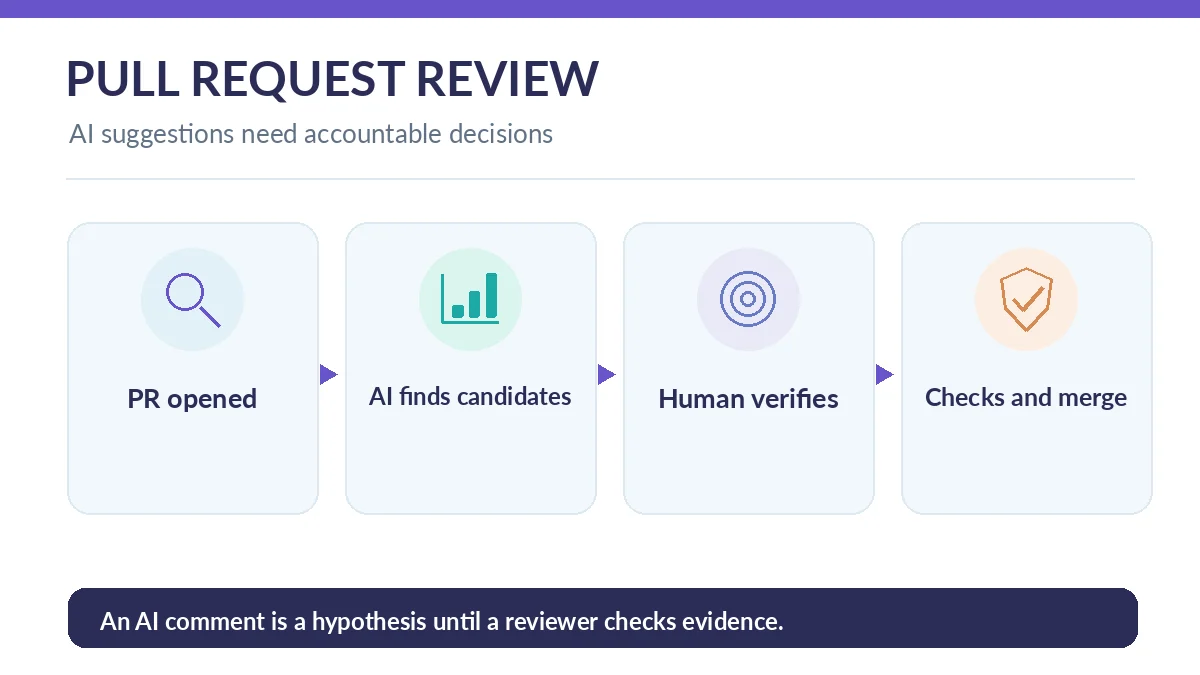
AI code review tools summarize pull requests and flag possible problems, but they cannot take responsibility for a release. A review that sounds confident may misunderstand a business invariant, and a quiet review does not prove a change safe. The useful purchase question is not which bot leaves the most comments; it is which reviewer fits your repository, finds meaningful issues and leaves engineers able to verify them.
This guide compares GitHub Copilot code review, Qodo’s Git integration and CodeRabbit as review workflows rather than ranking their accuracy with made-up scores. Use the same small, approved trial PRs, track human dispositions and judge access requirements before sending proprietary source code to a service. Pricing and availability depend on plans, configuration and time; check the current vendor pages.
Decide what the pull request review must catch
Divide your review needs into correctness, security, maintainability and process. Correctness includes bad edge-case handling and accidentally changed behavior. Security includes permissions, injection hazards and leaked data paths. Maintainability includes undocumented coupling and tests that no longer explain a requirement. Process includes whether the reviewer appears at the right stage before merge and whether its output can be audited.
Write two or three failure examples from your own codebase, without copying confidential production data into a trial. For a shopping cart, examples might include applying a discount twice, forgetting authorization on a refund action and accepting a missing quantity. These are candidate review cases, not claims that a named product detects every one.
Distinguish native PR review from a separate review bot
GitHub Copilot code review sits inside GitHub and can use repository context. Its documentation describes Lite and Balanced effort, with different credit implications. Qodo documents PR-change suggestions across common code-hosting workflows. CodeRabbit is another specialized PR-review option, useful to assess when teams want configurable automated feedback; confirm your exact provider and plan in the service’s current documentation.
Native integration often lowers setup work for a GitHub-centered team; separate bots may offer workflow-specific controls or conventions that justify evaluation. None should be declared universally best without your own test cases. Prefer the reviewer that produces actionable comments in the files your team actually changes and does not overwhelm maintainers with generic style notes.
Run a controlled trial with known defects
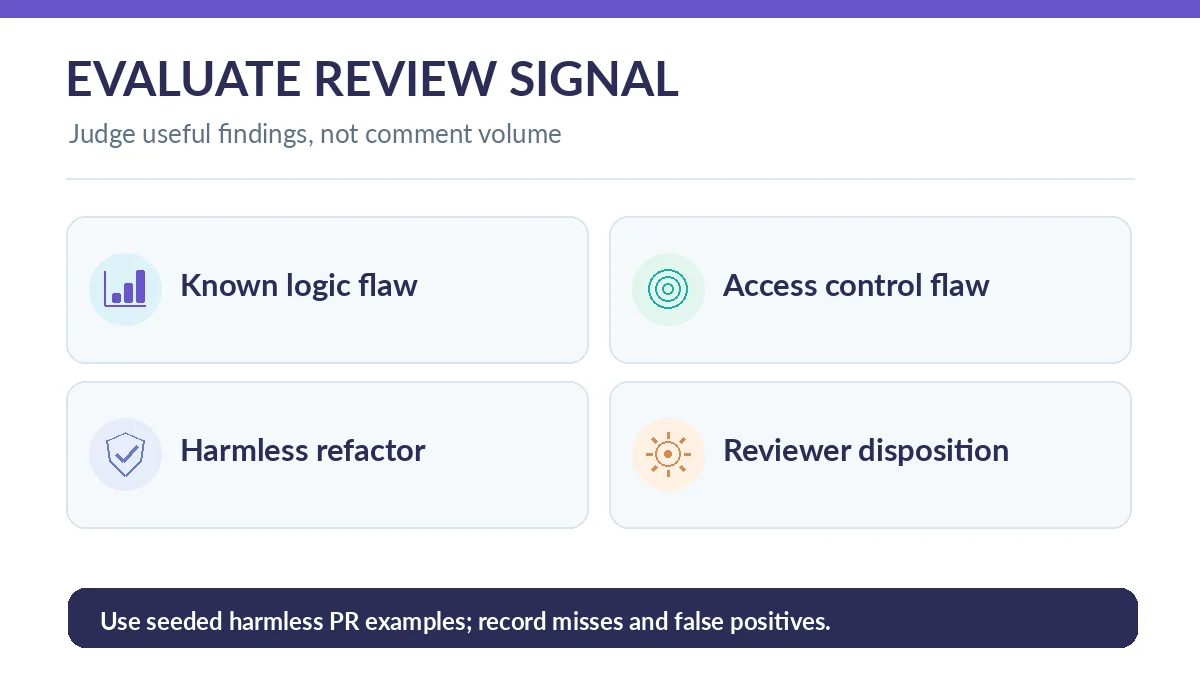
Prepare a harmless sample repository and three pull requests: a normal refactor, an edge-case logic bug and an authorization mistake. Document the expected issues before requesting reviews. Use consistent repository instructions, compare comment relevance and note whether the suggestions include a reproducible reason. If one bot sees more context or receives a custom prompt, disclose that difference rather than calling it an apples-to-apples benchmark.
Have engineers mark every recommendation as valid, incorrect, unclear or out of scope. Track how many serious seeded issues were discussed, how long humans took to assess the findings and whether the tool introduced distracting suggestions. These are trial measurements to collect, not published performance numbers. A tool that misses a seeded security issue remains subject to ordinary security scanning and human review.
Check how sensitive code and instructions are handled
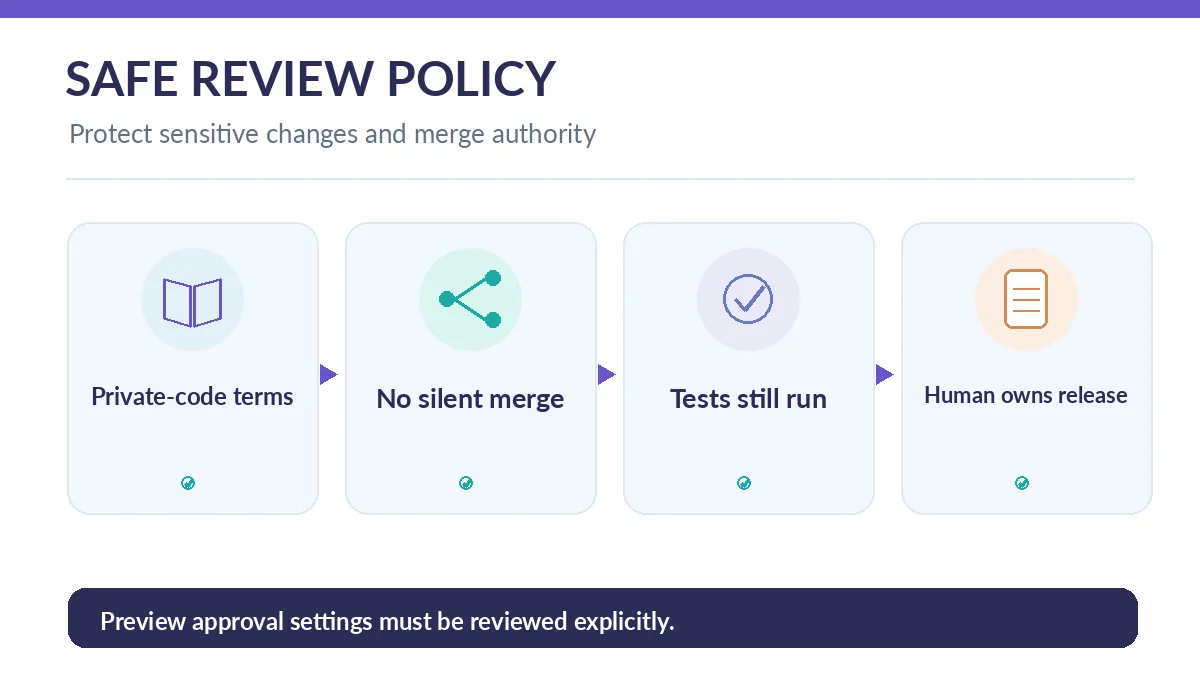
Review data retention and training terms, secret handling, repository permissions and administrative controls before enabling a bot on private source. Ask which scopes a GitHub App needs, whether comments or source code are retained, and how access is revoked. Start with non-sensitive repositories if policy permits. A third-party review agent does not inherit your security posture just because the comments appear inside GitHub.
Also audit repository-level instructions supplied to AI tools. They can improve context, but untrusted comments, files or pull-request descriptions must not be treated as permission to expose secrets or run commands. Do not let an AI-review tool silently merge, deploy or modify protected branches without an explicit, reviewed policy.
Treat AI approvals and suggested fixes as configurable risks
GitHub’s documentation now discusses preview Copilot approvals that can, when deliberately enabled, contribute to protected-branch requirements. That means old blanket statements that AI approval never counts are no longer reliable. The safer policy is to explicitly configure who can approve protected changes and require named human review for high-impact paths, regardless of which toggles the vendor currently offers.
When a reviewer suggests a patch, inspect the original test failure, the proposed diff and side effects. Re-run tests and perform code-owner review; do not equate an AI-generated patch with proof the issue is solved. Keep the audit trail of who accepted a suggestion and why. For dependency or configuration changes, check deployment and rollback implications beyond the edited lines.
Choose by PR volume, noise and developer ownership
A small team with a handful of PRs may value convenience over elaborate policy rules. A large monorepo may need repository context, custom paths, filters and administrative controls. Ask what costs are driven by seats, review events, credits or additional agent actions, but do not assume any single billing model applies to every tool or plan. Request a quote for your actual workflow when published prices are ambiguous.
Evaluate the impact on people: does the service teach junior contributors why a change matters, or does it encourage mechanically applying suggestions? Assign ownership of false-positive triage and set a mechanism for suppressing repeatedly unhelpful checks. A useful review tool saves attention for important decisions; it should not simply move the work from writing code to dismissing comments.
Adopt a release gate with humans and conventional checks
Require CI, static analysis, dependency scanning, code-owner review and test evidence according to the risk of the change. AI review is one additional signal, not the security control of record. Document an escalation path for payment, authentication and privacy-related changes, where a specialist may need to review data flows rather than only a source diff.
After a month of use, sample accepted and dismissed suggestions and interview reviewers. Look for repeated missed classes of problems, not a heroic isolated example. Keep the option to disable the bot when it slows urgent incident fixes or conflicts with company policy. The decision to merge should remain accountable and traceable.
How We Research
We reviewed GitHub’s Copilot code review concepts, its configurable approvals guidance, and Qodo’s PR improvement documentation. CodeRabbit is included as an evaluation candidate, not a performance winner. The three hypothetical PR tests are an assessment protocol, not a trial we performed. Checked October 26, 2026; enterprise contracts and settings require direct vendor verification.
Frequently Asked Questions
Not as a blanket policy. Some products expose configurable AI approval capabilities, but release accountability and high-risk change review should remain explicit.
No reliable universal winner is established here. Use seeded, permission-safe pull requests and compare validated findings and misses in your own environment.
Only after security review of permissions, retention, data-processing terms, administrative controls and any connected third-party services.
Review time is limited. Too many irrelevant comments can distract engineers from serious defects even when a tool occasionally identifies useful issues.
For ordinary teams, require a human to inspect the proposed diff and verify tests before merge; protected or sensitive changes need stronger controls.