
An AI character art generator can create dramatic portraits, but tabletop gaming needs a recognizable person or creature from one session to the next. Our original example is a fox ranger in a green cloak carrying a brass lantern and satchel. The job is to produce a portrait, side view and full-body pose without changing equipment or identity. We show how to use a character bible, references and a discrepancy log rather than declaring every visually appealing output a canonical design.
Build a character bible before generating portraits
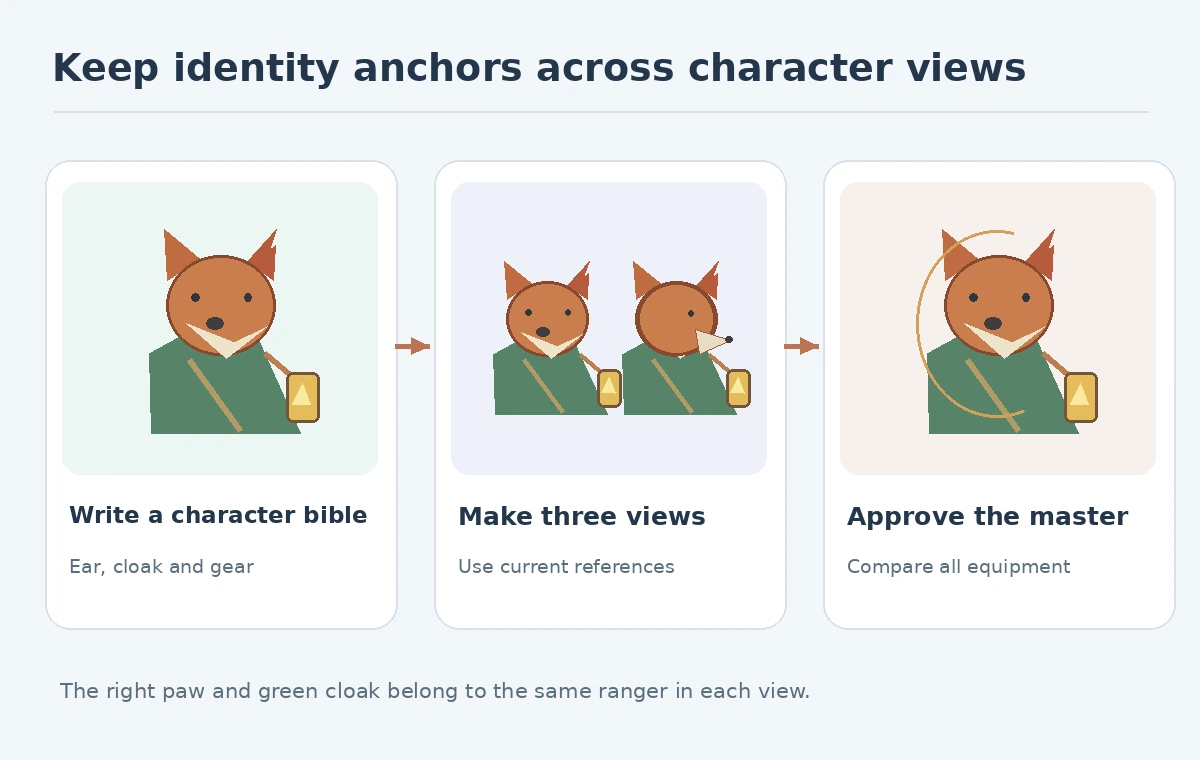
Write down five locked traits: tawny fox face, white muzzle, notch in the left ear, moss-green cloak and brass lantern held in the right paw. Add a brown crossbody satchel and a slim traveling staff. Those facts should be visible or explicitly accounted for in every view. Leave facial expression and pose as the elements that may change.
Also name the character’s narrative function. A cautious ranger exploring ruined valleys should read differently from a royal court magician. Story context can guide clothing wear and posture without making up new gear each time. If this character belongs to a paid commission or shared game, agree on allowed adaptation and source ownership in advance.
Create an approved neutral master portrait
Generate a simple full-body view against a quiet background and ask for unambiguous visibility of hands, equipment and ear notch. Avoid action scenes, darkness or complex crowd interactions in the first pass. A neutral master is much easier to compare with later poses and to correct when a lantern swaps hands or the satchel strap changes direction.
Choose one design as canonical. If you cannot tell which side the ear notch is on, do not approve it. Write down which details are intentionally stylized so they are not later “corrected” into something inconsistent. Save a compact palette of cloak green, fur amber and lantern brass.
Understand which reference controls are current
Midjourney’s Edit Model documentation explains that V8.2 supports creating or changing images with up to four references. Its older Omni Reference help explicitly describes V7 compatibility and points V8.X users to the Edit Model instead. Copying old commands into a new version can mislead readers or block a workflow.
Use any available reference feature as guidance, not as proof of identity consistency. The model may preserve facial color but move the ear notch. Keep the plain-language character bible alongside the images and review every candidate against it.
Request poses that test specific continuity risks
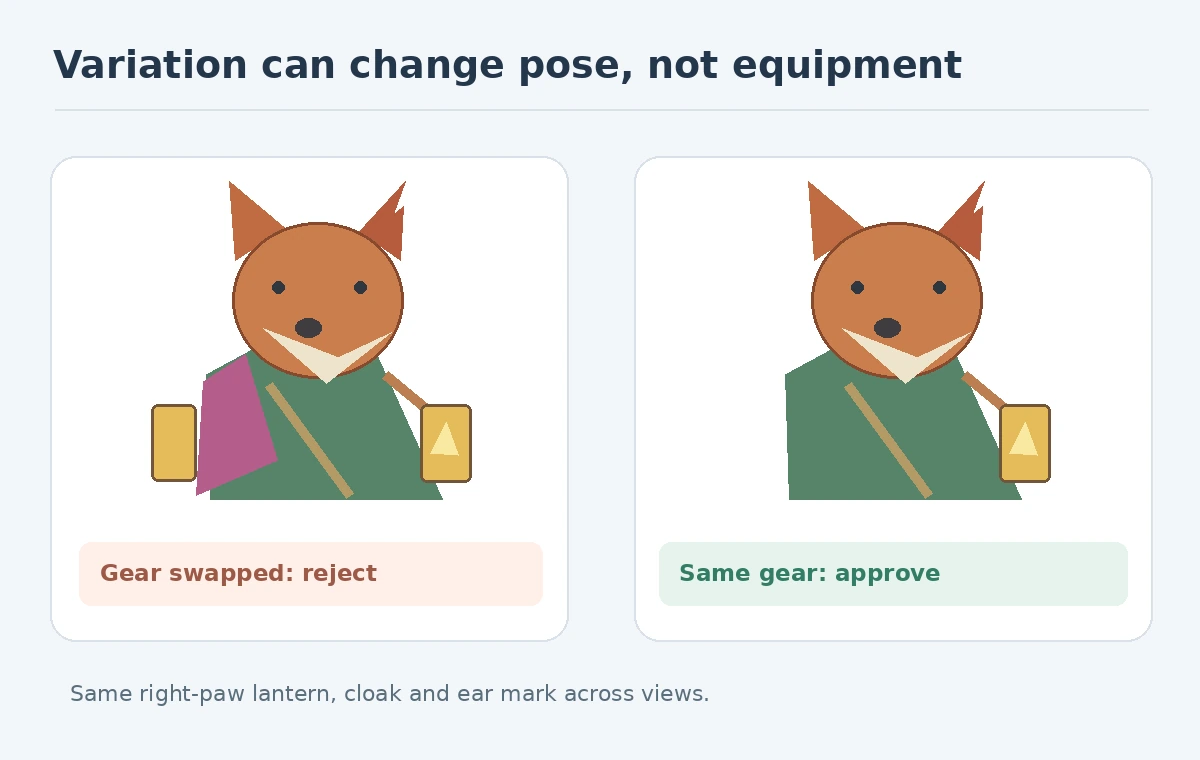
Choose three views: front three-quarter for expression, side profile for muzzle and ear notch, and walking full-body for lantern, boots and satchel. Use the same gear descriptions in each prompt. Change only the pose or camera direction when you can. A new cloak pattern or swapped lantern hand is a revision request, not an acceptable interpretation.
Make a two-column discrepancy log after each generation. The left side records the invariant, and the right side states what changed. For example: “Lantern should be in right paw; side view shows it in the left.” This is more actionable than the comment “character feels off.” If a variation has too many contradictions, restart from the approved master.
Separate character likeness from illustration style
A pencil sketch, watercolor portrait and clean cel-shaded drawing can all depict the same ranger. Likeness preservation means the ear notch, muzzle, cloak and gear remain identifiable even as brushwork changes. Keep the character silhouette larger than decorative background scenery, and review at the intended tabletop token size. Details such as the belt clasp may disappear at 64 pixels; the cloak shape should still read.
Avoid relying on descriptions such as “the same character as before” when earlier images are not loaded or referenced. Record the stable visual anchors explicitly. For actual people, obtain consent before uploading likenesses, but our fox is a fictional original character.

Prepare a token portrait and a full-body handoff separately
An overhead virtual-tabletop token and a full-body illustration have different framing requirements. For tokens, center the head and cloak silhouette inside a circular crop. For a printed character sheet, preserve the boots, lantern and satchel with enough surrounding space for captions. Do not crop the tail or staff accidentally just because the head looks good.
Deliver the approved variants with labels, a clean cutout where supported, and a written summary of essential gear. Provide alternative expressions as optional extras rather than mixing them into the canonical sheet. If other artists will work on the game, include a note identifying the reference image they should follow.
Approve the sheet without inventing game statistics
Inspect consistency and practicality: ear notch stays on the correct side, cloak color is stable, lantern hand is correct, and there are no phantom weapons or extra paws. Check image rights and local group consent to any shared artwork. Art should never imply official licensing from a tabletop publisher without that authorization.
This guide’s deliverable is a three-view fox-ranger character reference and a discrepancy list. It passes if views describe the same recognizable hero and token cropping is usable. It fails if an action image silently alters essential equipment. We are demonstrating editorial criteria with original fictional artwork, not reporting a controlled model consistency test.
How We Research
We reviewed Midjourney’s V8.2 Edit Model, V7 reference guidance and version history on October 27, 2026. The ranger is a fictional drawing and we did not conduct controlled cross-model likeness tests. We used named vendor pages for capability claims, not performance measurements; our accept-or-reject examples are editorial review criteria applied to deliberately fictional drawings.
Frequently Asked Questions
Lock a short list of visual identity anchors and compare each new pose to the approved master.
No. Style affects the look; identity consistency needs explicit character features and review.
Use the current V8.2 Edit Model guidance rather than assuming V7 commands work unchanged.
A neutral full-body view, an expression portrait, a profile and a concise gear description.
Do not assume permission; review the relevant character IP, licenses and your generator terms.