
Avatar-led training is attractive because an organization can refresh a policy module without gathering a film crew. But a polished presenter does not automatically improve learning. Scripts still need correct procedures, readable screen content, captions, a clear owner and a route for employees to ask questions.
This guide compares Synthesia and HeyGen as documented options and shows how to evaluate avatar workflows against training requirements. It focuses on employee learning, not celebrity impersonation or photorealistic entertainment. Personal-avatar creation must respect explicit consent, employment policies and rights in source footage.
Begin with instructional goals, not the avatar face
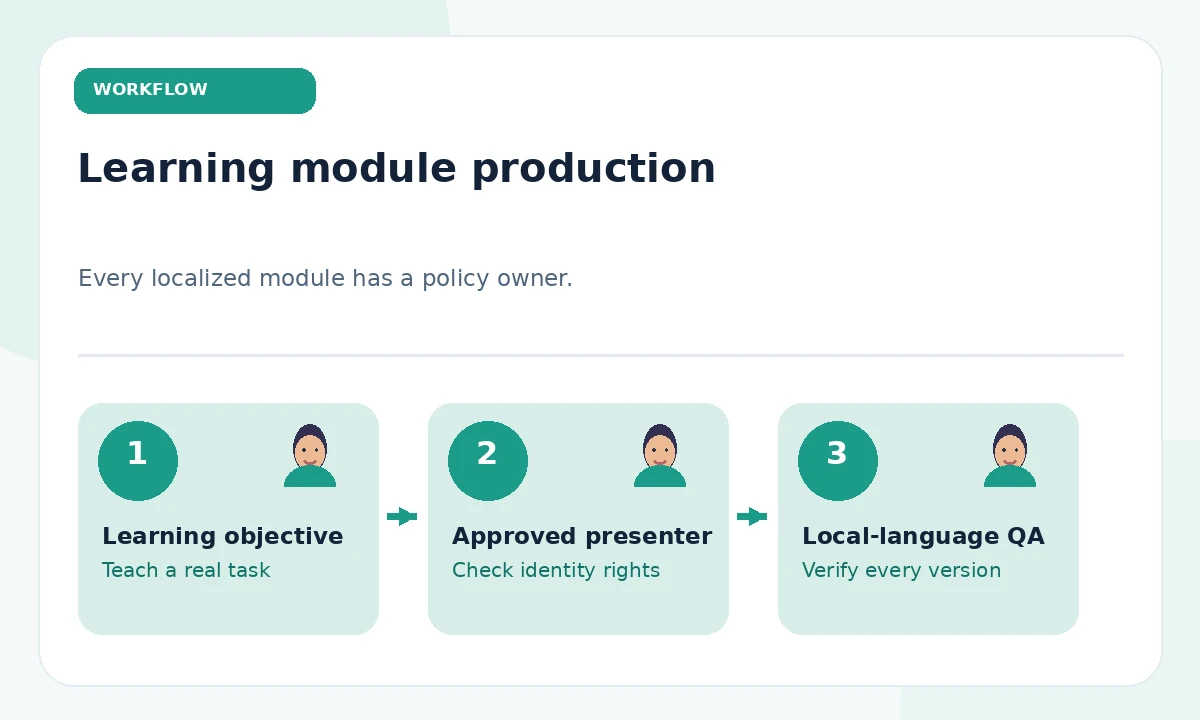
Specify what a learner must do after the video: submit an expense correctly, recognize a phishing email or operate a workplace procedure. Write the assessment first, then create the minimum script and examples needed to teach that behavior. The presenter should guide attention to evidence, not occupy most of the frame.
Use a module brief containing audience, reading level, target runtime, policy owner, accessibility needs, review date and escalation channel. For high-risk training, consider whether an actual subject-matter instructor or live demonstration is required. Synthetic delivery may be unsuitable for safety-critical nuance.
Synthesia: template-based business video and personal avatars
Synthesia documents Personal Avatars from photos and video as part of its business video workflow. Its July 2026 photo-avatar guidance limits that feature to paid plans and requires a live consent video from the represented person. Personal avatar allowances differ by plan, and enterprise controls should be checked with the provider.
Consider Synthesia when a company wants repeatable video modules managed through structured review. Evaluate screen layout, narration, subtitles, sharing and update workflow in a small course pilot. Do not infer that templates eliminate legal review or that a translated avatar is an accredited instructor.
HeyGen: digital presenters and video translation
HeyGen documents Photo Avatars, video-based Digital Twins and avatar-led script production. Its consent guide requires the individual in a video-based Digital Twin to record their own confirmation, even when another teammate prepares the upload. Current HeyGen options include different engines and credit-based usage for more expressive animations.
HeyGen also offers video translation, including voice and optional lip-sync, but translated speech should be reviewed by someone competent in the target language. A translated compliance sentence with a wrong negative or decimal is an error regardless of how convincingly it is spoken.
Decide when stock avatars are enough
A stock avatar can suit routine orientations where the individual presenter’s identity adds little value. A personal likeness may be appropriate for an identifiable executive announcement, but it requires a documented agreement on uses, retention, withdrawal and version control. Human resources should approve employment-related likeness use.
Make the choice with a permission matrix: stock presenter, approved custom presenter, human video or no face. Avoid using an employee’s photo merely because it exists in the corporate directory. Record who approved each likeness and restrict unused training assets from indefinite redistribution.

Protect clarity, captions and learning accessibility
Use a clean speaking pace and split complex procedures into short scenes. Place each important instruction as readable text or a screen demonstration, not only as spoken narration. Provide accurate captions and a text alternative. Pause after critical steps so viewers have time to act or reflect.
Review a module with the sound muted and another with visuals obscured; both passes can reveal missing information. Verify color contrast, keyboard-accessible player controls and the order of steps. A lip-synced avatar cannot substitute for a correct transcript or accessible player.
Plan localization as a new editorial review
For multilingual training, do not send an approved English script directly to mass export and assume the rest is complete. Translate policy terms using an approved glossary, have a local reviewer check tone and obligations, and confirm captions against the spoken track. Validate on-screen labels that may not be translated automatically.
Separate three approvals: subject-matter correctness, language accuracy and technical playback. Store the original and translated script versions with release dates. If the source policy changes, list which languages and formats require regeneration instead of only replacing the English master.

Calculate total effort instead of price per avatar
Include script preparation, approvals, custom avatar verification, translation, revisions, credit or minute usage, team access and subtitle checks. A lower subscription fee can be less attractive if every small script change forces a full regeneration or repeated legal review.
Pilot one complete lesson with a corrected sentence before you commit to twenty. Count the total number of renders and minutes that reach final approval. Do not compare providers on guaranteed output quality or invent minutes per credit; use each vendor’s current plan description and actual checkout.
Keep a maintained training asset register
Assign every lesson an owner, policy reference, audience, locale, caption file, avatar permission record and retirement date. Include a link to the authoritative written procedure. If the avatar tells employees an outdated process, a realistic presentation makes the error more persuasive.
Set reminders to review modules when policies change and after major incidents. Monitor completion and comprehension, not only video views. The best system is one that lets a training owner correct misleading content quickly and safely.
How We Research
We reviewed Synthesia’s July 2026 personal photo-avatar rules, HeyGen’s consent procedure, and HeyGen’s translation documentation. Our training governance checklist is an editorial recommendation; no learning-effectiveness trial or paid account test was performed.
Frequently Asked Questions
No. Obtain informed permission and check the provider’s current identity-verification requirements before using a personal likeness.
They can deliver routine modules but should not substitute for required expert judgment, live coaching or hands-on assessment.
No. Have a competent local-language reviewer verify policy wording, captions, numbers and on-screen terms.
Compare the lesson-building, approvals, consent checks, localization and account controls your organization needs in a real pilot.
Whenever the underlying procedure changes, and on a scheduled review cycle with a named policy owner and archived versions.