
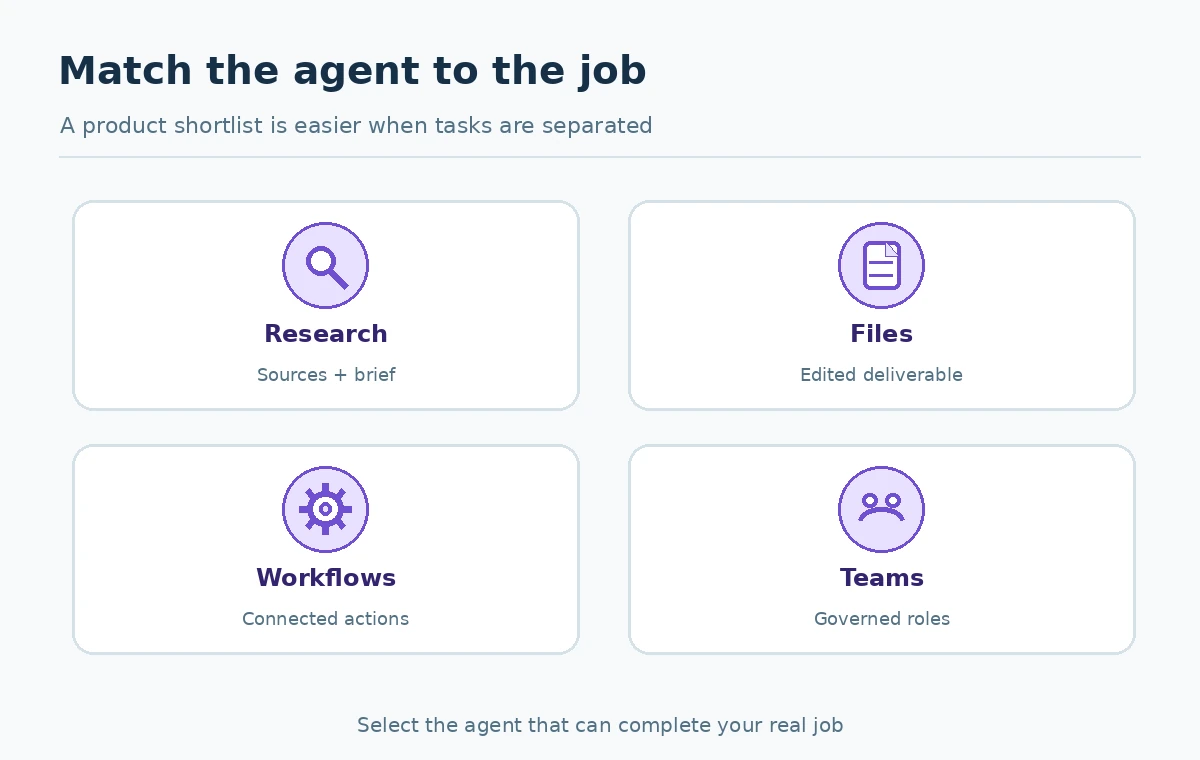
The best AI agents are not interchangeable chatbots. Some gather evidence and produce reports, some operate on files, some execute repeatable tasks through connected apps, and others are built for governed teams. This 2026 shortlist is organized around work you want completed and control you need to retain. It is based on product documentation rather than an invented hands-on leaderboard.
Choose your job before comparing brand names
An agent must be evaluated by the result it can produce, not by how confidently it describes a plan. Define a concrete job such as “research three suppliers with sources,” “prepare a weekly client brief from approved files,” or “triage new intake forms into a shared queue.” For each, document where information lives, what final artifact is required, whether it must change external systems and who can approve those changes.
A research agent with citations is often a better fit for a one-off brief than a workflow builder with dozens of connectors. A workflow tool can be better for repetitive intake because it has deterministic triggers, action history and permissioned destinations. A coding agent is appropriate when the deliverable is a reviewed repository change. Compare those categories separately instead of ranking them by an unspecified model intelligence score.
ChatGPT workspace agents: shared team workflows
OpenAI’s workspace agents announcement and current overview describes agents designed for team knowledge, connected tools and repeatable work. Examples include software-request review, product feedback routing, lead qualification and weekly reports. A key selection criterion is whether the organization can govern who builds and runs agents, which tools they can use and when actions require approval.
For a team already using ChatGPT in a managed workspace, prototype a read-only report that cites the records used. Ask an admin to inspect current plan eligibility and connected-app controls; product rollout language has changed during 2026 and public announcement pages may retain older preview details alongside newer availability notes. Avoid equating a shared workspace agent with an unrestricted personal web agent. Your permission model and the organization’s available features determine what actually works.
Claude: file and desktop-heavy delegation
Anthropic’s September 2026 update says its earlier Cowork and chat experiences are being combined into one Claude experience, with a gradual rollout. Claude’s related computer-use help describes access through connectors, browser and screen interaction, along with beta constraints and requirements. It is therefore useful to compare the actual enabled experience on the account, not rely solely on an old Cowork screenshot.
Choose this path when your work is deeply tied to draft documents, file revisions and multi-step desktop tasks. A useful pilot is to assemble a brief from five non-sensitive documents, demand provenance for claims and inspect every output before sharing. If the task requires modifying private files, test with copies first. Computer-use flexibility increases the need to confirm app permissions and review each external write.
Gemini Deep Research: source-driven analysis
Google’s Gemini Deep Research agent documentation describes iterative planning, searching, reading and synthesis into cited reports. The documented developer route uses the Interactions API, not the basic generate-content endpoint, and is labeled preview. That API detail matters to a developer choosing between programmatic deep research and a general chat assistant.
This is a plausible option for multi-step evidence collection rather than low-latency message replies. Ask it to build a research outline, identify source quality and mark disputed findings before drafting conclusions. Do not treat the presence of citations as independent proof that every claim is correct. Check link freshness, note sources that are paywalled or missing and require human judgment for market or legal claims.

Copilot Studio: structured organizational agents
Microsoft’s Copilot Studio agent overview explains that different agent harnesses target reasoning-heavy processes, Copilot Chat extensions, customer conversations and predictable rule-based interactions. It documents integrations through connectors, REST APIs, MCP servers and workflows. This makes it a strong candidate for an organization that already has defined Microsoft processes, governance owners and data boundaries.
Choose Copilot Studio when the goal includes approved company data, policy-based escalation or deployment across enterprise channels. Before pilot approval, confirm licensing for the exact harness and action type, which the documentation warns can differ. A support FAQ bot with a single knowledge source is not the same procurement problem as an agent that can update an ERP or hand off to another agent. Treat the deployment channel and audit requirements as first-class specifications.
Zapier AI by Zapier: repeatable cross-app actions
Zapier’s current AI by Zapier guide explains that agentic workflows now run within AI steps in a Zap; its previous standalone Agents experience is migrating. Its tool guide describes app actions, knowledge sources and approval settings. It is therefore misleading to recommend “Zapier Agents” as if every account still creates a separate product in the old location.
Choose AI by Zapier when an existing trigger-and-action workflow needs an AI step to classify, draft or use selected tools. A good trial has a deterministic trigger, a limited set of permitted actions and a review step before modifying customer records. This category can be more maintainable than a free-form browsing agent for repetitive operations. Check plan eligibility, task consumption and any connected model account cost in your current billing view.

Our selection matrix: five practical questions
Give each candidate a row and answer five questions with evidence: What input can it access? What artifact or action can it produce? Can access be scoped to an individual resource? Where is the approval boundary? How is the result logged and reversed? Add a sixth optional column for charging unit: seats, runs, credits, tasks or model usage. That prevents a seemingly cheap agent from becoming an unbudgeted automation bill.
For example, a research team prioritizes citation traceability and export format; finance operations prioritize deterministic validation, audit history and approvals; a consultant handling local files prioritizes file boundaries and manual review. These are editorial fit criteria, not benchmark scores. If a vendor does not clearly document a critical permission or rollback feature, mark it “verify during trial” rather than filling the cell with an unsupported yes.
Run an honest two-candidate bake-off
Test the same narrowly defined job in two suitable products using fictional or consented material. Specify input, expected output, time budget and unacceptable actions. Score factual correctness by comparing claims to the underlying sources, then record intervention count, missing information, wrong-tool actions and total billable units. Repeat the workflow on a second example to check whether success depended on a lucky prompt.
Exclude sensitive account access and irreversible changes from the starter pilot. Every platform may change availability, model selection, billing and UI. As of October 27, 2026, this guide documents what providers say they support; LabFin has not bought seats or run comparative hands-on tests. Make a buying decision only after the owner of the process has reviewed both the output quality and the permissions it requires.
How We Research
We reviewed current official first-party documentation on October 27, 2026: OpenAI workspace agents, Claude unification announcement, Gemini Deep Research API, Microsoft Copilot Studio, Zapier AI guide. This page addresses a specific buyer or implementation question, with independently written decision criteria and example workflows. Product statements and public price/limit figures reflect the named provider pages, which can change by plan, rollout, geography, billing method and account. We have not claimed to buy subscriptions, run live agent tests, process real documents, measure accuracy or obtain commercial approval. Reader-run examples are suggested evaluation procedures, not LabFin experimental results.
Frequently Asked Questions
A dedicated deep-research workflow is a strong shortlist candidate when source gathering and cited synthesis matter most; verify the claims it returns.
An agent typically uses tools and multiple steps to pursue a task; a chatbot may only generate a reply without acting on systems.
Some platforms document shared workspace agents or organization-managed deployment, subject to plan and admin permissions.
Zapier documents migration from standalone Agents to AI by Zapier steps inside Zaps, so check the current builder.
Costs are not comparable without a real usage scenario because vendors may bill by seat, tasks, credits, model use or connected actions.