
A shared webhook endpoint needs stable metadata
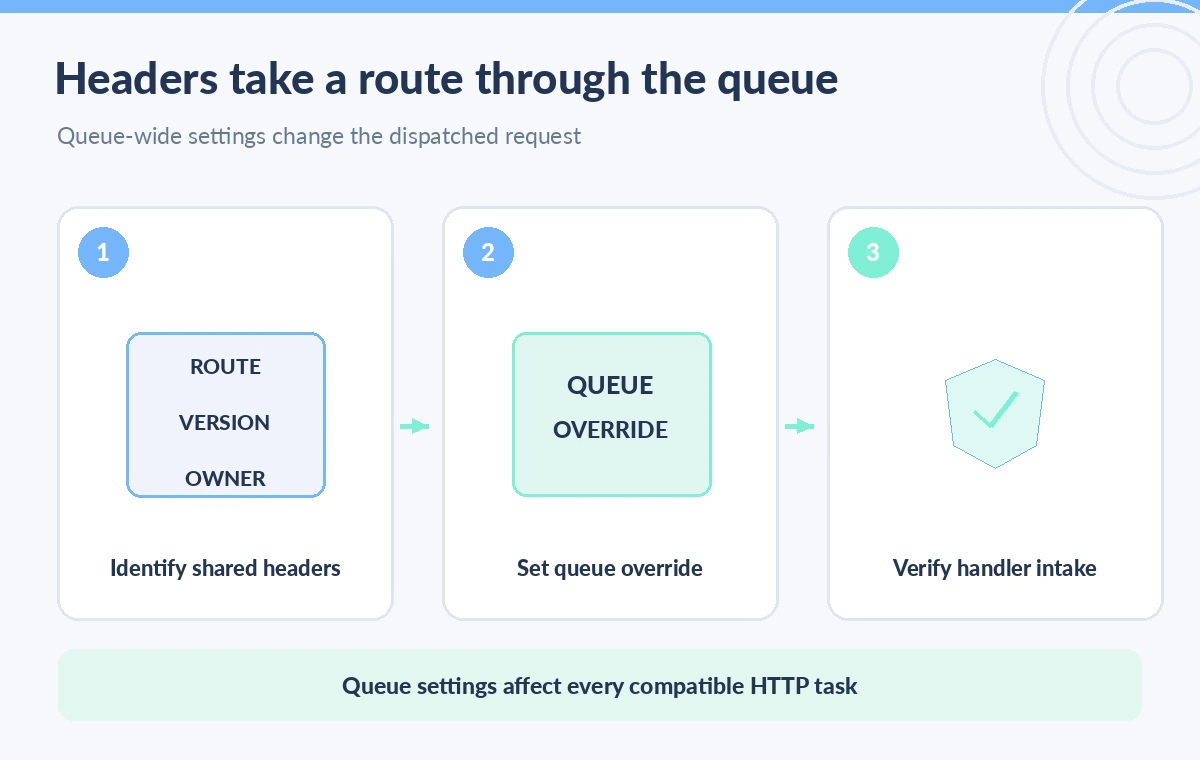
Suppose a museum operates an HTTP handler for exhibit reservations, with several Cloud Tasks producers sending delivery jobs. The team wants every request in one queue to carry a non-sensitive routing version or handler identifier. Setting each task independently can lead to drift, especially during a queue migration. Google Cloud Tasks exposes queue-level HTTP target configuration with headerOverrides. The useful idea is a shared, audited default for a class of tasks, not a secret channel or a replacement for request authentication. This scenario describes a design pattern rather than a live deployment.
Find the correct scope in the queue resource
The Cloud Tasks v2 Queue resource documents httpTarget, including headerOverrides, uriOverride, an optional HTTP method override, and queue-level authorization fields. When an HTTP target is specified at the queue level, it can override portions of HTTP tasks according to the configured settings. Do not assume this applies to every type of task or that it rewrites a stored task into a different record. Inventory the affected queue, destination handlers, existing task-level headers, and dependencies before editing configuration. A queue-wide setting has a broader blast radius than a one-off CreateTask request.
Design only the headers a handler truly needs
Choose a small set of non-sensitive header keys with a documented meaning, such as an application protocol revision. The documentation warns against putting personal or business-sensitive data in header override configuration. A visitor name, email, reservation code, donation amount, or secret token does not belong there. Prefer a bland routing label whose value can be logged safely, and put operational trace IDs in systems that already provide authorized traceability. If a handler needs access to a sensitive record, it should resolve the information through its own properly authenticated authorization path.
Understand precedence and generated headers
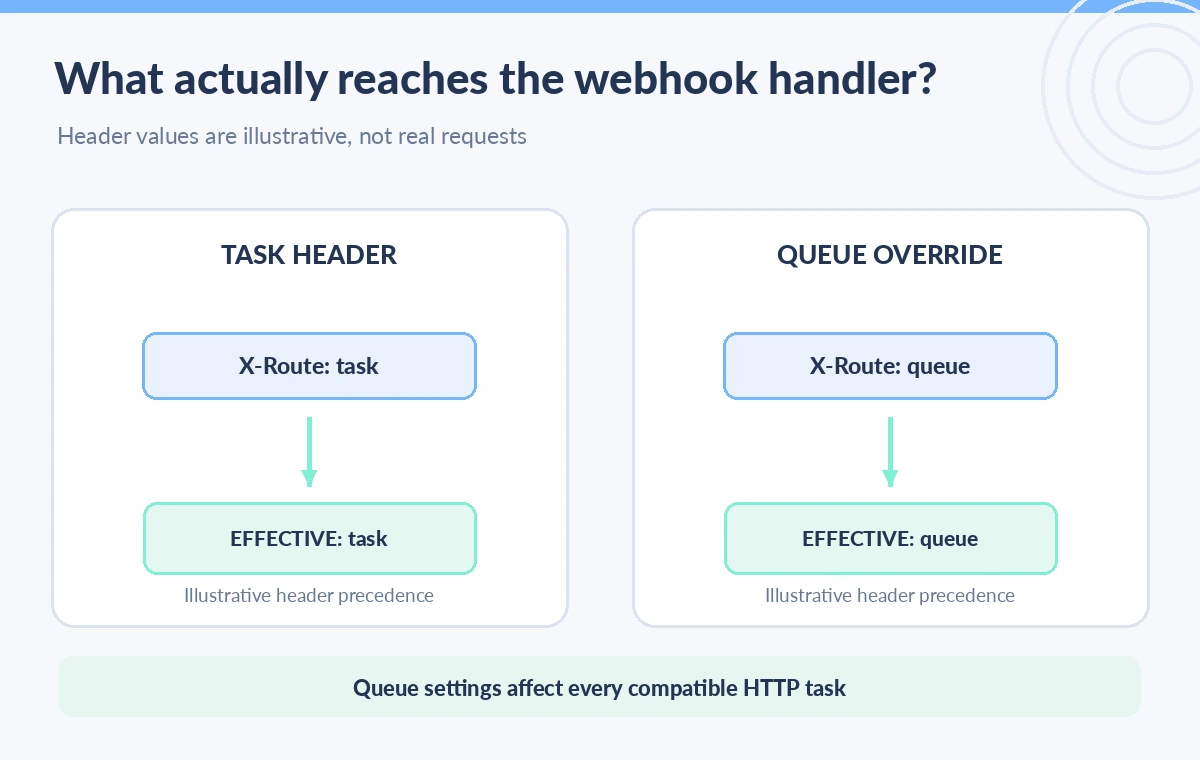
Queue-level header overrides can take precedence over header values supplied on individual tasks. The documented service also computes or replaces headers such as Host and Content-Length, and sets its own User-Agent. Treat the eventual HTTP request as the source of truth during testing rather than expecting every author-specified field to survive. An override that silently changes Content-Type expectations can break request parsing; explicitly verify the content-type handling in the task creation and destination. Do not copy a generic list of headers and assume all of them are accepted unchanged.
Do not confuse metadata overrides with authentication
Queue-level httpTarget also supports oauthToken or oidcToken configuration. Google documents that queue-level authentication overrides task-level authentication when configured. That is not the same thing as adding a custom X-Route header. Select token type and audience for the actual destination: OIDC is commonly appropriate for authenticated Cloud Run-style services, while OAuth access tokens are generally used for Google APIs. A header override must not be treated as proof of identity, and a custom token-looking string must not bypass signature, audience, issuer, or authorization checks at the receiving service.
Evaluate URI and method overrides as separate risks
A queue-level HTTP target can also change URI components or the HTTP method, depending on its settings. This matters when the handler interprets paths or methods to select operations. For example, a mistaken method override to GET can cause a request body to be ignored, according to the v2 documentation. Keep a route inventory and an explicit before-and-after request contract. If the migration only needs a harmless version header, avoid changing the host, scheme, path, or method simultaneously; bundle fewer changes so an error can be isolated.
Test on a staging queue with representative task shapes
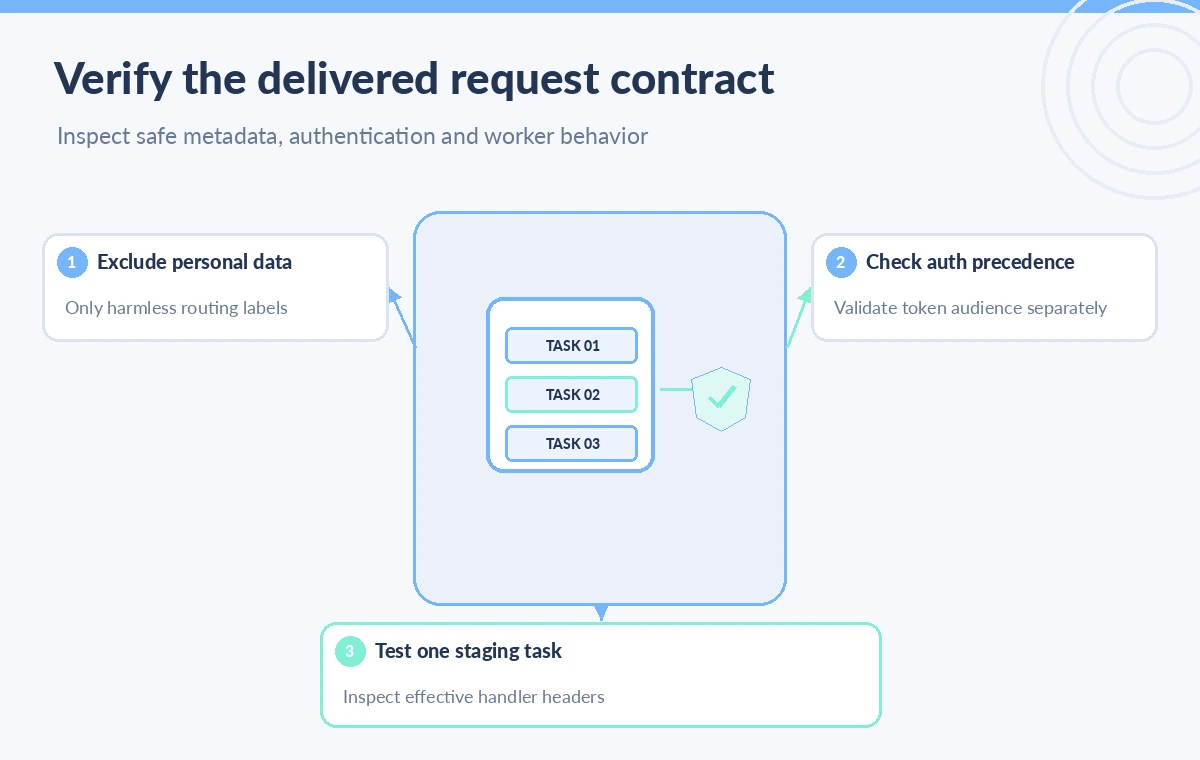
Before touching a production queue, send non-sensitive fixture tasks to a staging handler that records the request method, effective header names, authentication result, and response code. Check a task with its own value for an overridden key, a task without the key, and a task that sends a valid JSON body. Keep the raw body out of broad logs. Confirm the selected header behavior in the actual worker, not only the API configuration response. A successful task dispatch should also be checked for business idempotency; a repeated delivery is not automatically a new visitor reservation.
Plan rollback and monitoring before changing production
Record the prior Queue configuration and determine who is authorized to change it. Stage rollout during a low-risk period, monitor authentication failures, 4xx and 5xx responses, and handler routing decisions, and maintain a tested restoration procedure. Reverting a queue setting does not recall requests already sent under the previous setting. For queues holding mixed purposes, separate task types instead of forcing one global override on incompatible handlers. If unexpected values appear in logs, treat that as a privacy incident requiring restricted review, not a reason to spread copies of the log.
Write a release gate that protects visitor data
The final checklist should identify the approved header values, the expected destination, the intended authorization audience, and a person who can halt deliveries. A passing configuration check is insufficient if the handler mistakenly maps the routing header to a privileged action. Require an application-side authorization check and a repeatable fixture test that rejects an altered or missing authentication token. Document why each header is needed and when it will be retired. This is a bounded configuration technique, not a substitute for consent, secure handling of guest data, or downstream deduplication.
Inspect header size and compatibility constraints
The queue reference documents a total header-size limit and says several reserved or transport headers are ignored or replaced. A large, highly customized set of headers creates brittle integration behavior even when configuration is accepted. Write a short table for the handler owner showing each approved key, purpose, expected value format, and whether Cloud Tasks itself supplies the field. Test case normalization and duplicate key assumptions with your own HTTP framework rather than relying on a visually similar header name. Ensure that authorization tokens are processed only by the authentication middleware, not treated as routing hints by application code.
Keep the rollout auditable across producers
When multiple teams create tasks, a queue-level change can make requests appear different from what each producer submitted. Tell those teams which effective headers will be delivered and where configuration ownership lives. For incident review, record the queue configuration revision, the staging test artifacts, and the operator who approved the transition. Avoid copying entire task payloads into documentation; note a fixture ID and expected schema instead. After rollout, compare the handler’s accepted and rejected request classes, and have a clear path to pause deliveries if a shared override breaks one producer. Header configuration is an interface contract that deserves version control.
How We Research
Our primary named official sources were: Google Cloud Tasks REST v2 — Queues HttpTarget and HeaderOverride; Google Cloud Tasks — Creating HTTP target tasks. We reviewed the v2 HttpTarget, HeaderOverride, and authorization-header precedence descriptions and the HTTP-target setup guide. No queue was modified or live webhook invoked; all depicted requests and resulting headers are conceptual examples. Readers should verify current environment-specific documentation and permissions before adopting a workflow. The figures are original teaching diagrams, not vendor screenshots or measured results.
Frequently Asked Questions
No. They are configured at the queue HTTP target level and can affect HTTP tasks in that queue; test the full set of task producers.
No. The Google documentation warns against putting personally identifying or business-sensitive data in the configuration.
No. Queue-level OAuth or OIDC authorization configuration can override task-level authentication settings.
Do not rely on that. Cloud Tasks computes or replaces certain transport headers including Host and Content-Length.
No. The HTTP response describes handler delivery. Track application-side processing, idempotency, and separate downstream notification evidence.