
A worker migration changes routing, not the archived job
A museum may move photo-thumbnail generation from an older App Engine version to a new worker without recreating every queued task. In the middle of an exhibition launch, the team cannot afford to send the same thumbnail job to an untested service or to assume that moving one queue also moves unrelated HTTP webhook jobs. Cloud Tasks supports a queue-level appEngineRoutingOverride for App Engine tasks. The practical question is which route wins, how to verify the receiving worker, and how to prevent duplicate processing during a cutover. The routing setting does not transform or validate each task payload.
Recognize the queue-level precedence rule
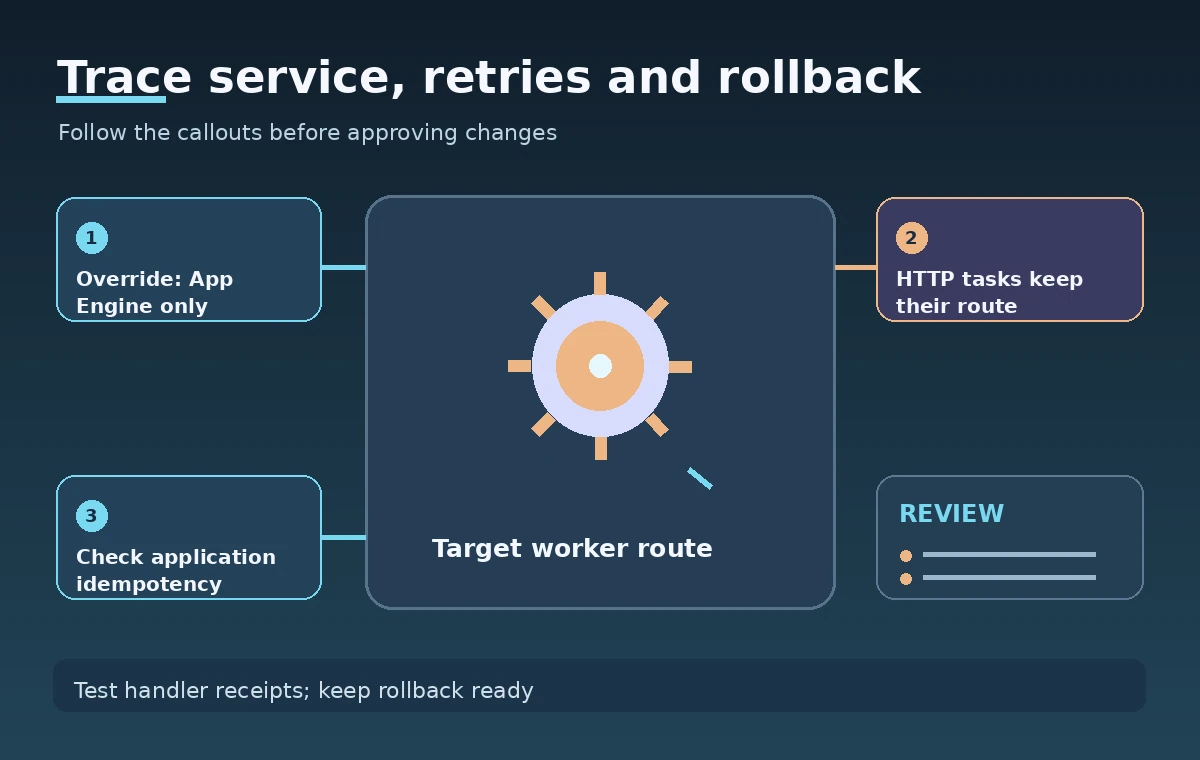
Google documents that appEngineRoutingOverride overrides task-level appEngineRouting for App Engine tasks in that queue. The new queue-level service or version can therefore take precedence even when an older task names a different App Engine worker. However, the same API documentation states that HTTP tasks are unaffected by this setting. Check the actual queue type and task payload representation before changing anything. Treat the override as a routing rule, not as a method for rewriting task bodies or reassigning every job in a project. A mixed inventory needs a task-type-specific migration plan.

Record the existing routing state first
Before the hypothetical cutover, save a read-only export of the queue configuration: name, location, routing override if any, rate limits, retry settings, and state. Record which App Engine services and versions exist and which identity or handler restrictions apply. The operator needs a rollback reference that reflects the current configuration, not an old screenshot. Check whether tasks specify their own appEngineRouting and note which overrides will stop taking effect at the task level. Make the dependency list explicit: object storage, image codec, and metadata database availability may determine whether the new worker can actually finish a task.
Test the target handler without a production dispatch flood
Stage a representative synthetic thumbnail task in a controlled queue or staging project. Verify that the new App Engine service can receive a request, authenticate appropriately, validate its input, and record an idempotency marker before writing an output. Distinguish a handler returning HTTP 2xx from the business operation producing an approved thumbnail. Google documents response-code and deadline behavior for task attempts. Use bounded request volume and permissions, and avoid a production RunTask loop as an informal load test. No actual handler testing was performed for this instructional scenario.
Apply the route change as an explicit reviewable operation
The Cloud Tasks configuration guide provides a queue update command for routing overrides, including service and optional version. Operators should scope the change to the intended queue and have an approved change record specifying the desired destination. If patching through the API, use the correct fields and update mask instead of replacing unrelated queue configuration. The queue must still be configured with appropriate rate and retry limits. Do not describe the queued work as migrated until the queue configuration and receiving worker have both been independently checked.
Account for propagation and in-flight tasks
The queue configuration guide recommends operational care around routing changes and documents a waiting interval in one of its queue-change procedures. Build a bounded cutover window rather than assuming that every request arriving after the command immediately uses the new route. Separate jobs that were already dispatched from those still awaiting delivery. The application should make thumbnail exports idempotent so a retry or overlapping attempt does not create duplicate catalog attachments. Monitoring should include the new worker’s handler receipts, job identifiers, and known failed attempts, not just the presence of the override field.

Compare task-level and queue-level destinations visibly
A clear audit example uses three cases: an older App Engine task naming version A, the same task under a queue override targeting version B, and an HTTP task in another supported configuration. The queue override can redirect the first App Engine task, while it does not redirect the HTTP task. Preserve these differences in the change document so reviewers do not assume a generic route switch. Confirm the generated host or service destination using the documented queue description and service configuration, and separately verify authorization to the target handler.
Remove the override with a rollback plan
Google documents clearing the queue routing override. Clearing it restores task-level routing behavior for the App Engine tasks rather than necessarily routing all work to the previous worker. If task-level destinations were inconsistent before the override, a simple clear command may distribute work across several versions. Capture the prechange route inventory so rollback can be assessed accurately. Test both directions in staging. An operator should halt the cutover if the old destination has already been decommissioned, because the queue rule alone cannot make a missing service available.
Investigate failures without confusing retry with success
Inspect handler errors, the task deadline, queue state, and retry configuration before drawing conclusions from a growing backlog. Google documents that non-2xx attempts or missed deadlines can lead to retry behavior, and a 503 App Engine system response can influence queue congestion control. A retry does not prove whether the earlier worker committed its side effect, so check the application’s idempotency ledger. Separate task delivery records from object-storage outcomes. For sensitive collection files, do not dump task payloads into broadly accessible CI logs merely to debug the migration.
Sign off on a route, a worker, and a recovery path
A defensible release note records the exact queue, destination service and version, approved change time, synthetic test case, postchange queue description, handler receipt sample, and rollback method. It should explicitly say that HTTP tasks are outside appEngineRoutingOverride and that task-level routes may reappear if the override is removed. Have a person with deployment authority approve the new worker version before the queue routes work to it. Queue configuration is one component of a safe museum workflow; it cannot substitute for permissions, content checks, or a reliable application recovery ledger.
How We Research
This November 11, 2026 article is a documentation-based instructional analysis, not a hands-on test or production benchmark. We compared Google Cloud, Queue resource REST reference and Google Cloud, Configure queue routing and limits and Google Cloud, Task resource REST reference, identified the precise parameter or behavior that the documentation supports, and organized the guidance around an illustrative museum workflow. We did not run a live service request, inspect real WordPress content, measure accuracy, or verify delivery against a working customer account. Each pictured scenario is an original conceptual illustration; current settings, permissions, supported API versions, and organization-specific governance must be confirmed before use. The release checks deliberately distinguish technical output from authorization, evidence quality, and actual user outcomes.
Frequently Asked Questions
No. Google documents the field as applying only to App Engine tasks in the queue.
When set, the queue-level override takes precedence over task-level appEngineRouting.
No. It changes routing behavior, not the saved business data in each task.
Task-level App Engine routing becomes relevant again, which can produce different destinations if old tasks specify different routes.
No. Verify the application-side output, authorization, and idempotency record separately.