
A secret-free workflow still needs authorization
A small museum deploys its collection website through GitHub Actions. The familiar setup stores a cloud access key in repository secrets, where misconfiguration or privileged workflow execution can expose a credential that remains valid after the job ends. GitHub’s OpenID Connect integration allows an approved workflow to request an identity token and exchange it with the cloud provider for short-lived credentials. That reduces the need for static cloud keys, but it is not automatic deployment safety. A token can be valid while the cloud role is too broad or the workflow contains untrusted code. Design the trust boundary before changing the YAML.
Define which release job can assume the role
List the repository, branch or tag, environment, and workflow that should be allowed to deploy the public museum site. The cloud provider’s federation trust policy should check appropriate token claims and reject jobs outside that exact release scope. If pull request jobs share a broad subject pattern with production deployments, a contributor’s change could reach privileges it does not need. GitHub recommends defining conditions for token issuance and using environment protection rules when appropriate. Do not grant a generic organization-wide identity simply because several repositories deploy to the same account. Separate read-only build checks from the specific production deployment job.
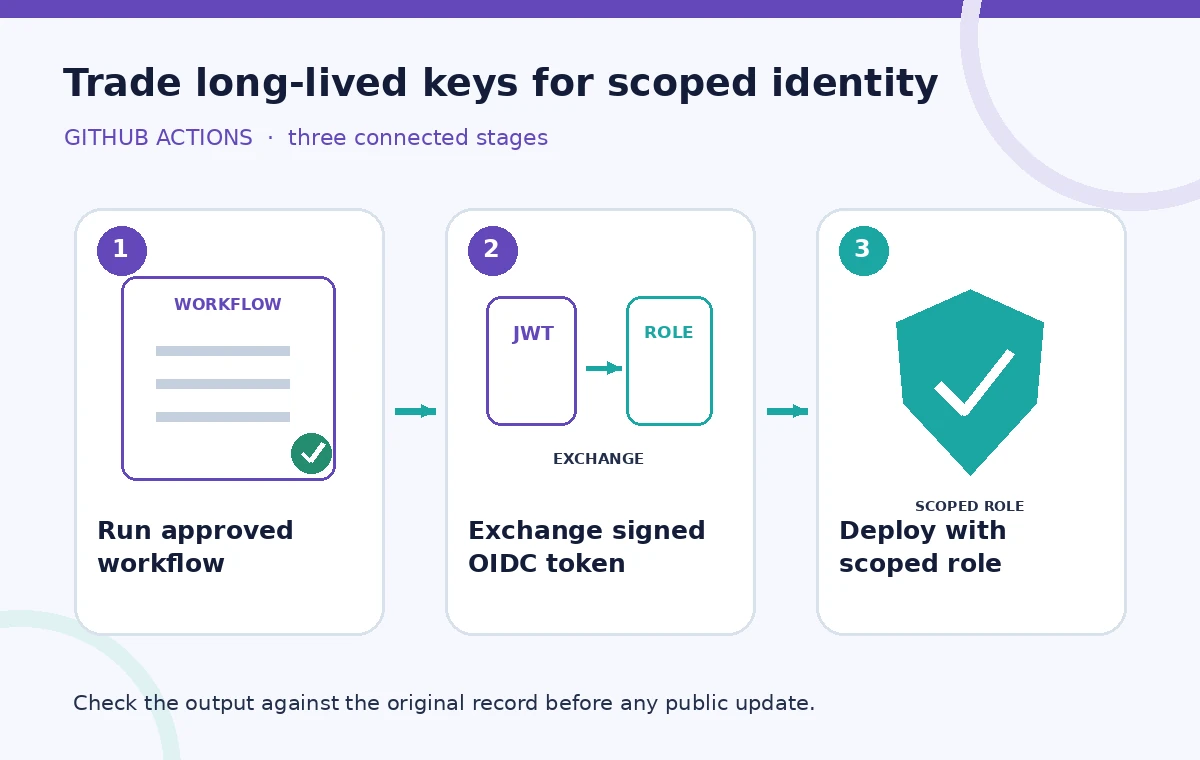
Request id-token: write only where needed
GitHub documents the permissions setting id-token: write for a job that requests an OIDC token. That permission allows fetching a token; by itself it does not grant permission to modify cloud resources. The external cloud trust policy and exchanged role determine what the job can actually do. Put the permission at the narrowest practical job level and avoid giving routine test jobs tokens they never use. Scope contents access separately, typically read-only for deployment input where possible. Check how reusable workflows and environments pass identity context before assuming the token’s claims match those from a standalone workflow.
Exchange the token using a supported provider flow
In the deployment job, use the official cloud provider action or documented identity federation procedure to exchange the signed GitHub OIDC JWT for a short-lived credential. Avoid printing that credential, passing it into artifacts, or storing it in repository outputs. Keep the role’s permissions limited to the destination service and deployment objects. The identity exchange should fail closed if the repository, ref, environment, or audience does not match policy. Treat a successful exchange as authentication and authorization for a specific role, not as confirmation that the new museum content is accurate or safe to publish. The release workflow still needs its own quality gates.
Compare three credential designs
A static key copied into CI can remain usable outside the original run until someone rotates it. A federated token with an overly permissive trust policy may be short-lived yet still grant unexpected workflows too much power. A narrow trust policy tied to an approved release ref and environment can substantially reduce that risk. The comparison illustration depicts these as conceptual security models, not a penetration test or a claim that every cloud provider implements identical conditions. A short token lifetime is useful, but access scope and who may request the token are equally important. Do not confuse fewer stored secrets with permission minimization.
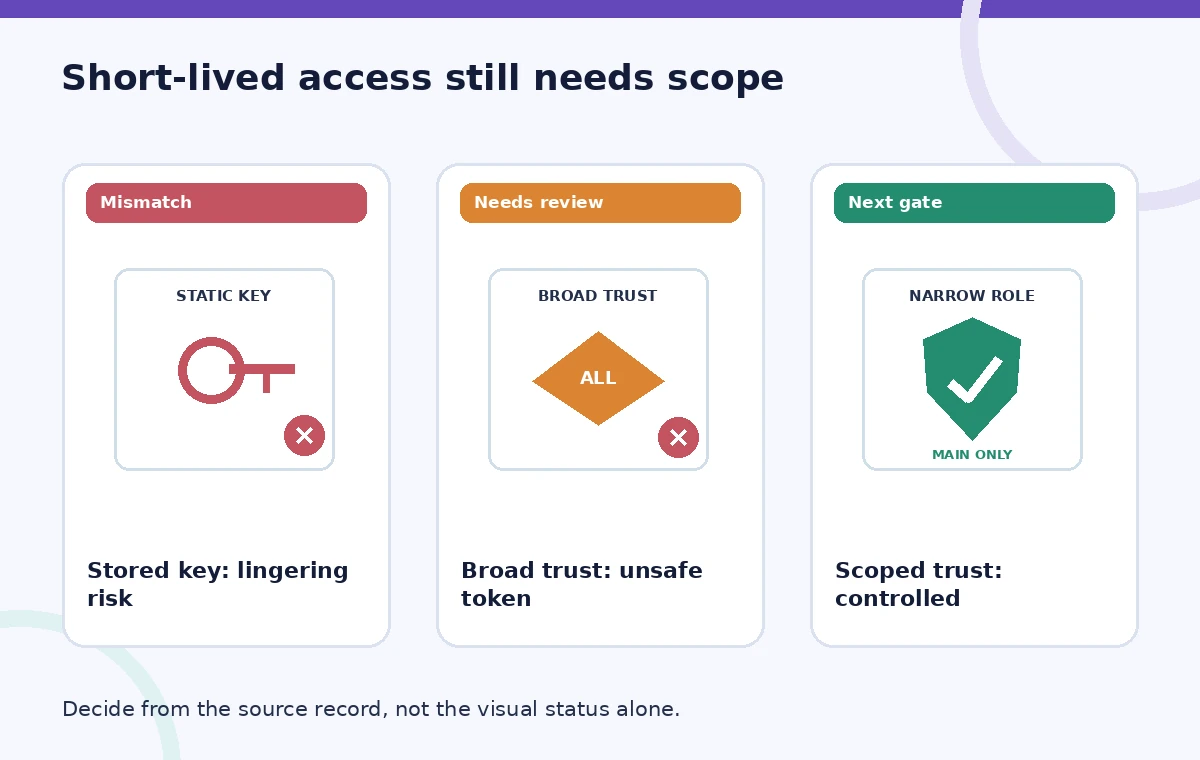
Keep the build and publication phases separate
The museum’s CI pipeline may need to compile code, check links, run accessibility tests, and validate content records before it is permitted to deploy. Only the final protected job should exchange a token for production write privileges. An artifact that passed its build stage may still contain unreviewed descriptions, wrong exhibition dates, or private collection metadata. Require a known source revision and reviewable deployment artifact, and avoid rebuilding from mutable dependencies after human approval. If an earlier gate fails or the necessary evidence is missing, the deployment job must not run merely because identity federation works. OIDC secures access to cloud infrastructure, not editorial truth.
Review the cloud role itself
Least privilege must be enforced in the destination cloud as well as in GitHub. A role used to upload static site assets should not be able to read unrelated private buckets, administer identities, or delete archival backups. Specify allowed resource paths and actions, use the provider’s audit mechanisms, and review whether temporary credentials can be escalated through a secondary service. Check that the trust policy rejects forks and unexpected repositories or refs. Define who can edit the workflow, environment rules, and cloud-role configuration. Without those controls, the apparent removal of a secret may simply move excessive privilege into federation configuration.
Exercise negative cases before production
Test with staging roles and a synthetic site build. Attempt token exchange from an unapproved branch, a nondeployment test job, a fork where applicable, and the designated release environment. Confirm that only the authorized job receives usable scoped credentials. Also simulate an expired token and a failed cloud exchange so that the job stops instead of falling back to a long-lived secret. Review logs to ensure identity tokens and provider credentials are not emitted. No real production credentials or intrusion exercises are claimed here; these are tests a museum team should perform in its own environment with authorization.
Plan incident response and key removal
Moving to OIDC does not automatically revoke any old access keys. Inventory existing CI secrets, confirm which deployments still depend on them, then disable and remove obsolete credentials through a controlled migration. Keep an emergency deployment procedure with separate approval and short-term access. In an incident, investigators should know which workflow run assumed which cloud role and which files were deployed. Review job logs and provider audit records without copying sensitive tokens into issue comments. Protect environment administrators and repository settings as carefully as the YAML itself, because changes there can broaden who is trusted.
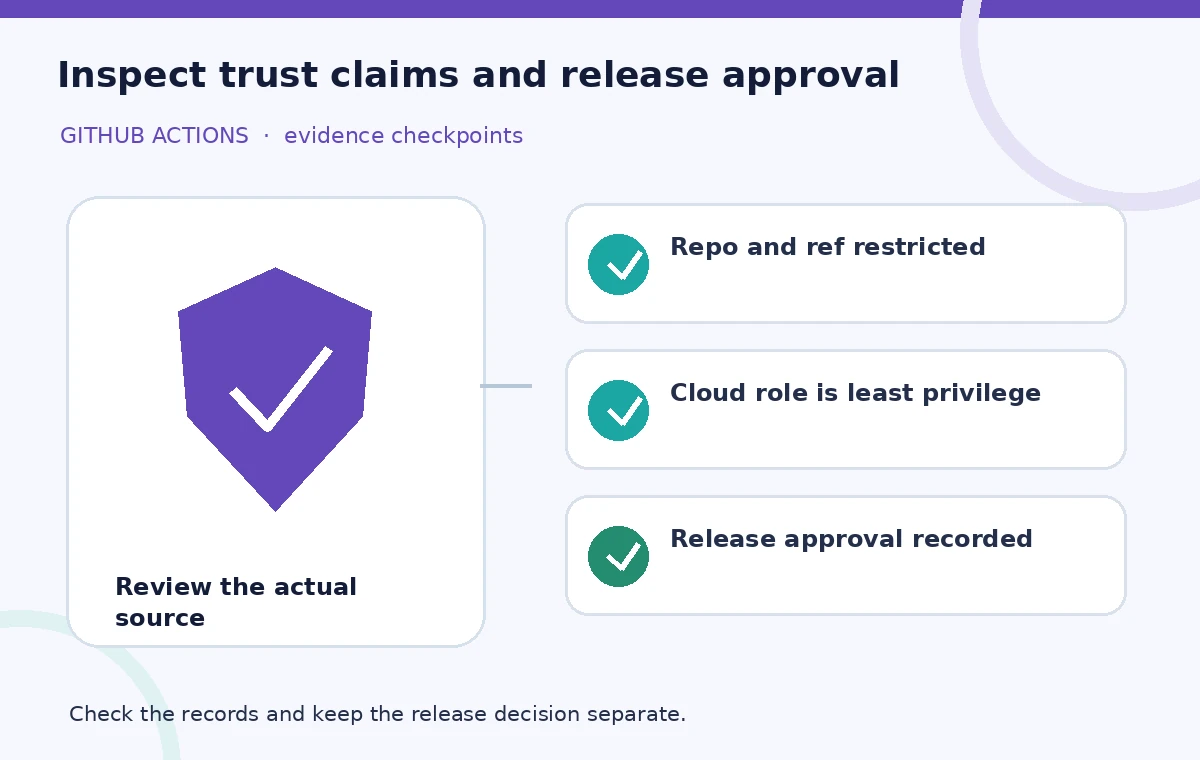
Approve the release, not just the identity
A secure release sequence has three independent results: the workflow identity is allowed, the build and tests passed, and the museum’s editorial release was approved. Record all three before changing the public site. Link the deployed artifact to an immutable source revision and preserve a rollback plan. If the role cannot be assumed, stop rather than asking staff to paste a permanent cloud key into an emergency job. If the role succeeds but a caption review is incomplete, keep the site on the previous version. GitHub OIDC provides a useful credential boundary, while people and release policy determine whether the content should go live.
How We Research
We reviewed these named official references: GitHub OIDC configuration for cloud providers; GitHub OIDC reference. We checked the documented feature, relevant configuration fields, and important stated limitations against a hypothetical museum or archive task. We did not run live production APIs, use real patron or loan records, perform a security penetration test, or measure accuracy, latency, search rank, or costs. The accompanying diagrams are explanatory models, not captured application screenshots or measured results. Verify current documentation, account-specific availability, and permissions before implementation; confirm all public-facing decisions with authorized staff and primary evidence.
Frequently Asked Questions
No. It allows the workflow to request an OIDC token. Cloud access depends on the provider trust policy and assumed role.
It should not unless the cloud trust policy explicitly permits it. Verify repository, ref, event, and environment conditions.
No. Authentication and editorial approval are separate stages; require QA evidence and authorized approval.
No. After controlled migration, revoke unnecessary long-lived credentials and avoid automatic fallback to them.
In the cloud provider policy and the GitHub workflow/environment configuration, with the narrowest feasible job permissions.