
More search context is not a grant decision
A small museum may ask an assistant to locate a conservation grant and explain whether the institution seems eligible. A short answer can sound decisive even when the notice contains residency, matching-fund, or deadline exceptions. The Responses API web_search tool supports search_context_size, which changes the amount of retrieved material made available to the model. It does not create an eligibility certificate. Start with an internal worksheet listing each claimed requirement, the page or document where it appears, the document date, and a reviewer status. Keep the grant announcement and application instructions as authoritative sources. Everything produced by the assistant is a candidate research note, never a submission-ready conclusion.
Choose low for narrow factual lookups
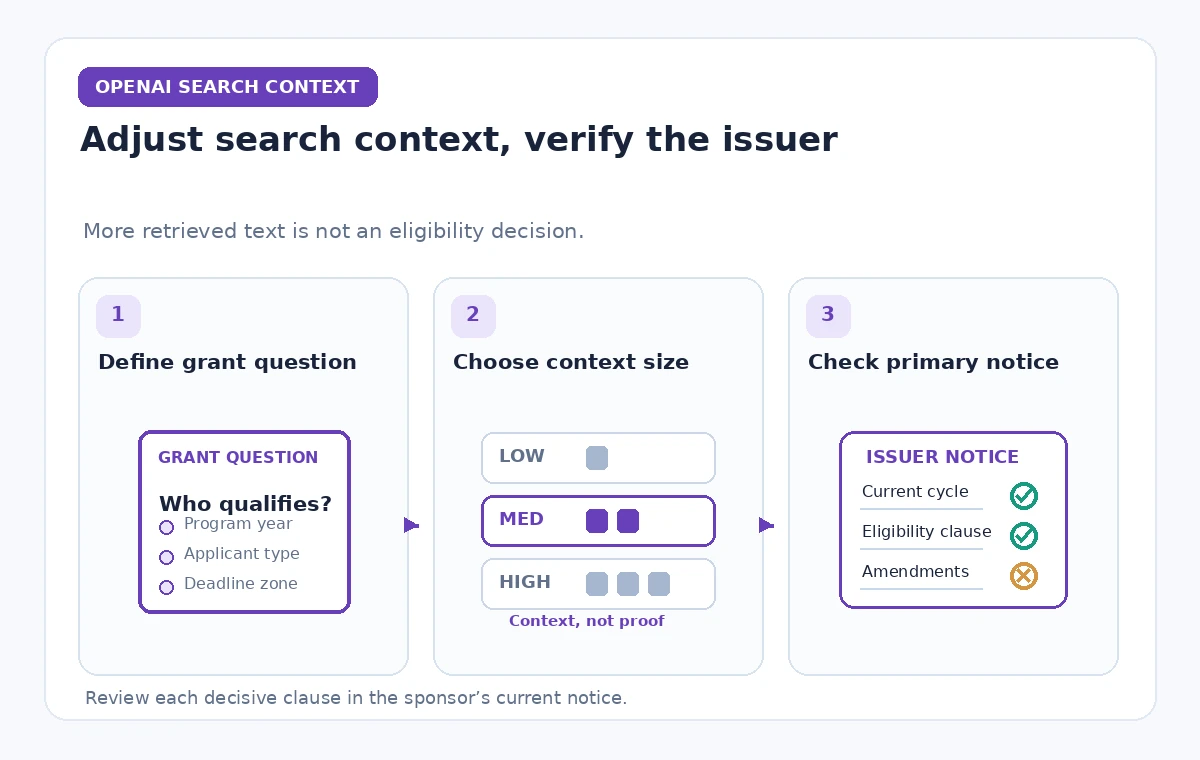
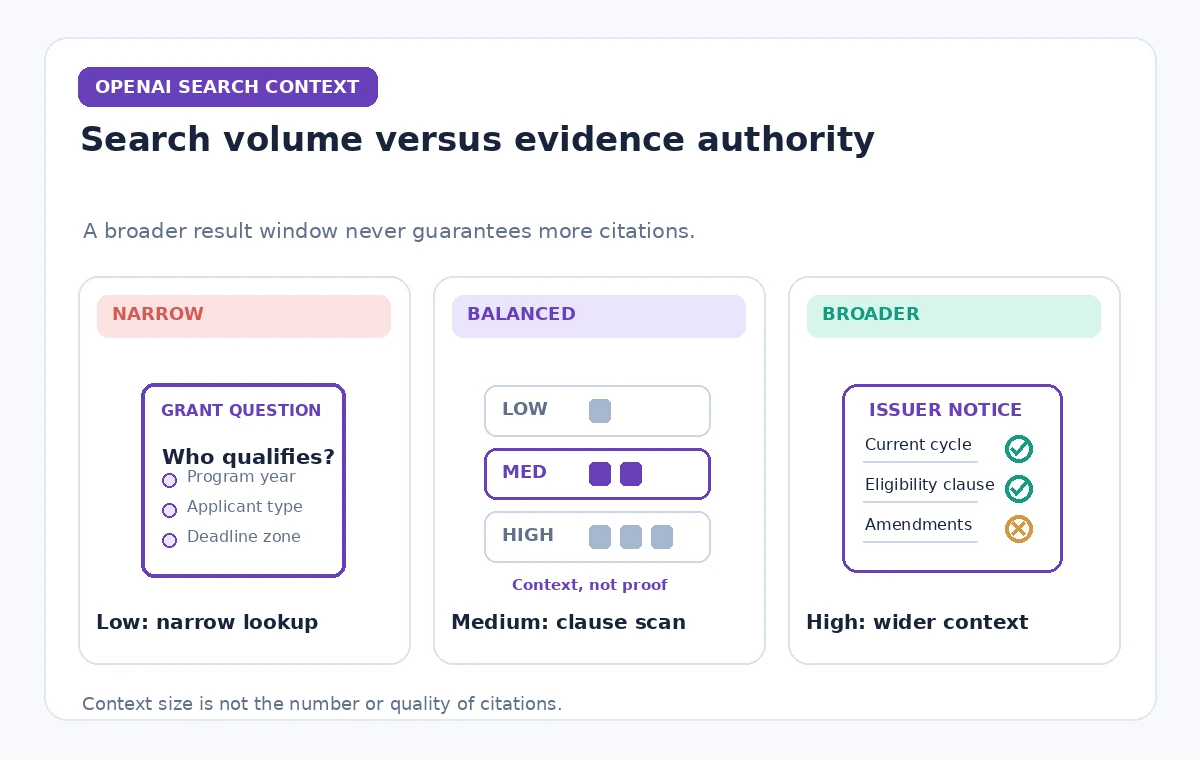
The low setting is appropriate to evaluate when the question asks for one bounded detail, such as the location of an application portal or the published closing date. OpenAI describes it as providing a smaller amount of result context to the model. Ask for the primary source URL and a clearly attributed answer rather than a broad summary of unrelated websites. The model may still miss an amendment or misread local time, so the operator should open the actual notice. A result that supplies a date without its timezone or funding round should be marked incomplete. Low is an efficiency choice, not permission to skip fact checking.
Use medium for a structured first pass
Medium is the documented balanced default. For a question involving several eligibility clauses, make a short comparison sheet: applicant type, eligible location, project activity, matching contribution, exclusions, and deadline. Give the assistant an instruction to label missing evidence as unknown rather than guessing. Inspect whether the retrieved pages correspond to the current funding cycle rather than a previous year’s cached announcement. Use the first pass to identify where to read more, not to choose a winning grant automatically. If two official pages disagree, preserve both links and the revision dates until a human owner resolves the conflict.
Consider high when several clauses must be compared
High can provide more search material for a request that genuinely needs cross-document comparison, such as a grant guide, an FAQ, a geographic appendix, and a clarification notice. The OpenAI guide explicitly warns that search_context_size does not set an exact token count or guarantee a number of sources or citations. A larger context may also contain irrelevant older pages. Before spending more on a run, rewrite a vague question into one precise comparison objective and identify the official organization. Human review should focus on the hard exceptions, not the length of the model’s explanation. Do not treat a longer answer as evidence of superior accuracy.
Separate the search configuration from source authority
A museum should track two different properties for every answer: how the tool was configured, and how reliable the cited evidence is. Record the supported web_search tool variant, requested search_context_size value, chosen model, and a task identifier without patron or donor details. Separately record whether each citation points to a primary issuing organization, a trusted explanatory source, an outdated announcement, or an inaccessible page. If a search result quotes a third-party summary, check the original announcement before declaring an eligibility clause final. The point of the configuration field is reproducibility; it must never appear as a source-quality grade.
Design three comparable research scenarios
Prepare synthetic scenarios before changing a production workflow. The first asks for a single deadline; the second compares residency and organization type; the third checks several cross-referenced exclusions. Run low, medium, and high against the same scenario and save the actual sources returned. An evaluator can record which clauses are grounded, which are absent, whether the right funding cycle was used, and the true API usage reported in the response. Do not invent improvement percentages or claim that this article measured the settings. A better configuration is the one that reliably supports the review task at an acceptable observed cost, not whichever output contains the most words.
Audit amendments and conflicting deadlines
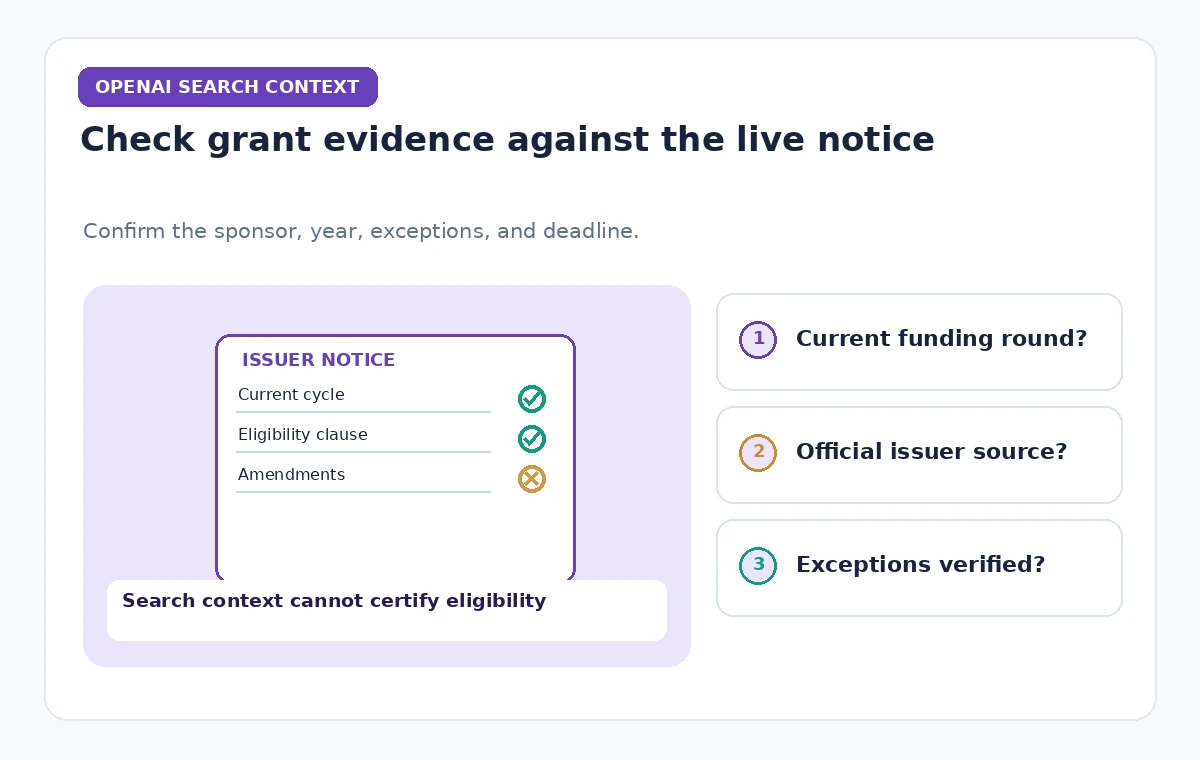
Grant eligibility frequently changes through addenda, updated application forms, and program-specific notices. When a search answer says the deadline has shifted, compare the date with the issuing organization’s current notice and the submission portal. Capture timezone and required document upload time where the source states them. If a nonprofit registration requirement appears only in a third-party listing, mark it as unconfirmed and find the actual eligibility text. The assistant should not resolve an inconsistency through fluent prose. An unresolved conflict is a useful research result because it tells staff which official contact or clarification page must be consulted.
Protect private proposal information
The public web-search stage does not need a complete confidential proposal, donor list, draft budget, or employee profile to find public eligibility rules. Submit a generalized description such as small nonprofit museum seeking conservation support, then perform private eligibility reconciliation in a separate authorized process. If an application draft must later be analyzed, apply the organization’s data handling and retention rules and keep public search evidence distinct from private files. Avoid inserting real applicant identifiers into examples or images. Search-context settings do not determine the confidentiality of input data; the operator controls which material is submitted and which result may be shared.
Create an explicit reviewer checklist
A practical review sheet has one row per decisive criterion: permitted applicants, geography, award purpose, funding floor or ceiling, match, exclusions, and due date. Each row needs a source URL, a verbatim short passage or accurate reference, the cycle or amendment date, and a disposition of confirmed, conflicts, or missing. A second person should spot-check the criteria that can disqualify an application. If any disqualifier remains unknown, the report should say research incomplete. A green API response only means the request completed; it does not mean the museum has met the sponsor’s legal or financial requirements.
Choose settings from evidence rather than habit
After controlled evaluation, document a default setting for narrow lookups and an escalation condition for complex searches. Revisit the configuration whenever models, API documentation, or the grant issuer’s website change. Keep a small regression set containing a superseded deadline, an ambiguous eligibility term, and a missing official source. The operator must be able to reproduce which sources were reviewed, not merely display a polished summary. If a result cannot be grounded, the correct output is a note to investigate further. The final eligibility statement belongs to a responsible staff reviewer and the sponsor’s current rules.
How We Research
We reviewed the named official developer references OpenAI: Web search guide, OpenAI: Create a model response. We compared their documented request and delivery behavior, accepted configuration patterns, and explicit limitations with the proposed hypothetical museum workflow. This article is a source-based implementation guide: we did not execute live customer API calls, inspect private cloud accounts, run production tests, or measure latency, cost, or accuracy. Readers should verify current limits and deployment settings with the original documentation and run their own controlled staging tests before changing public systems.
Frequently Asked Questions
No. OpenAI documents that search_context_size does not guarantee a number of sources or citations.
Medium is documented as the balanced default for web search.
It can support a narrow lookup, but the date, cycle, and timezone still need checking against the issuing organization.
No. The amount of context and the authority of a cited website are independent questions.
An accountable staff reviewer should compare every decisive criterion with the current official notice and application rules.