
What cache-only actually controls
A local museum is preparing a short grant eligibility brief from documents already reviewed by its staff. The editor wants to prevent the AI research step from fetching newly published websites, yet still wants citations to material available in an existing search cache. In the Responses API, the hosted web_search tool has an external_web_access control. Setting it to false requests offline, cache-only search behavior instead of new live external fetching. It does not establish that the cached pages are comprehensive, current, officially approved, or appropriate for publication. Treat this as a retrieval configuration choice, not a certification of the grant rules or a permanent archive.
Configure the right web search tool
Use the modern web_search tool in a Responses request and set external_web_access to false in that tool configuration. The setting is optional and normally defaults to allowing external access. The older web_search_preview integration does not honor the newer control in the same way; OpenAI documentation warns that preview variants ignore this parameter. Audit the exact tool type and request that your application sends, including any wrapper library defaults. Do not label a workflow cache-only because its user-facing prompt says “do not browse”; a prompt is not the same thing as a tool-level restriction. If the application cannot prove which tool version executed, preserve that uncertainty in the run record.
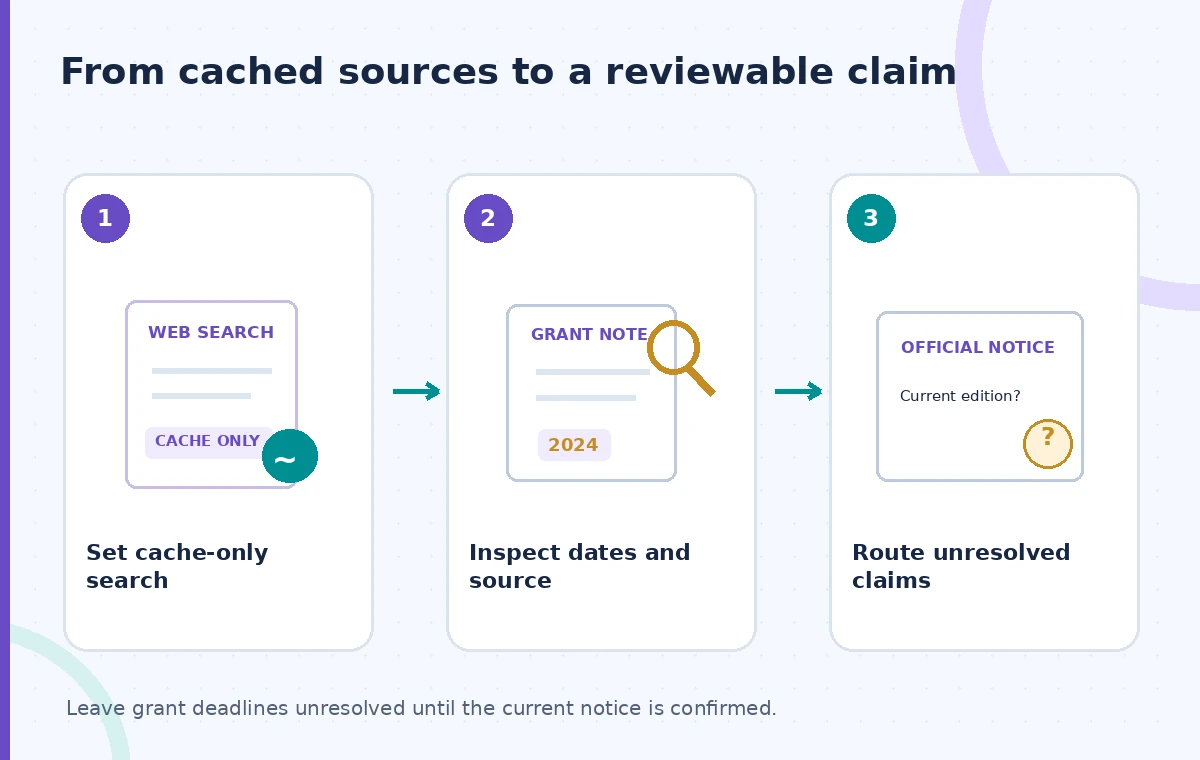
Classify every grant claim by evidence age
For an illustrative community conservation grant, separate stable program background from changing details such as the current submission deadline, matching-fund percentage, eligible applicant types, or active application portal. Each claim should carry a named source, document date, retrieval mode, and review status. A cached official PDF might be useful for explaining an earlier funding round, but it cannot authorize the statement that this year’s eligibility is identical. A secondary blog can help identify terms to investigate, not replace the official call for proposals. Build a compact evidence ledger before drafting prose so a fluent model answer does not blur the age and authority of different sources.
Treat missing results as an explicit gap
Cache-only retrieval can return fewer pages or a different set of sources from a live search. An empty result must not be translated into “no grant exists” or “the application is closed.” Distinguish not found in available cache, inaccessible in this run, and independently verified absent. The editor can insert a plain-language note such as “current conditions not verified” while requesting a separate check by an authorized researcher. Keep a candidate program in the research queue without inserting an unsupported deadline into a public brochure. In evaluation, use several deliberately outdated and recently amended notices to see whether the workflow leaves unresolved claims unresolved.
Show the difference between an old citation and confirmation
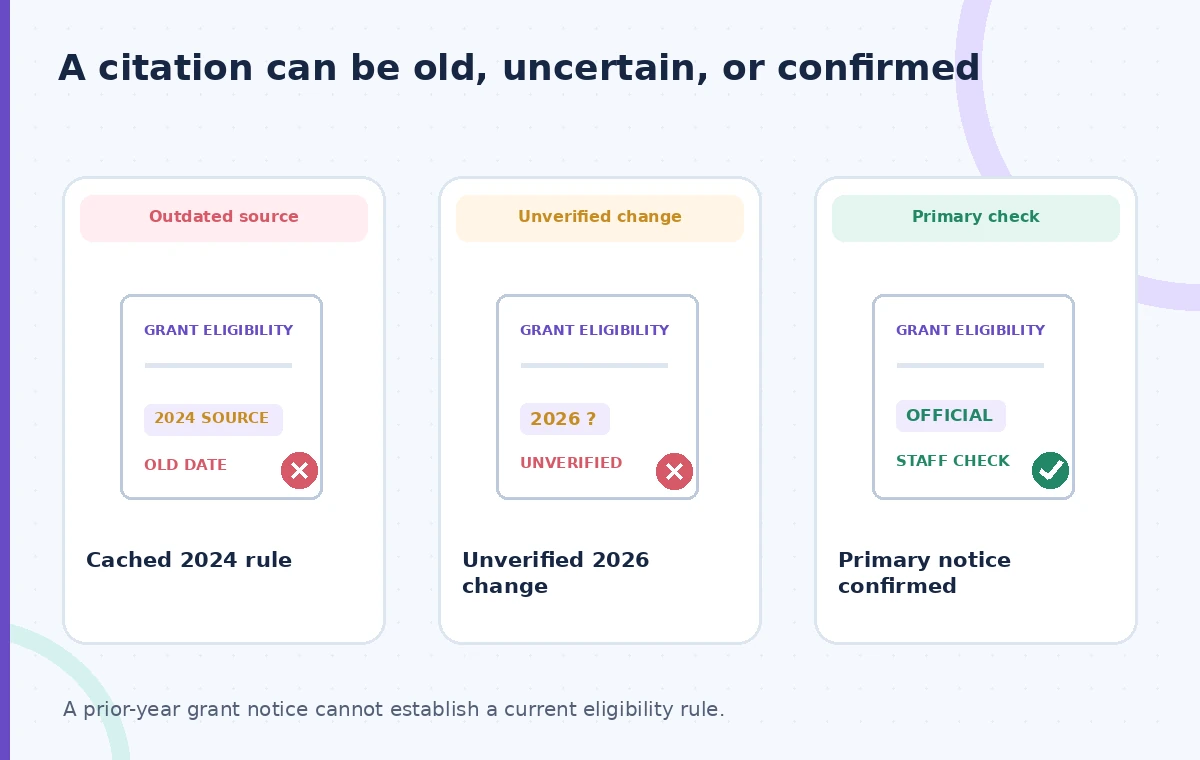
Consider three conceptual evidence states. In the first, a cache returns an authentic prior-year notice. In the second, a dated secondary article suggests a change, but the revised notice is unavailable through this run. In the third, a staff member independently opens the current official notice and confirms the clause. The third state is a human evidence gate, not a consequence guaranteed by the cache-only flag. A citation marker identifies a source the model used; it does not prove that the cited source is the governing edition. State that distinction in the article template, especially next to deadline or eligibility language that a visitor might act on.
Separate research privacy from retention promises
Preventing live external fetching may be one part of a sensitive internal research workflow, but it is not a promise of zero data retention, anonymization, or local-only processing. The request still goes to an API service, and the organization’s account configuration and data controls govern other handling. Avoid sending donor names, unpublished financial details, or applicant identifiers unless the workflow has an explicit lawful and operational basis. Use synthetic text when checking behavior. If privacy or contractual eligibility matters, review the provider’s current data-control documentation and your own organization’s agreements rather than inferring guarantees from the words “offline” or “cache-only.”
Build an approval-ready evidence packet
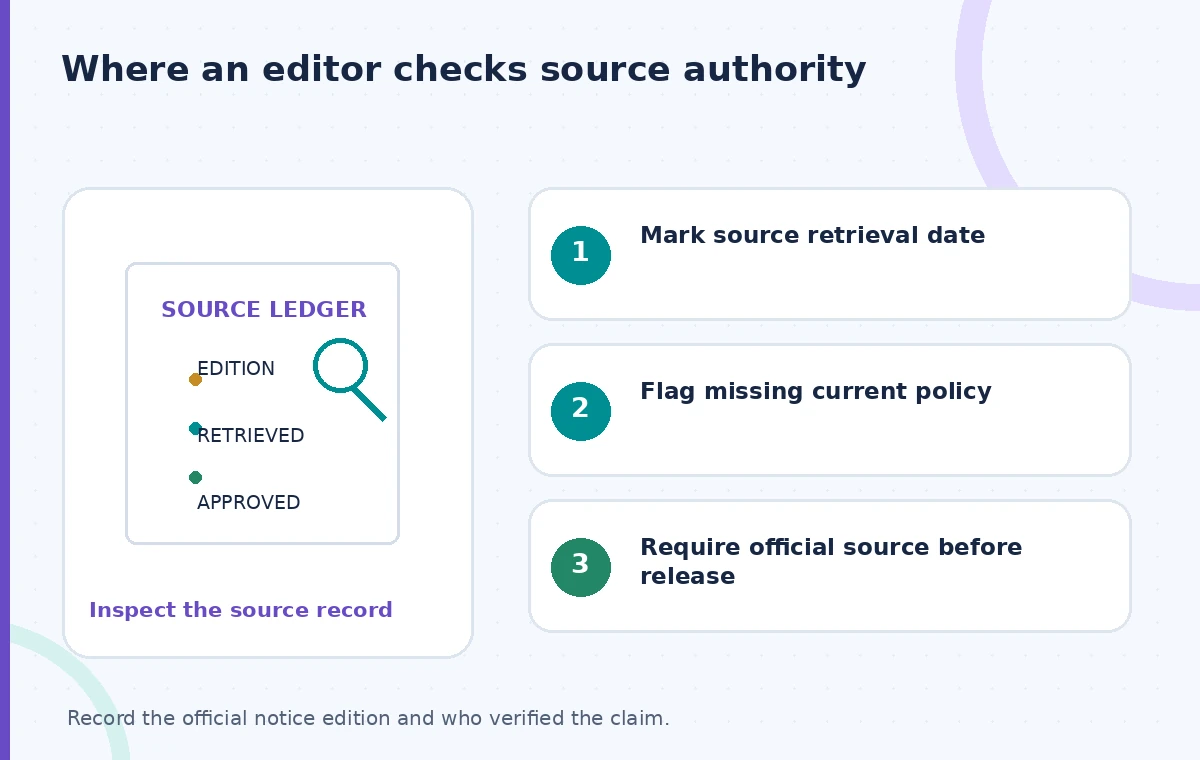
For every proposed grant fact, preserve its wording, source URL or document identifier, publication date when stated, the query that surfaced it, and a reviewer decision. Separate citations that were retrieved from sources that were subsequently verified in a browser or from an official downloadable document. Ask the reviewer to check all high-impact clauses against the grantmaker’s own latest notice before publication. A simple table with columns for claim, version, evidence, and action is more valuable than a long list of indistinguishable links. If no current first-party source can be obtained, leave the claim unapproved, even when the model response reads confidently.
Test the boundary without fabricating a live experiment
A team can create a synthetic evaluation pack with an outdated grant notice, an amended version, and an intentionally missing source. First exercise the cache-only configuration, then run a separately authorized live research procedure for comparison. Review whether the system marks missing changes, avoids invented deadlines, and attributes statements to the correct edition. Record tool configuration and actual outputs from your environment rather than copying sample “results” from a tutorial graphic. The diagrams here show conceptual pathways, not measured model performance or proof that a specific grant site has been crawled or cached.
When to use it and when to switch
Cache-only search can support controlled review of known references or a reproducible drafting step when fresh external fetching is unwanted. It is the wrong final verification mechanism for newly issued deadlines, venue changes, program closures, or last-minute eligibility amendments. Give staff a separate, documented route to check authoritative live sources and log the distinction in the article. If a cached citation contradicts a current notice, the current controlling primary document should govern after human review. Publish only the clauses that survive that review; the API setting protects a retrieval boundary, not the quality of the final editorial judgment.
How We Research
Our research consulted these named official documents: OpenAI Web search guide; OpenAI Responses API reference; OpenAI API data controls. We checked tool behavior, version-specific options, and stated limitations against an illustrative museum scenario. The examples are suggested implementation and editorial review procedures, not production tests. We did not call the services with live patron records, benchmark latency or accuracy, measure storage savings, or obtain third-party consent. All images are original explanatory drawings rather than screenshots or claimed measured results. Verify provider documentation, service availability, access policies and current organization rules before adoption; keep final publication approval with authorized staff.
Frequently Asked Questions
No. It prevents new live external fetching for the supported web_search tool; cached material may be out of date or incomplete.
Do not assume so. OpenAI states that preview variants do not honor this newer access control. Verify the actual tool type.
Yes, with its date and context, but a prior-year PDF cannot establish current eligibility without a separate official check.
No. Review the applicable API data controls and your account configuration; retrieval mode and data handling are different questions.
Keep time-sensitive claims marked unverified and do not publish a deadline or eligibility conclusion until an authorized reviewer confirms the source.