
An offsite rule is not an offsite copy
A community archive may store recorded oral histories in one S3 bucket and configure replication to a second bucket for preservation. The existence of the replication rule is not proof that each audio master has reached its destination. Amazon S3 exposes per-object replication state through the x-amz-replication-status response header on eligible source objects. Staff can use it as an operational signal while building an itemized preservation report. The report should list the exact source object key and version, the intended destination, status, checksum or fixity plan, and authorized retirement decision. Deleting the source before checking the destination can turn a recoverable delay into a serious archival problem.
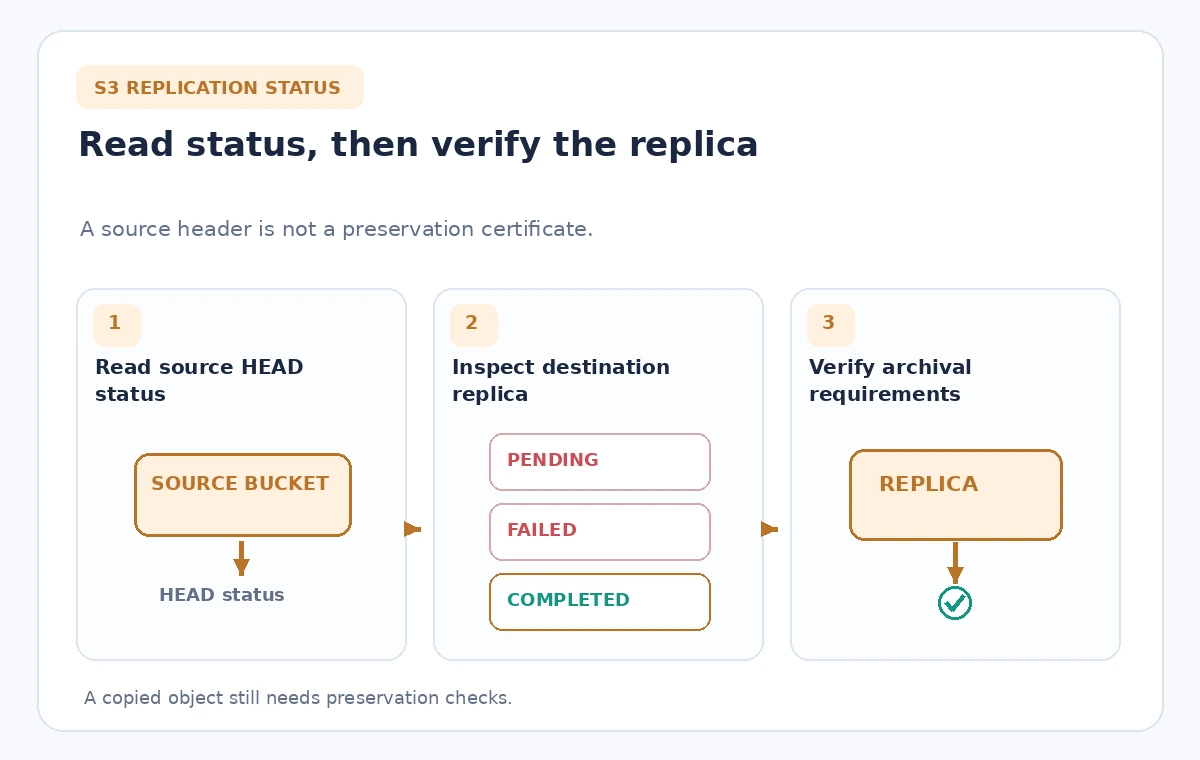
Read the source status with HeadObject
The HeadObject API retrieves metadata without downloading the whole audio file. For an eligible source object, the replication header can indicate PENDING, COMPLETED, or FAILED. This makes a scripted inventory possible without opening each interview recording. Ensure the identity running the audit has the necessary read permission and understands object versioning. A missing replication header is not equivalent to success; the object may not be eligible under the rule, or other configuration details may require examination. Record the actual returned status, the object version, and the time of observation. Avoid constructing a green dashboard from successful API calls alone.
Understand the three source states
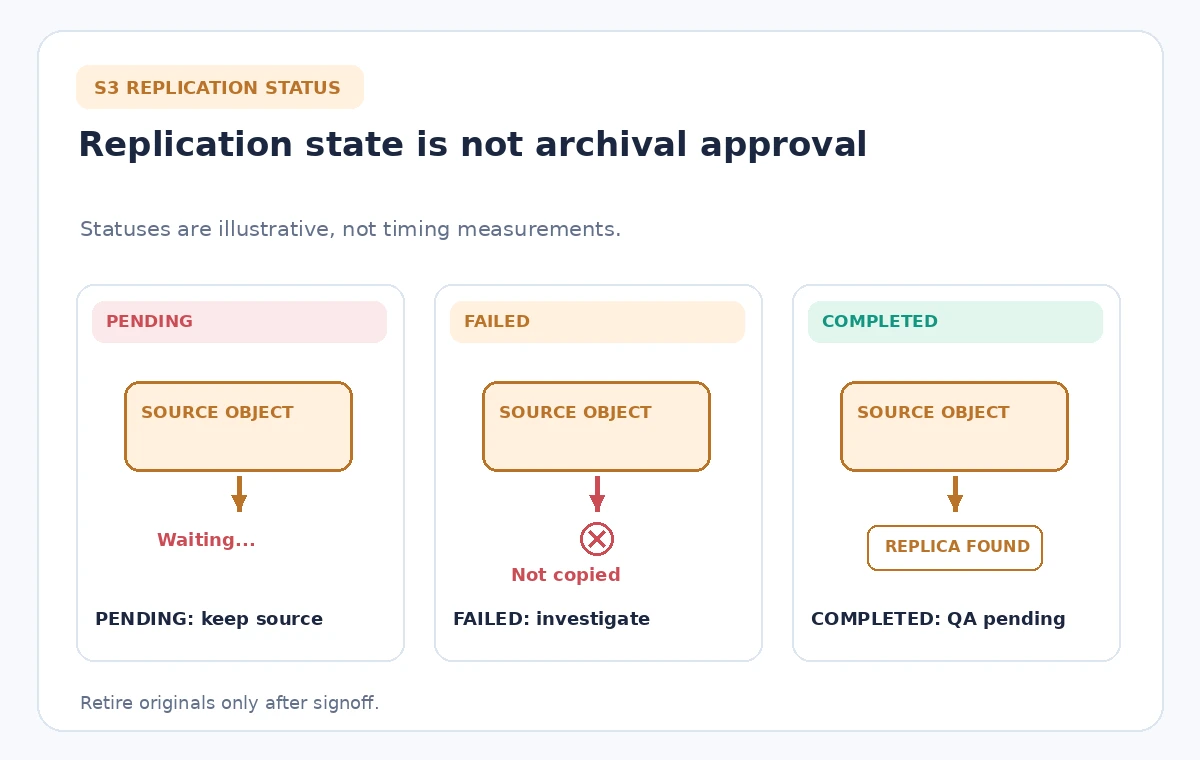
PENDING means that S3 has not yet completed the required replication work, which may include temporary service or destination delays. COMPLETED indicates the source object has met its replication destinations under the applicable rule. FAILED means a replication attempt could not complete, often because of permissions or key-management issues. These are distinct from an archivist verifying the destination audio, release permissions, or access restrictions. A correct dashboard should visually separate waiting, operationally copied, and failed. Some conditions can keep an object pending rather than marking it failed. Do not convert a long wait into an assumed completion or claim that every failed object will automatically retry.
Treat replicas and sources differently
An object read from a destination bucket commonly reports REPLICA rather than the source statuses. This is not a contradiction: source and destination answer different questions. Keep bucket role and object location alongside the header in the audit record. In a multi-destination rule, the source status becomes COMPLETED only after all required destinations succeed; a single destination succeeding does not imply the whole source rule is complete. Avoid sampling only a destination and deciding the entire preservation arrangement is healthy. Confirm the expected copy exists under the right bucket and key, then evaluate its integrity and retention according to the institution’s preservation policy.
Investigate PENDING before taking destructive action
A source remaining PENDING may reflect a temporary outage, authorization concern, or replication backlog. Start with the configuration and eligibility of the object and the destination. Check whether versioning, bucket settings, KMS permissions, and role policies match the documented rule. Do not delete or transition the source because the intended destination appears listed in the console. AWS describes lifecycle behavior that blocks certain actions on pending or failed objects, but that service safeguard is not a substitute for archive policy. The operator should preserve the source, record the unresolved state, and hand the issue to staff with authority to fix replication infrastructure.
Handle FAILED without a blind retry
AWS documentation says that a failed replication is not simply retried by rerunning the original asynchronous operation. Supported recovery options include S3 Batch Replication for affected objects or re-uploading an object to generate a new replication event, with careful consideration of object identity. Do not blindly re-upload an approved audio master: a new object version can alter provenance tracking and reconciliation. Identify why failure occurred first, such as missing IAM or KMS rights, then choose a controlled recovery that preserves original source evidence. Keep the failed version on the exception list until an independently verified destination copy and revised source status support closure.
Compare three illustrative preservation states
Picture an accessioned interview recording in three fictional states. First, the source exists with PENDING and no confirmed destination. Second, the source reports FAILED after a permission denial. Third, the source reports COMPLETED and a corresponding replica has been located, but editorial rights and fixity checks remain open. The first two block source retirement; the third can proceed to preservation QA. This is a schematic explanation, not measured replication timing. Reporting green simply because the destination object name exists misses versions, metadata, and access rules. Use separate operational and preservation-approval columns in the audit sheet.
Verify rights, fixity, and lifecycle after replication
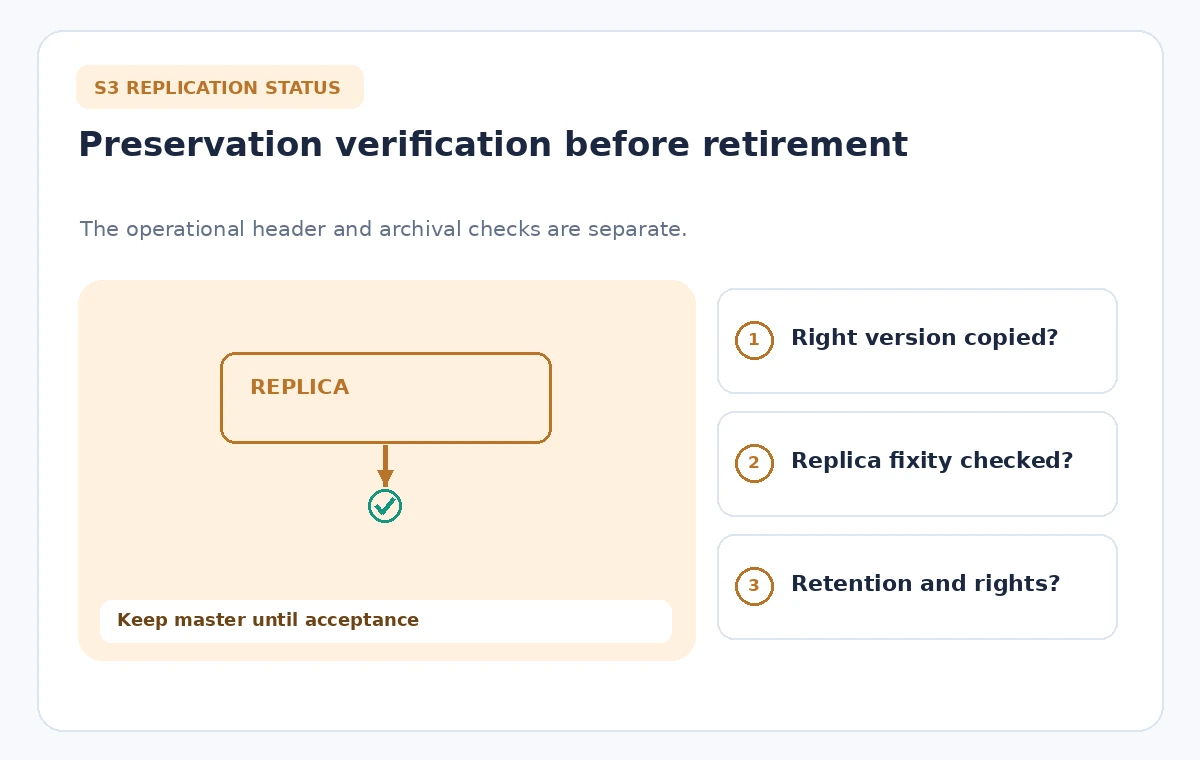
Replication does not certify that an oral-history recording can be played publicly or that every transcript consent covers the destination location. Once operational status is satisfactory, validate object version, expected length, applicable integrity metadata, encryption, retention, and who can retrieve the replica. Compare source and destination fixity using a documented method suitable for that object, not an assumption that all ETags are content hashes. Confirm that lifecycle rules will not remove the master before the retention interval ends. Coordinate with consent and records owners for recordings containing restricted voices or identifying details. The archival acceptance decision should be explicit.
Build an exception report with one row per object
Run a controlled audit on a representative group of synthetic or non-sensitive objects first. Include one eligible completed copy, one pending item, one intentionally misconfigured failure, one excluded key, and a replica viewed from the destination. Check which headers actually appear and whether your script distinguishes absence from success. Then make the report actionable: accession ID, object key and version, intended destination, source status, destination verification, failure reason, owner, and next review date. No real AWS environment was tested for this article, so readers must measure their own backlog and costs. Preserve original recordings until the approved preservation workflow concludes.
How We Research
We reviewed these named official developer references: Amazon S3 replication status overview; Amazon S3 replication troubleshooting; Amazon S3 HeadObject API. We compared documented API behavior, supported configuration fields, and stated limits against a hypothetical museum workflow. We did not perform live customer API calls, examine restricted collection records, run a real production benchmark, or measure service speed or costs. The conceptual figures show workflow logic rather than screenshots or test results. Reconfirm documentation and available API versions before deployment; use authorized staging tests and human review for every public-facing workflow.
Frequently Asked Questions
No. Inspect the eligible object’s replication status and verify the destination.
The applicable replication work is not finished; treat it as unresolved, not successful.
Yes. The destination may report REPLICA while the source reports its replication progress.
No. AWS documents recovery approaches such as Batch Replication or re-upload after root-cause review.
No. Apply independent integrity, retention, rights, and records-approval checks first.