
Why a Successful Download Is Not an Approval
A small museum uses CI to build a static catalog and then downloads the generated files in a deployment job. The build report says tests passed, yet the downloaded artifact is not the exact one expected. A hurried operator treats a warning in the job log as harmless and publishes the package. Even if the problem is a benign workflow mismatch, the release process has failed to prove which build reached the public site.
The aim is narrow: associate a build artifact with its digest, verify it on receipt, and prevent deployment until the expected content and release authorization are established. This example uses fictional files and no production credentials. A SHA-256 digest proves byte equality to an expected value under the chosen verification method; it does not independently certify that the code is safe, licensed or approved by curators.
What GitHub Upload and Download Report
GitHub documents that upload-artifact returns a SHA-256 digest for the uploaded artifact. The corresponding download-artifact action calculates a digest when downloading and compares it with the stored value. If the digests do not match, the workflow displays a warning in logs and the UI. GitHub’s documentation does not promise that this warning, by itself, will fail the deployment job.
That last distinction matters. Teams need an explicit release gate rather than a policy written as if a digest warning always terminates the job. Check the behavior and supported versions of the actions you actually pin. GitHub’s changelog introduced artifact digest support for v4 or later and described platform availability restrictions at that time; consult current product documentation before selecting a runner or enterprise environment.
Give the Build an Unambiguous Identity
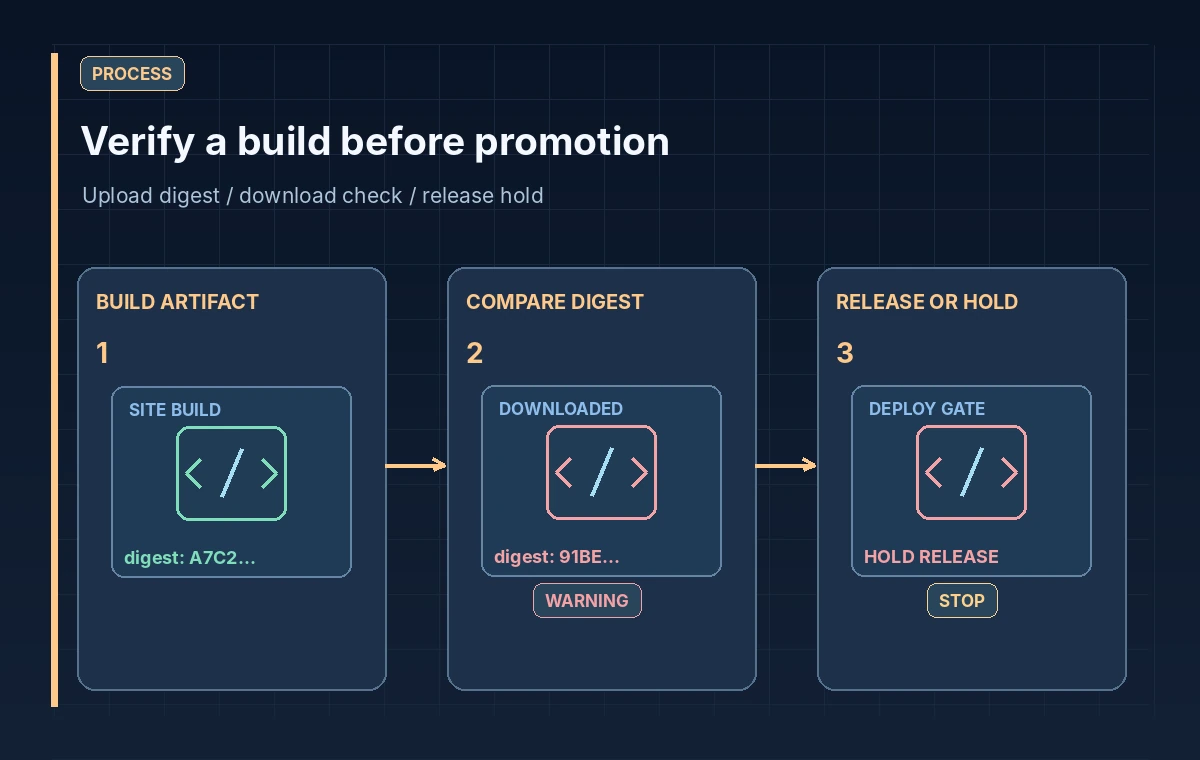
For a hypothetical catalog update, produce a build from a specific reviewed commit. Record the commit identifier, workflow run identifier, artifact name, generated digest and the identity of the job that produced the asset. Include a machine-readable list of expected site files with their own checksums when the deployment process needs file-level traceability. Do not place passwords, API tokens or private catalog exports in this manifest.
Treat artifact digests and file hashes as related but different layers. The artifact hash covers the representation uploaded through the action; a separate file-level manifest helps audit individual images, pages and JSON records after extraction. Comparing only the name “museum-site-build” is insufficient because different runs can produce artifacts with that same human-friendly label. The deployment should identify exactly which run it is consuming.
Verify After Download and Before Promotion
Design a privileged deployment job to download only the artifact from the intended trusted run. Confirm the resolved artifact ID or run association and inspect digest verification output. In addition, independently check the approved file manifest and any relevant provenance evidence before copying files to public hosting. A single suspicious hash or missing expected file must hold the release pending staff review.
Do not parse an arbitrary substring from a free-form log and call it cryptographic verification. Use documented action outputs and a checked comparison step appropriate to your pinned version, supplemented by your own hash computation where needed. Artifact data originating from an untrusted pull request should never be promoted merely because its digest matches itself; integrity and authorization are different questions.
Draw the Three Release States Honestly
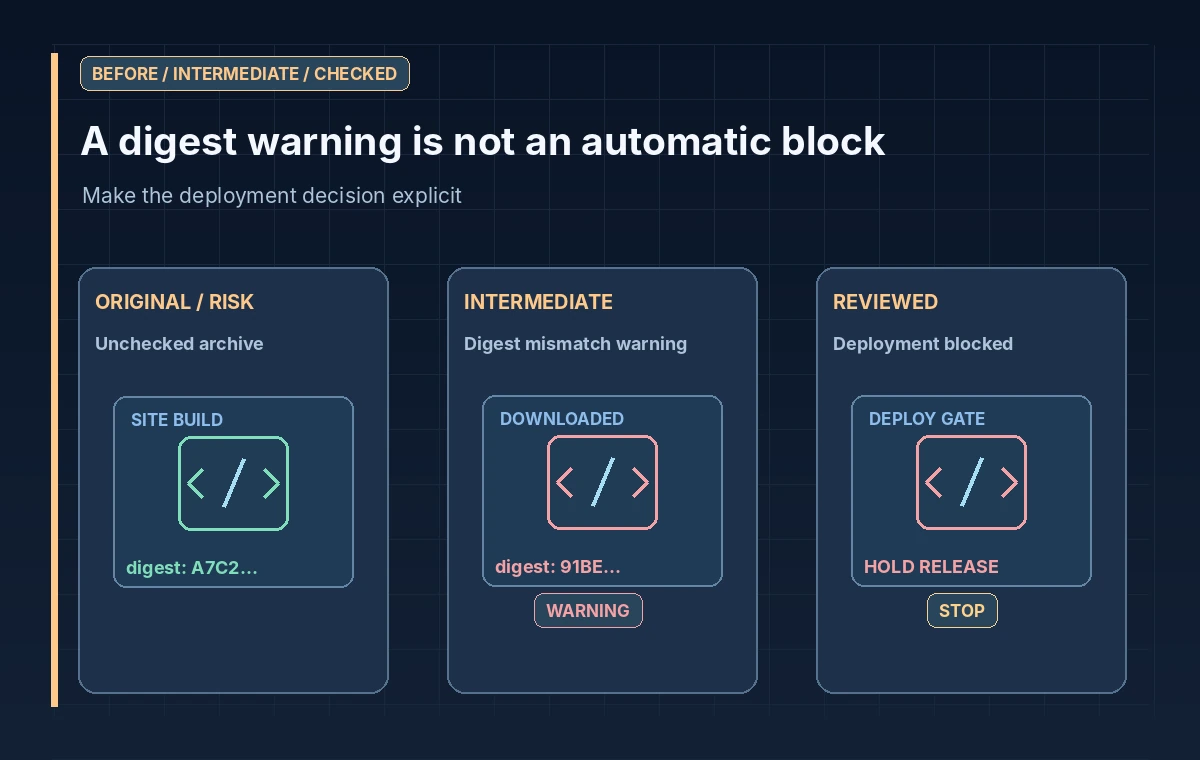
The visual comparison shows a build package beside a recorded digest, a downloaded copy that triggers a mismatch warning, and a deployment gate that stops promotion until reconciliation. The “warning” state remains visually distinct from a failed job because GitHub’s default behavior is to warn, not necessarily to fail. The corrected state must include the explicit hold, not a fictional automatic hard failure.
A simple example uses a fictional catalog image whose expected checksum prefix is A7C2 while the received copy yields 91BE. These are illustration labels, not real digest values from an API. The security message is that the team needs to stop and compare provenance, regenerate from the reviewed commit if necessary and avoid silently trusting the latest file with a familiar artifact name.
Keep Trust Boundaries and Secrets Clear
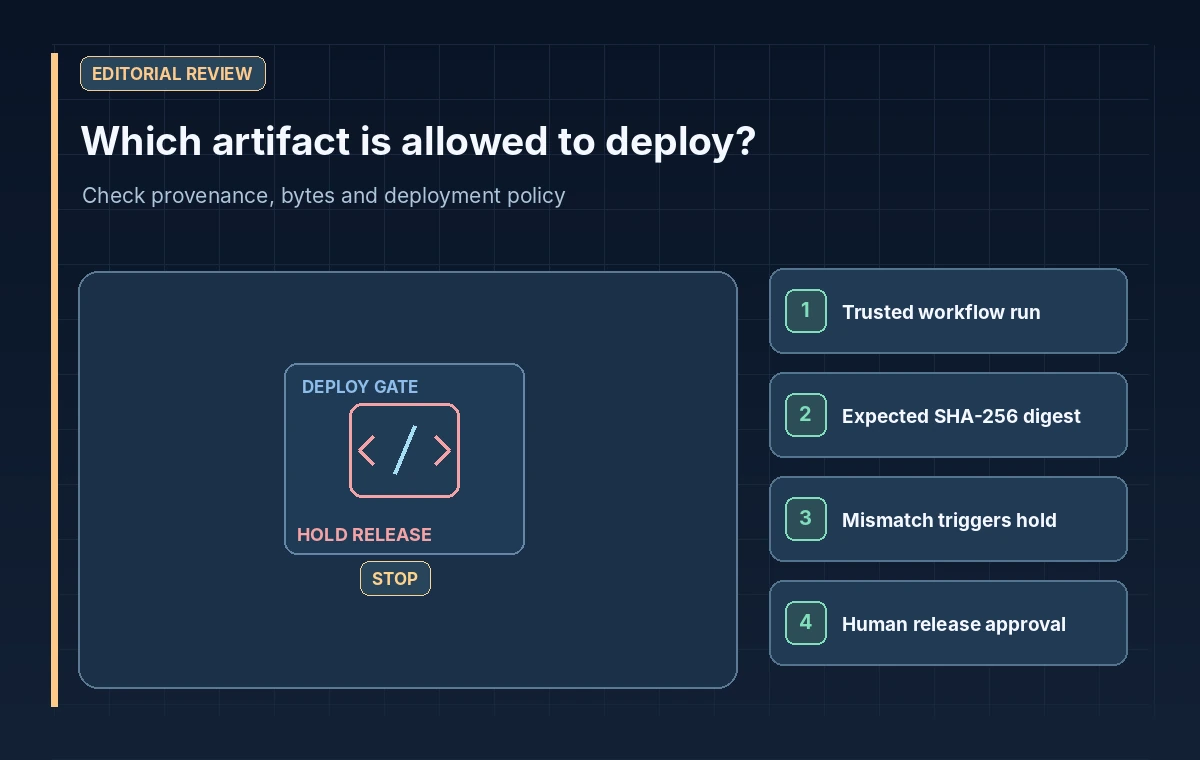
A build running on an untrusted contribution should not receive deployment secrets just to upload a test artifact. Store secrets in the privileged deployment boundary, apply branch and environment protections and restrict the token permissions needed for each job. The download step should not execute embedded scripts or installers from an untrusted artifact as part of verification. Treat the package as data until its source has been approved.
Protect against accidental cross-run downloads, partial artifact retention, digest mismatch and manual overrides. An exception procedure should identify who may approve a rebuild and what evidence is retained. If a hash is unavailable due to an older action version or unsupported environment, fail closed under the museum’s release policy rather than claiming the package passed an integrity check that did not occur.
Practice With a Deliberate Test Matrix
In a safe test repository, propose cases for identical bytes, a modified image, wrong run ID, missing artifact, expected hash absent and a package supplied by an untrusted workflow. For each case define whether the deploy job should pass, block or require human reconciliation. Record intended outcomes without inventing actual CI results or benchmark figures. The test material should contain only public or fabricated catalog content.
Before releasing to production, check the action versions, hash outputs, runner permissions, artifact retention, environment approval and rollback path. Archive a minimal evidence record linking the approved commit to the published digest. GitHub’s automatic comparison is a useful signal, but operational assurance comes from interpreting that signal correctly and maintaining an explicit independent promotion gate.
How We Research
We consulted the following official developer documentation on November 8, 2026: GitHub Docs: Store and share workflow artifacts; GitHub Changelog: Artifact digest validation; GitHub: upload-artifact action. We compared the documented parameters, data flow and stated limitations with this hypothetical editorial scenario. The diagrams are original instructional illustrations, not real vendor screenshots or outputs. We did not submit private archive material, run a production API evaluation, measure tool accuracy, obtain legal consent, or test a live service configuration. Product behavior, access rules, quotas and supported settings may change; confirm the latest documentation and your organization’s policies before deployment.
Frequently Asked Questions
GitHub documents a warning in the workflow UI and logs. Configure an explicit deployment gate to stop promotion when evidence does not match.
No. It supports integrity against the expected artifact. Source trust, permissions, tests and human release approval require separate checks.
Track the reviewed commit, workflow run, artifact ID or name, expected digest and file-level manifest where appropriate.
A fork can produce test data, but do not promote it with privileged credentials merely because it has a matching digest.
No. They are fictional shortened values for an instructional comparison.