
A community center uploads posters for a public health workshop. Some contain medical diagrams that are appropriate for education but might trigger a content-classification flag. Google Cloud Vision SafeSearch reports likelihoods for particular image categories; it does not decide whether a poster is truthful, legal, age-appropriate, or suitable for a specific venue. This guide proposes a human-reviewed triage workflow built around fictional posters. It does not claim that any image was classified by the API or approved by a real moderator.
Define the venue policy before invoking a detector
Write down the community center’s actual moderation rules: who may attend, which rooms are public, whether educational anatomy is allowed, what warning labels are required, and when staff must escalate a safety concern. A poster for a clinician-led wound-care workshop may contain medical imagery without being inappropriate. A content score alone cannot establish that context. Avoid policy rules that punish legitimate health education simply because a classifier sees medical content.
Separate factual review from visual suitability. A medically misleading diagram might get a low explicit-content signal and still require correction. Conversely, a highly accurate clinical illustration might deserve a content notice and placement decision rather than rejection. Assign those decisions to named staff with the authority and domain knowledge to make them.
Know the five SafeSearch categories
Google documents SafeSearch Detection categories named adult, spoof, medical, violence, and racy. For each image it returns a likelihood rather than a simple “safe” or “unsafe” verdict. Published likelihood values include UNKNOWN, VERY_UNLIKELY, UNLIKELY, POSSIBLE, LIKELY, and VERY_LIKELY. These are categorical outputs, not validated probabilities that an event policy was violated.

The medical category is especially important to interpret correctly: it concerns whether an image appears medical, not whether the image is medically correct or harmful. Treat spoof as a category with its own visual meaning, not a general fact-checking score. Do not combine all five labels into a universal risk percentage without a separate, justified local evaluation.
Create a narrow image-analysis request
For each permitted poster image, send an authenticated Vision API annotation request with feature type SAFE_SEARCH_DETECTION. Google’s REST documentation describes images:annotate and the safeSearchAnnotation response. Maintain a reference to the exact image version and use service credentials managed by the backend. Do not embed access tokens in web pages or public poster metadata.
Confirm current supported formats, size constraints, billing configuration, and regional privacy obligations before uploading. For sensitive patient imagery, verify permission and data minimization; use synthetic examples during development. The API may also support asynchronous batches, but batch processing does not change the need for a reviewer who understands the context behind a flagged image.
Route uncertain or medical imagery to human review
Design triage rules around review queues rather than immediate publication or deletion. For example, a medical signal can prompt a staff check for educational purpose, consent, and an accurate content notice. A violence or adult likelihood may prompt additional review under the venue’s written policy. In every lane, retain an override reason and a way to appeal a mistaken judgment.
Do not claim a particular label value always requires a block. A rigid threshold could disproportionately hide legitimate public health material. The best configuration depends on audience and policy, and would need evaluation with representative, lawfully sourced images. Our pictured routes illustrate potential outcomes, not actual classifier responses.
Use contrasting examples to expose the limits
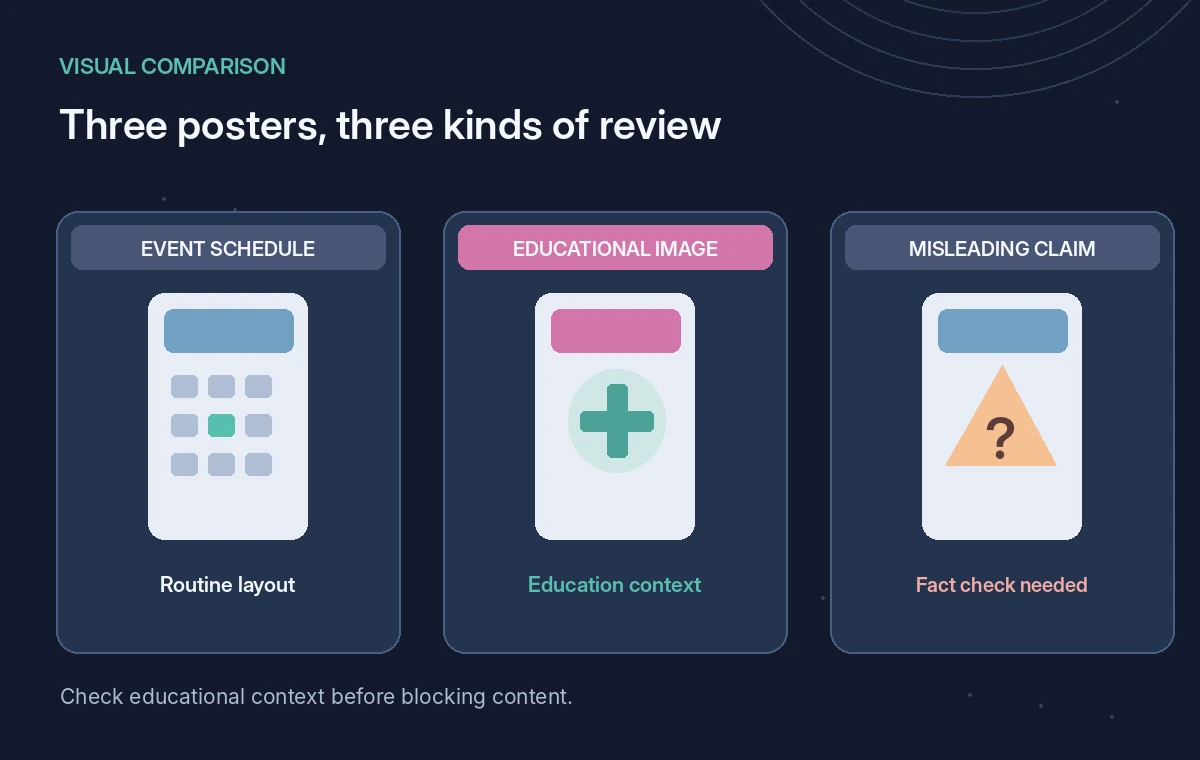
Compare three fictional posters: a plain event schedule, a medically accurate first-aid diagram, and a misleading promotional claim with no graphic imagery. The schedule is visually ordinary. The first-aid diagram may need a content notice. The promotional claim needs fact review, even if a SafeSearch response were unremarkable. These different editorial needs explain why one automatic label cannot make the publishing decision.
Also examine accessibility. If a graphic is likely to be disturbing, provide suitable text alternatives and a viewer choice. If the content is educational, do not strip the supporting context or sources when cropping a thumbnail. A visually compliant poster can still fail the community center if its instructions are unreadable, unverified, or inaccessible.
Keep the evidence needed for an appeal
A decision record should include original asset ID, image revision, submitted feature set, returned likelihood labels, policy clause applied, reviewer identity, and final disposition. Store only data needed for the stated purpose, with retention controls. If the asset changes, rerun review; classification for last week’s version is not evidence about a new image that replaces the original.
Allow a poster owner to explain educational relevance and challenge a mistaken flag without exposing private patient information publicly. Staff should be able to reopen a decision and compare it with the same policy version used earlier. This is an editorial governance process, not a guarantee that the API can recognize truthfulness or contextual appropriateness.
Measure the harm of false blocks and missed flags
Before automating any triage, create an authorized and representative review set containing routine announcements, permissible educational images, and items that truly need restriction. Have trained reviewers label decisions from the written policy, then examine disagreement and error patterns across content types. Do not convert the model’s likelihood word into a fabricated percent-accuracy estimate.
Track both false-positive restrictions and content that should have been escalated. A system that blocks everything suspicious can look deceptively safe while censoring vital instruction. Periodic audits matter because the poster mix, audience, and vendor implementation may change. A publication decision should always be reversible by authorized staff.

Publish only after the full content check
The release gate should cover rights and consent, accuracy of health claims, accessibility, audience suitability, context notices, location and date information, and the SafeSearch review record. No classifier can authorize using someone’s medical image or verify an educational claim. A decision to publish should come from the community center’s appointed human reviewer under its adopted policy.
This article reviews documented functionality only; we did not send images to Cloud Vision, calculate a confusion matrix, or evaluate a real moderation dataset. Recheck the Google documentation and service conditions before implementation. Treat all illustrations as explanatory diagrams, not screenshots or evidence of performance.
How We Research
For this November 2026 guide, we reviewed named vendor-maintained documentation: Google Cloud Vision: Detect explicit content (SafeSearch), Google Cloud Vision: Features list. We extracted the documented feature controls, compatibility boundaries, and relevant limitations, then designed a narrowly scoped fictional workflow and evidence-based failure checks for the specific scenario above. This was a source review, not hands-on testing: no account or API credentials were used, no live data was sent, no outcomes or quality measurements were observed, and no vendor-generated screenshots were taken. The diagrams are conceptual. Before deploying, recheck current availability, privacy terms, region and plan access, prices, and the latest official documentation. An authorized human, not an extraction or language model, remains responsible for any legal, safety, access-control, or release decision.
Frequently Asked Questions
No. It returns category-specific likelihood labels for adult, spoof, medical, violence, and racy content.
No. Medical imagery can be legitimate education. A human should apply the venue’s policy and context.
No. Content likelihood detection is not medical fact-checking or safety certification.
Google documents UNKNOWN, VERY_UNLIKELY, UNLIKELY, POSSIBLE, LIKELY, and VERY_LIKELY.
Yes. Re-evaluate a changed asset and preserve which version the previous decision covered.