
A fictional community foundation asks an AI assistant to summarize a transportation grant. The source rules allow travel expenses but exclude reimbursement for personal vehicles without written authorization. A fluent summary that says ‘all travel expenses qualify’ could mislead applicants. Amazon Bedrock Guardrails includes contextual grounding and relevance checks for assessing a generated answer against a supplied reference and query. This tutorial explains a review design, not a measured accuracy test or a live grant decision.
Define the claim and the governing source
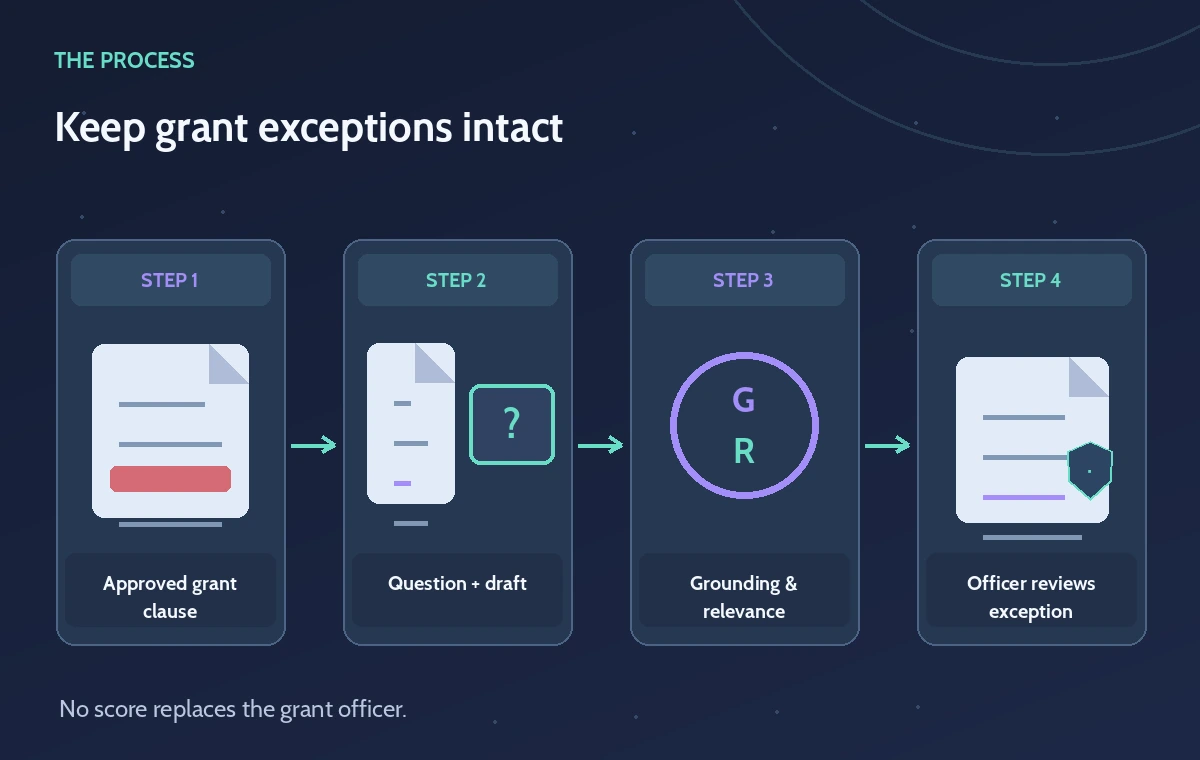
Start with a specific question: ‘Which transportation expenses may a grantee request?’ Keep the approved policy paragraph, its effective date, and the exception in one traceable source record. A summary should never merge the exception into a vague phrase such as ‘reasonable costs’ when the underlying rule requires an approval letter. Record the actual clause ID and identify the policy owner before any model is invoked.
For illustration, an approved clause could read, ‘Public transit is reimbursable; personal-vehicle mileage requires written preapproval.’ That wording is hypothetical and is not legal guidance. The reference should include both halves. If the only snippet supplied to the checker mentions public transit, the system cannot independently discover the missing mileage provision in a different policy file. Retrieval quality is a prerequisite to grounding evaluation.
Distinguish grounding from relevance
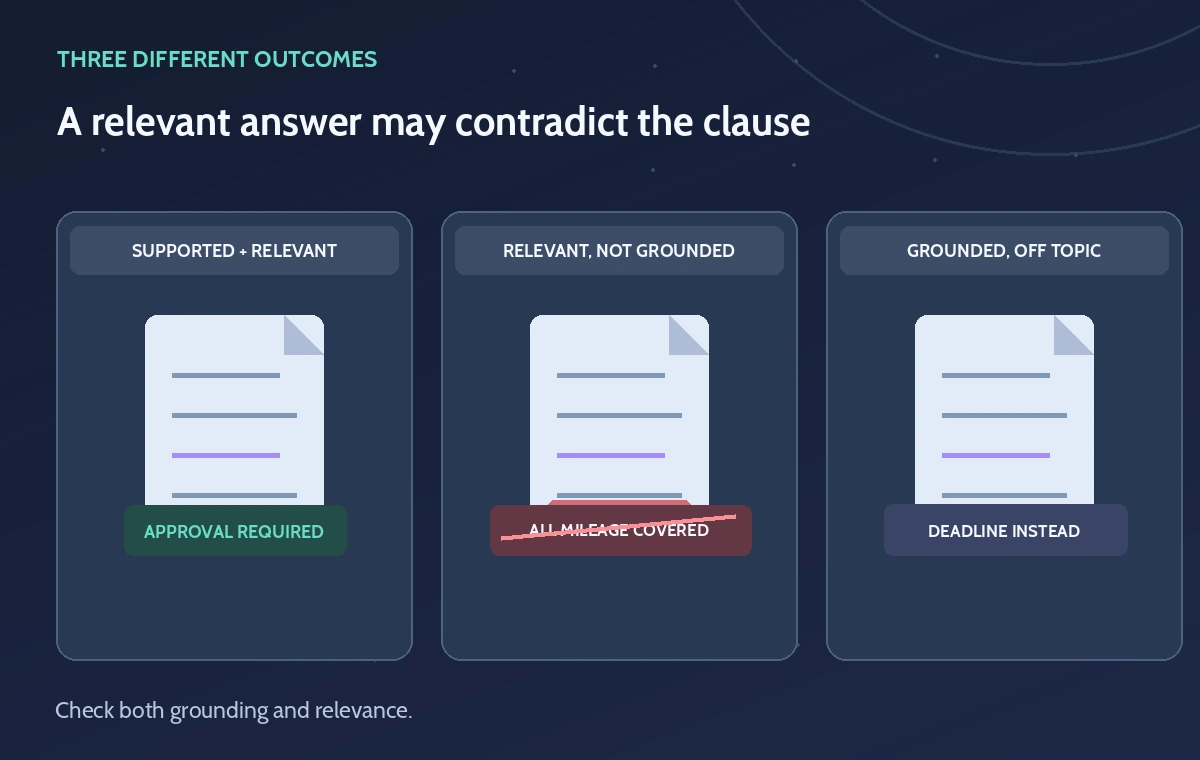
AWS describes grounding as whether an answer remains supported by the provided source and relevance as whether it addresses the question. These are related but separate assessments. A correct quotation about the application deadline may be grounded yet irrelevant to a travel reimbursement question. Conversely, ‘All mileage is covered’ may appear responsive while contradicting the clause requiring prior approval. Review both outcomes rather than collapsing them into a single safe-or-unsafe flag.
Construct a small matrix of hypothetical replies and ask a reviewer to label each as supported, responsive, both, or neither. Give the reviewer the source clause, not only the model draft. This educational matrix illustrates expected distinctions; no real Bedrock scores were collected. Preserve the exact query and source revision for later review, especially if the answer might be placed into applicant-facing instructions.
Provide all three contextual-grounding inputs
AWS requires a grounding source, a user query, and the content to evaluate. For Invoke or Converse integrations the model response supplies the evaluated content; for a direct ApplyGuardrail call the application passes response text explicitly. The documentation shows `grounding_source` and `query` qualifiers in the API content blocks. An unqualified answer block can be assessed as the candidate response. Choose one integration path and test its actual response handling.
Do not treat a retrieved passage as untrusted simply because it is text, but do not treat retrieval as authorization either. Confirm the source is the approved revision, belongs to the intended program, and does not accidentally combine rules from different grant years. If several grounding sources are provided, AWS notes that they are combined for evaluation; this is a reason to keep mutually inconsistent editions out of the same request.
Tune thresholds against meaningful failures
A contextual grounding policy exposes grounding and relevance thresholds from zero through 0.99. Higher thresholds can reject more unsupported or off-target material but also create false blocks. AWS distinguishes Classic and Standard tiers; Standard handles conversational or reasoning content differently and requires cross-Region inference in supported Regions. The default tier is Classic when one is not selected. Check service-region and tier support before designing a production requirement.
Avoid borrowing a score threshold as if it were a universal assurance level. Create a review set containing an omitted exception, an irrelevant but correct deadline, a paraphrase of the genuine rule, and a response that admits uncertainty. Inspect the labeled outcomes with a grant officer. Re-evaluate the threshold if the safeguard tier or policy wording changes; a numeric score is a screening signal, not a legal or funding decision.
Do not stream unsupported claims to applicants
AWS documents a caveat for streaming: assessment of a complete response can identify irrelevance after some streamed content has already been shown. For applicant-facing eligibility guidance, buffer candidate text until the relevant checks and human-defined requirements have passed. A guardrail action that blocks a response cannot retract misleading information that a user already read in an earlier stream chunk.
Design the safe output message before an incident. It can say, ‘The automated summary could not be verified against the current policy. Consult the official grant conditions.’ Include a stable link to the approved source only when that link is genuine and maintained. Never improvise a new exception, invent a decision deadline, or silently lower the threshold just to reduce visible error messages.
Keep a reviewer and evidence trail
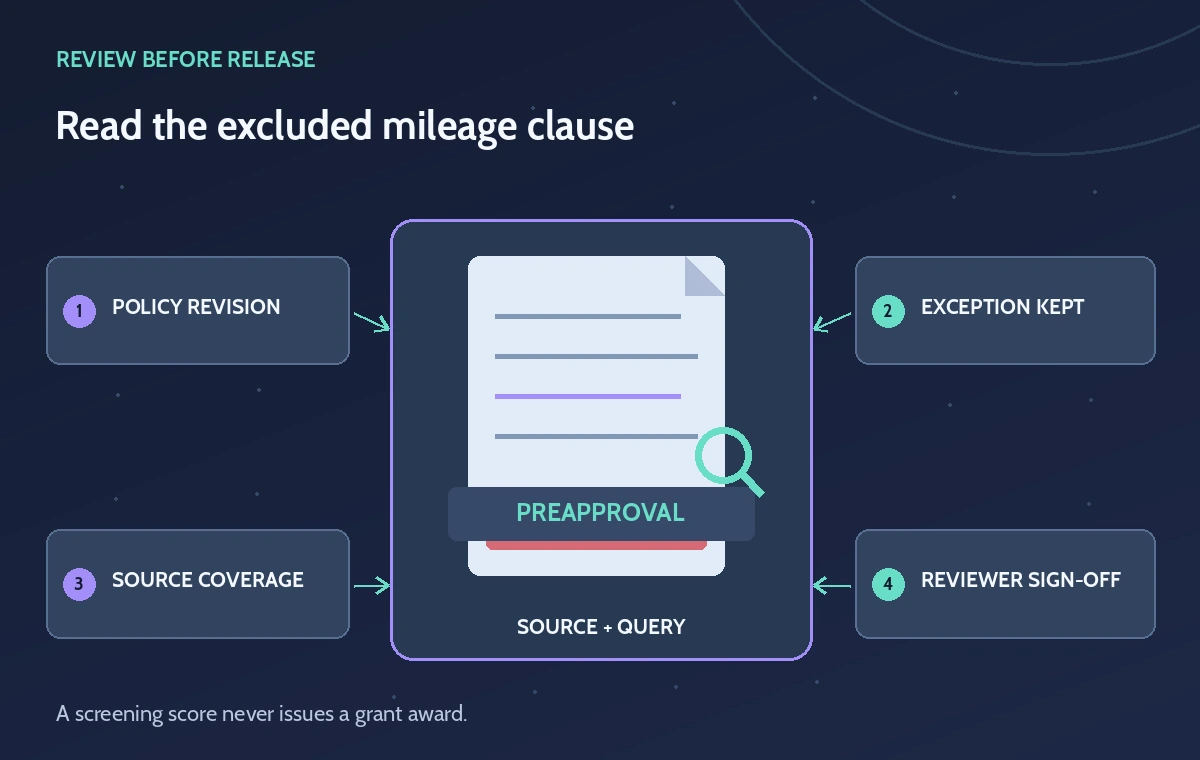
For a draft sent to staff, capture source document ID, version, question, candidate answer, grounding/relevance outcomes, and any manual correction. A reviewer should underline where the mileage preapproval condition is retained. Do not log applicant identity, sensitive attachments, or bank information if those fields are irrelevant to the summary check. Restrict access to evaluation records and define retention before production.
Separate the analyst’s approval from the model result. A staff member may approve an accurate summary only after checking related rules and the current eligibility bulletin. If a source is incomplete or contradictory, the assistant must point to the missing clause instead of manufacturing a definitive answer. The final communication should name the policy owner rather than imply that AWS has endorsed an interpretation.
Release only a qualified, traceable summary
Before publication, replay the concrete failure examples: an excluded reimbursement, a cross-year policy mix, a nonresponsive answer, and a response that introduces an unsupported permission. Review accessible wording and ensure the exception is legible in mobile and screen-reader contexts. Keep a direct reference to the official policy so that staff can correct downstream materials when the rules are updated.
This method is based on documentation and hypothetical text; it is not a hands-on result. Confirm current supported Regions, model/API integration, guardrail tier, and documentation as part of a deployment checklist. No grounding score proves the entire grant file is accurate, that the right policy was retrieved, or that a particular applicant is eligible. Only authorized personnel can approve grant interpretations.
How We Research
For this November 2026 guide, we consulted the following official product documentation: AWS: Contextual grounding checks, AWS: Amazon Bedrock Guardrails overview. We checked the named feature’s documented request patterns, eligibility or platform limitations, and failure modes, then designed an editorially hypothetical workflow that tests the source-to-output handoff. This was a documentation review, not a hands-on evaluation: no paid service was accessed, no account was connected, no live media or source data were uploaded, and no timing, costs, recognition scores, model-generated text, or real screenshot results were measured. The original diagrams illustrate design decisions rather than actual vendor interfaces or product output. Readers must recheck API and plan availability, price, data processing terms, and regional limits before implementation. Source records and authorized human review remain necessary for any release or consequential decision.
Frequently Asked Questions
A source passage, a user question, and the candidate response. Without all three, the application cannot evaluate grounding in the intended way.
Yes. An answer can accurately repeat a clause about a different topic while failing to answer the actual question.
No. Thresholds are configurable screening rules and need evaluation with actual domain-specific failures and false blocks.
No. AWS documents different evaluation behavior and cross-Region inference requirements for Standard; test again before switching.
No. The check cannot replace current-policy retrieval, exception review, or an authorized grant decision.