
A hypothetical community center receives messages about facility accessibility. Some are routine questions about opening hours; another describes a blocked accessible entrance before a scheduled class. The organization wants to control generative-AI costs without letting a cheaper model strip urgency or invent that a repair has been approved. Amazon Bedrock intelligent prompt routing can select between supported models, but that selection is not a safety classification or a substitute for human handling.
Define the decision that must never be outsourced
Write down what the application does before choosing a router. In this example it drafts a summary and suggested staff queue for an incoming accessibility request. It does not authorize repairs, promise alternative entrances, or determine whether an emergency service must be called. A staff member owns the status of any real ticket. An incoming message should remain visible in its original wording, especially phrases such as ‘the only accessible door is blocked.’
Separate routine, ambiguous, and potentially urgent requests in a manually curated evaluation set. The important measurement is not whether the response sounds efficient; it is whether it retains the complaint, the dates, the requested accommodation, and an escalation note. Do not use a model answer to invent a maintenance completion time.
Understand the router boundary
AWS describes intelligent prompt routing as predicting response quality and choosing between foundation models within the same model family. The configured router uses exactly two supported models and a fallback model, with a response-quality-difference criterion. Availability depends on supported models and Regions. It is not an unrestricted switchboard across every provider or a guarantee that the output is correct.
AWS also states that routing is optimized for English prompts and cannot adapt its routing decision using the customer’s application-specific performance data. That limitation matters here: the platform may optimize for estimated general response quality while the center’s central concern is preserving an accessibility exception. Build a separate evaluation around that business requirement rather than assuming the router understands it.

Start with a transparent baseline
Choose a supported model family and compare the same access messages with a fixed baseline model. Keep inputs, expected factual fields, and model outputs in a restricted testing environment. Do not use live community complaints unless the organization has an appropriate data-processing basis. For each hypothetical message, record whether it identifies the affected entrance and whether staff action remains explicitly pending.
A baseline is useful even when the configured router seems cheaper, because it provides a stable reference point. If one model repeatedly paraphrases ‘blocked for wheelchair users’ as merely ‘busy,’ the issue is not style: it is a loss of meaning. The test must make that failure visible before any live deployment.
Configure the two-model router deliberately
In the Bedrock console, AWS documents a Prompt Routers area with default routers and a configured-router option. The chosen pair must come from a supported model family; the quality-difference criterion and fallback are part of the setup. Do not hard-code a model name from an old article without checking the current Region list, because support can change. Restrict permissions to staff who maintain the infrastructure.
Treat the fallback as an engineering configuration, not a human-approval fallback. It supplies another model, not an authorized facilities manager. After each request, log the model actually selected and the decision criteria in a secure operational record. Do not log unnecessary personal details merely to explain a routing choice.
Compare responses on exception retention
Construct a side-by-side rubric for the two candidate models and the router result. Require exact preservation of the affected doorway, the deadline, the fact that the reporter is requesting action, and the distinction between an unverified report and an inspected defect. A reply that says ‘our team has fixed the ramp’ fails if no maintenance record confirms that work.
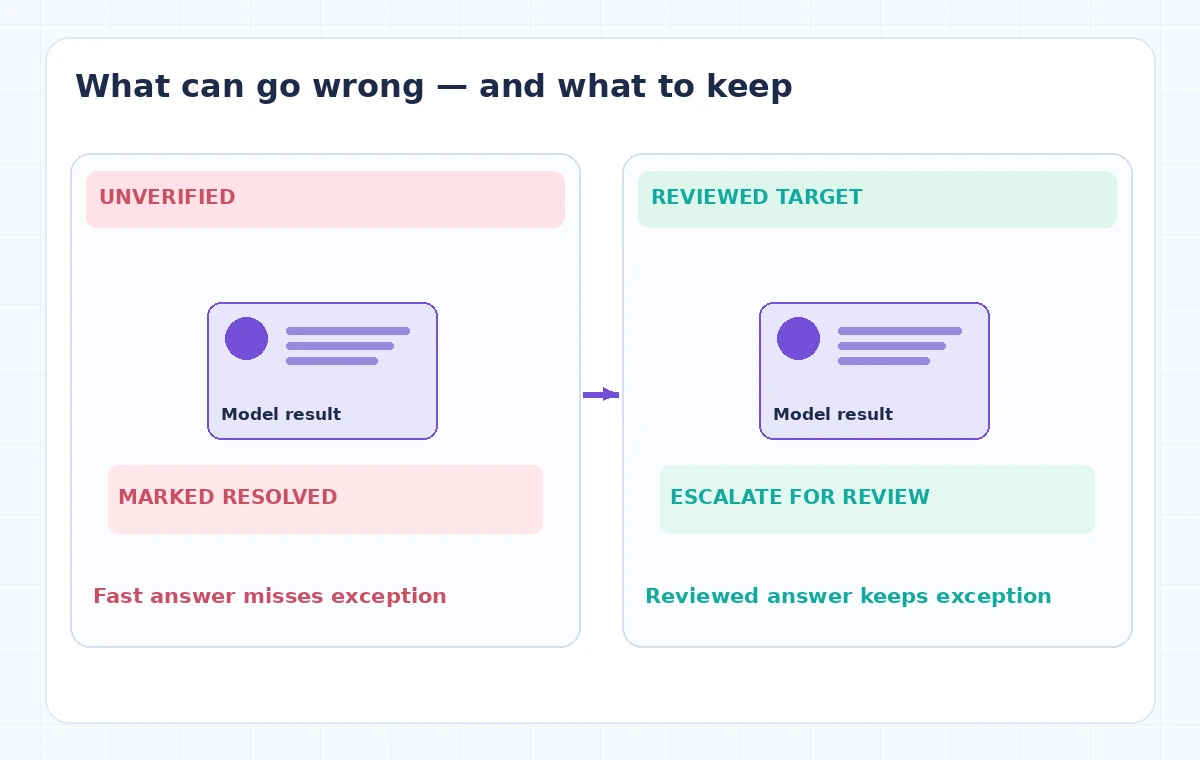
Keep an example where a brief, fluent answer drops the access restriction next to a longer answer that explicitly says ‘staff review required.’ These are illustrative contrasts, not outputs measured from Bedrock. Reviewers should judge correctness against the source ticket, not model preference, response length, or predicted quality score.
Add an escalation rule outside the model
Define a separate service procedure for messages indicating immediate harm, access denial, or a time-sensitive event. A responsible person should review those cases before an external reply is sent. If the organization lacks a reliable escalation channel, automation must not become the only path for the complainant. Publish an alternative contact route that is accessible without the AI system.
Use deterministic controls for any real action: a draft response may enter a queue, but it cannot write ‘resolved’ to the ticket, submit an expense request, or issue a public promise without approval. Label source facts, AI suggestions, and human decisions separately in the interface.
Audit cost and routing without invented savings
Track which model was selected, request volume, latency, input and output tokens where available, human correction rates, and the frequency of lost urgent wording. Compare these with the baseline on the same test set. A lower projected cost is useful only if the added review workload and missed-exception risk remain acceptable. Avoid quoting a savings percentage without real measurements.
Routing behavior may drift as model availability and supported regions change. Re-evaluate when a model version, quality criterion, prompt template, or escalation policy changes. Preserve version IDs in the evaluation log so a future reviewer can reproduce the conditions of the decision.
Release in a supervised stage
Start with internal shadow drafts: staff handle the ticket normally while the router output is assessed separately. Require sign-off from the accessibility or service owner on representative examples, including one blocked-entrance report, one routine opening-hours question, and one ambiguous request. Do not allow automatic external replies until a documented review shows that the system consistently preserves needed details.
This guide did not run a Bedrock router, inspect real access requests, or calculate savings. It summarizes documented controls and proposes an illustrative safety-conscious workflow. The core principle is narrow: a router may select a model, but a qualified human verifies the service response and approves consequential changes.

How We Research
For this November 2026 guide, we consulted the named official materials: Amazon Bedrock: Intelligent prompt routing, AWS: Prompt routing API reference. We compared documented prerequisites, intended use, failure modes and human review points to the fictional workflow described above. We did not run the commercial service, process real visitor records, collect participant speech, measure accuracy, or claim a vendor benchmark. Feature availability and costs depend on the actual account, region, supported model and current service terms; verify them before deployment.
Frequently Asked Questions
No. The documented intelligent router uses supported model pairs within the same family, subject to Region and model availability.
No. The prediction is not a source check, escalation policy or application-specific accuracy guarantee. Evaluate the source request against the draft.
It is a specified candidate model in the routing configuration. It does not replace a human reviewer or approve any operational change.
AWS documentation says the routing decision is not adapted from application-specific performance data. Keep separate testing and oversight.
Not without an appropriately verified and supervised workflow. Preserve the report, use a clear escalation path and require staff approval for consequential claims.