
A fictional museum collection needs to confirm a courier’s credential under a documented internal handoff process. It would be easy to ask an AI system to read an ID photograph and mark the courier as cleared. That jumps over several important questions: whether collecting the image is necessary, whether the credential is authentic, what the extracted date means, and who is authorized to make the decision. Amazon Textract AnalyzeID is a field-extraction service, not an identity-verification service.
Confirm that ID scanning is necessary
Before enabling any extraction, review the museum’s actual policy and applicable legal obligations. A signed handoff token, staff roster or another less intrusive method may be sufficient. Do not ask volunteers, visitors or couriers to provide identity documents merely because an API can process them. If an ID is genuinely required, inform the person about the purpose, the data processor, retention, and the available alternative review process.
Define one narrow decision, such as checking whether a document appears to have a future expiration date and matching the supplied name to an authorized roster. Avoid copying birth dates, full addresses, document numbers and unrelated restrictions into a general-purpose museum CRM. The sample contains imaginary fields and no real person’s details.
Understand the AnalyzeID output
Amazon documents AnalyzeID for passports, US driver licenses and other supported government identity documents. The response includes IdentityDocumentFields with normalized field types and extracted values, plus confidence information. For example, a document might print LIC# while the extracted normalized type is Document ID. This normalization helps downstream mapping but cannot confirm that the source image is genuine or belongs to the presenter.
The API accepts a small set of document pages, with an option for front and back where appropriate. The AnalyzeID reference says this operation does not return Geometry data in the same way as many other Textract operations. Do not design an audit step that assumes precise field coordinates will always be returned. Keep the original view securely available to an authorized reviewer when an extraction needs checking.
Distinguish issue, expiration and birth dates
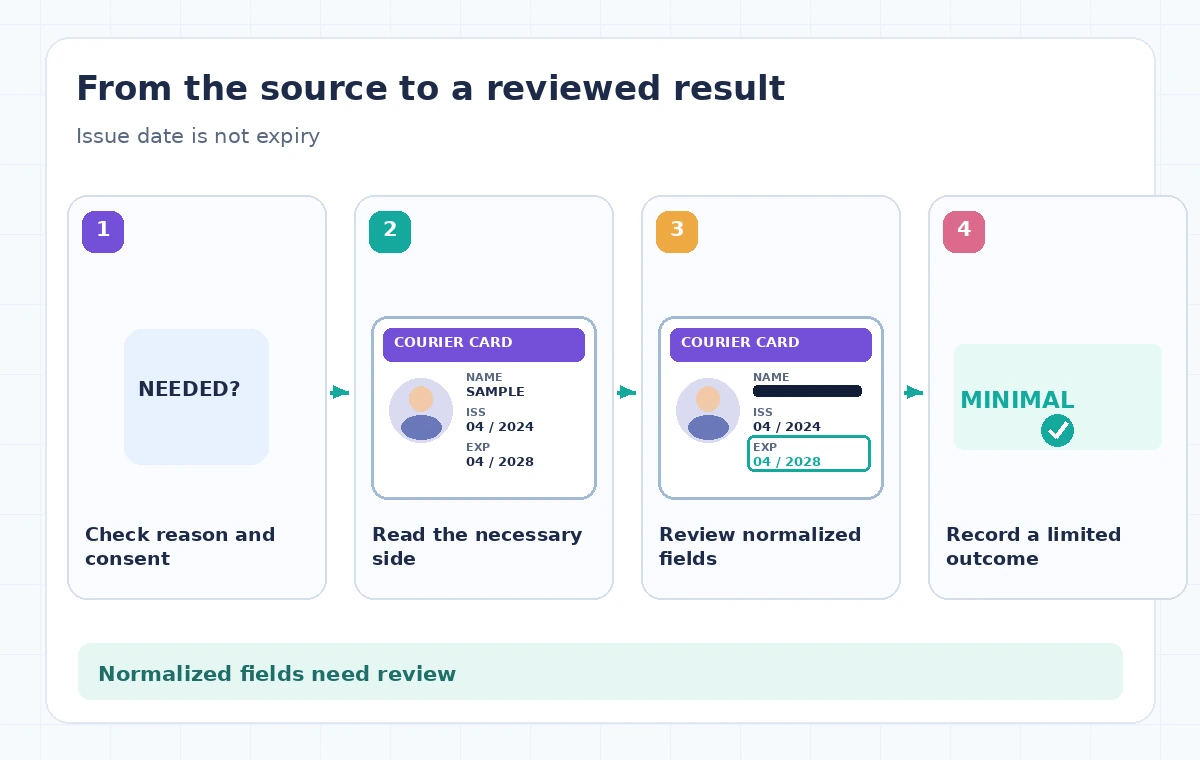
A crowded card can contain several adjacent dates. The fictional handoff procedure requires the expiration date, not the date issued. When the output includes a field label and extracted value, compare it to the visibly printed label on the source. A field labeled ISS is not a license-expiration field; EXP normally denotes expiration in the illustrative card. These labels are examples, not a universal mapping for every jurisdiction.
Never populate an ‘approved through’ field from whichever date the model returns first. Keep unresolved fields blank and route them to manual review. The reviewer should confirm the interpretation and the museum’s actual access rules rather than relying solely on an extracted confidence value.
Prepare input with limited permissions
AWS shows AnalyzeID accepting image bytes or an S3 object. Establish explicit account permissions and choose a controlled storage path before handling sensitive document imagery. Use only the pages required for the purpose. Restrict logs, debug traces, analytics exports, and vendor support tickets so they do not accidentally duplicate the original ID contents.
Do not upload actual ID photographs to tutorial notebooks or third-party online demonstrations. For development, use permitted synthetic examples with clearly fake names and numbers. Keep encryption, access review, retention and deletion policies aligned with the institution’s documented data rules; the Textract API by itself does not supply a complete privacy governance program.
Map fields into a review interface
Build a form that distinguishes source label, extracted value, human-verified value, and review status. Show the normalized type without hiding the raw label used by the document. Where a source image is necessary for review, make it available only to an authorized person and avoid adding a copy to a public audit report. A mismatch should be a prompt for investigation, not an excuse to overwrite the source.
The interface should have a non-decision state such as ‘cannot determine from image.’ Cropping, blur, glare, unusual card layouts and out-of-scope documents all create ambiguity. Require re-photography only where the policy authorizes it; otherwise offer an in-person verification path. Do not use image quality as a proxy for the person’s trustworthiness.
Compare extraction with verification
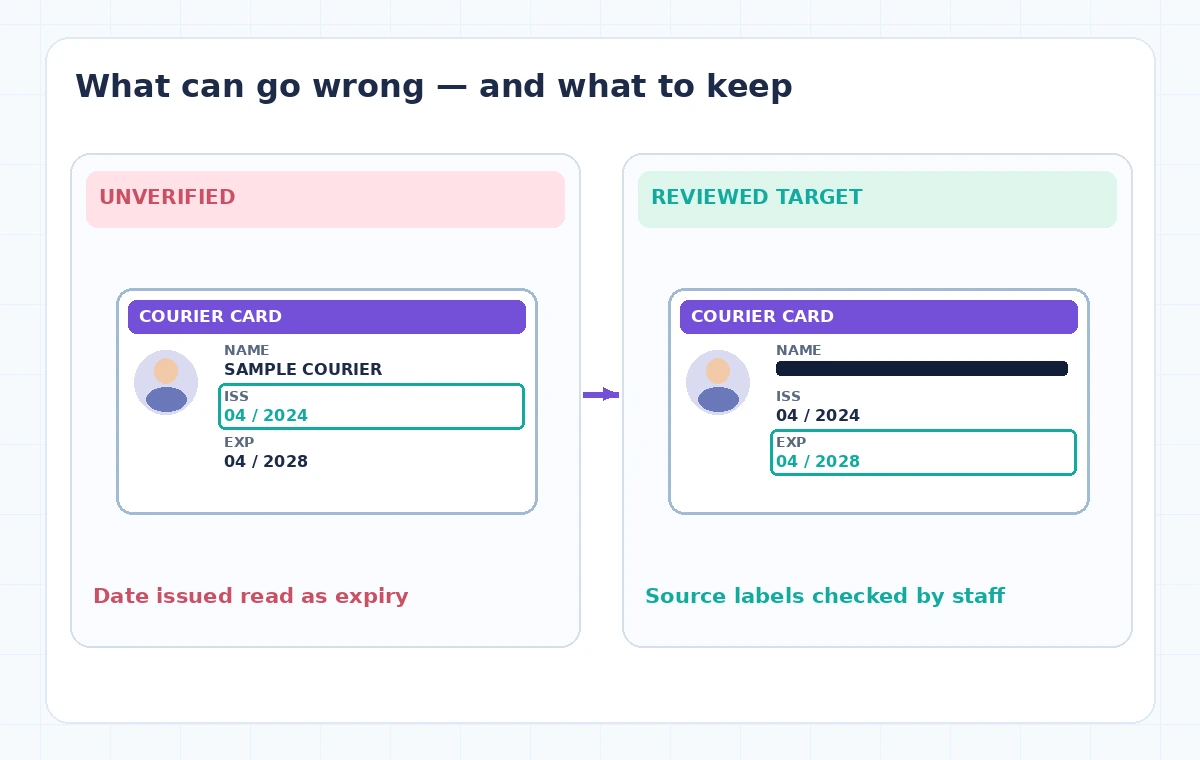
The most dangerous shortcut is to equate a parsed string with a verified credential. AnalyzeID does not establish that the ID is unaltered, current in an external registry, or presented by its owner. A careful reviewer may need to inspect the physical credential and follow the institution’s authorized process. The system must not label a person ‘identity confirmed’ because it extracted a plausible name and date.
In the conceptual illustration, an issue date is initially placed into the expiry slot. The corrected workflow compares printed labels, records an unresolved result when necessary, and leaves admission or collection release to a designated human. That example is drawn for teaching; it is not an observed extraction error.
Limit what persists after the handoff
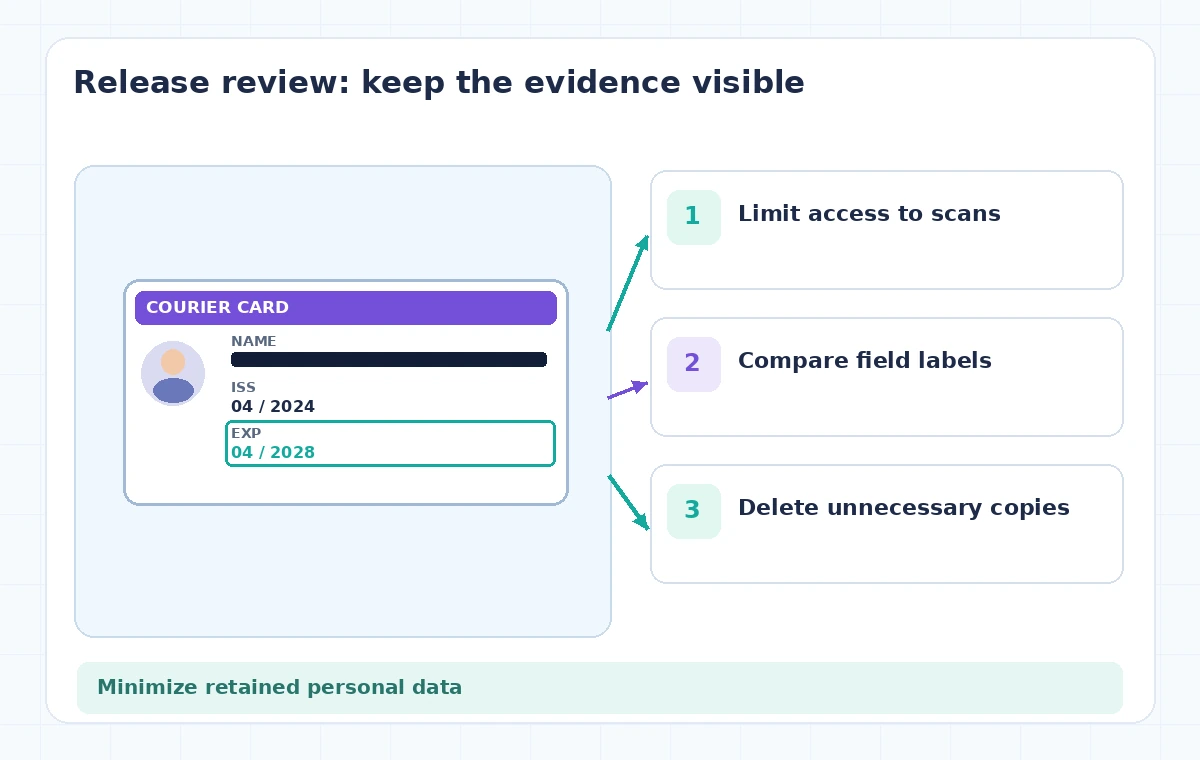
A museum may need an audit trail that records who reviewed the handoff and whether an authorized procedure was completed. It usually does not need to keep a new copy of every face, address, or ID number in an editorial database. Choose a minimal outcome record, such as reviewer, decision timestamp, policy version, and internal handoff reference, subject to the real retention requirement.
Separate deletion of temporary uploads from deletion of logs, previews, cached files and backups. Confirm the service’s current data-handling terms and the organization’s security configuration before using live IDs. A test report should show only fabricated sample data or an appropriately redacted record.
Evaluate with boundaries rather than speed claims
Build a permitted set of fictional images showing issue and expiry labels, front/back ambiguity, glare, and unsupported formats. Have trained reviewers label the correct fields independently. Measure field-level mismatches and how often the system returns insufficient evidence. A fast response or a high confidence score alone is not a reliable measure of operational readiness.
This guide did not submit an ID to Textract, measure an accuracy rate, or verify a real person’s identity. The documented feature performs extraction; the proposed human workflow supplies policy checks, source verification and data minimization. Do not use it as a legal compliance checklist or a replacement for professional privacy advice.
How We Research
For this November 2026 guide, we consulted the named official materials: Amazon Textract: AnalyzeID API, Amazon Textract: Analyzing identity documents, Amazon Textract: Analyze identity documentation. We compared documented prerequisites, intended use, failure modes and human review points to the fictional workflow described above. We did not run the commercial service, process real visitor records, collect participant speech, measure accuracy, or claim a vendor benchmark. Feature availability and costs depend on the actual account, region, supported model and current service terms; verify them before deployment.
Frequently Asked Questions
No. It extracts document fields and may attach confidence information. Authenticity and the presenter’s identity need a separate authorized verification process.
No. Compare issue, birth and expiration labels on the source, and leave ambiguous values for manual review.
No. Input may be supplied as bytes or a controlled S3 object. Retention is an organization-level decision and should be limited to actual need.
AWS documentation describes passing front and back images as document pages where appropriate. Supported formats and request limits should be checked in the current API reference.
Treat it as a mismatch. The source and authorized human procedure take precedence; do not silently change the record or approve the handoff.