
A fictional community arts organization uses an AI research agent to compare potential grant programs. After dozens of searches the transcript is crowded with old website extracts. A current rule says equipment costs are eligible only with written preapproval. The agent needs to keep working without losing this restriction while trimming irrelevant tool output. This is a design exercise, not an API benchmark or a real grant application.
Identify the authoritative decision before clearing anything
The research agent should begin with a stable decision record: the program title, source URL, publication or revision date, eligibility category, and the exact passage requiring written preapproval. Do not make the model reconstruct this rule from a remembered summary later. An organizer may reject a funding request if a tiny exception vanishes, even while most of the report remains fluent.
Preserve a compact source note in an application-controlled store that humans can inspect. Record whether the rule comes from current official guidance, an archived FAQ, or an email with limited authority. The note is not a substitute for reopening the source before a submission; it protects an important constraint when the agent eventually clears older browsing results.
Understand what context editing actually removes
Anthropic documents context editing for its Messages API as a beta mechanism for managing large histories. The server can clear older tool results or earlier thinking blocks before a request reaches Claude. The client keeps its original full message history. This is not the same as permanently deleting a file, erasing organizational records, or changing the underlying grant rules.
For research agents, tool-result clearing is the relevant mode because a long succession of page reads consumes tokens. Anthropic names the strategy clear_tool_uses_20250919. Cleared results are represented by placeholder text in the model-facing context. Before using the feature, check the required beta header, current eligible models, data-processing terms and deployment platform.
Choose a trigger and protect indispensable tools
Context editing has a configurable trigger and keep behavior. A documented default for tool-result clearing starts at 100,000 input tokens and retains three recent tool interactions. Those are defaults rather than a recommended safety threshold for every grant case. In a prototype, log usage trends first, then choose a threshold that leaves room for the model to finish and cite its response.
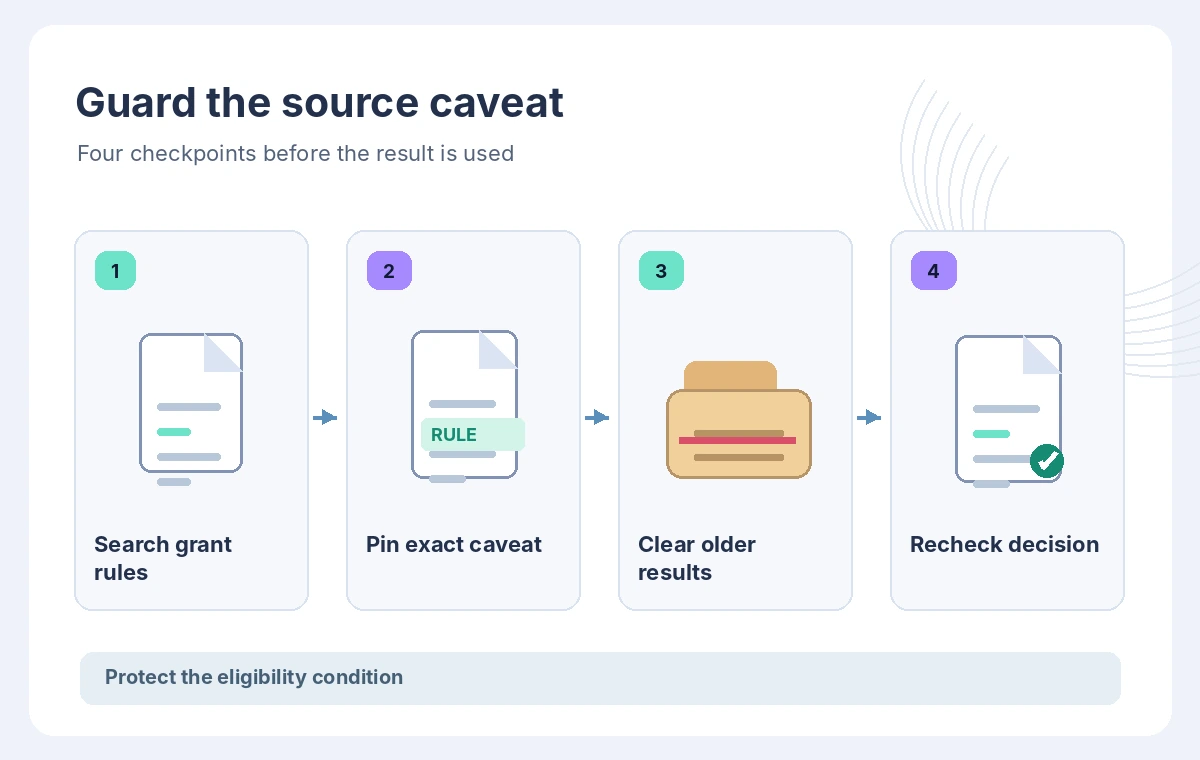
The exclude_tools option can preserve results from selected tools. If the application offers a specific verified-rules tool, consider excluding it; this reduces the chance that the authoritative eligibility quote is cleared alongside routine searches. Tool exclusion is not a provenance validator, however. An incorrect tool output remains incorrect even when deliberately kept in context.
Build an evidence ledger outside the prompt window
Set up a small structured record with source ID, official publisher, retrieved date, original quote, rule status and human review. The fictional program has an equipment-support page with an approval clause, while a past application example omits that clause. Give each document a separate entry and never merge the absence of a warning in an example into permission to ignore the real requirement.
Ask the agent to attach stable source IDs to its claims. If it loses a long page extract, it can fetch the specific official paragraph again rather than inventing an explanation. A diagram in this article shows search results flowing to a protected evidence ledger before older results are cleared. This is an architectural suggestion, not an observed Claude run.
Compare the misleading and controlled summaries
An unsafe draft might say, “Equipment purchases qualify under the program,” because the short summary omitted the preapproval condition. A controlled draft says, “Equipment may qualify if written preapproval is obtained; the applicant must verify the current process.” The second formulation is longer, but it carries the condition that determines what the organization can honestly claim.
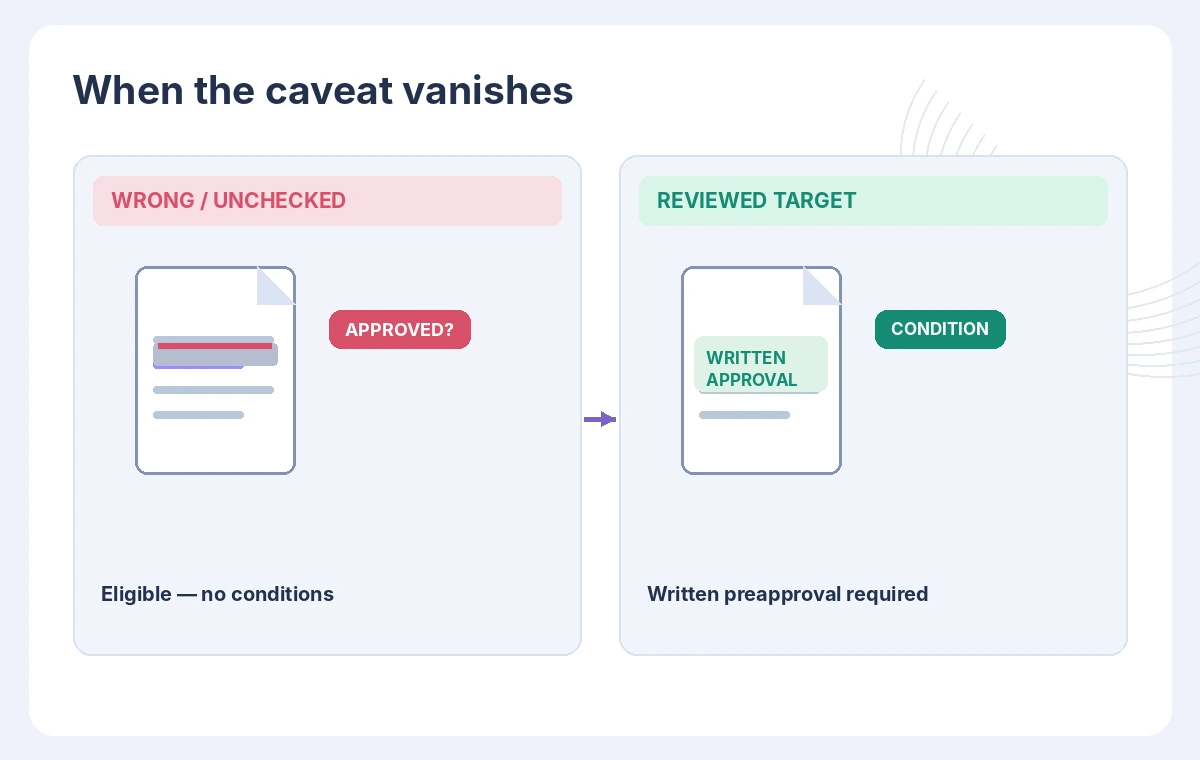
This difference must be checked by comparing actual cited text, not by trusting a green badge from the assistant. In a review table, mark every claim as directly supported, conditional, disputed or unresolved. If the only source is an old scraped page with no date, request fresh documentation rather than filling a gap with model confidence.
Inspect applied edits and cache trade-offs
The Claude response can include context_management.applied_edits with details of the edits applied and counts of cleared tool uses or input tokens. Log this signal with request identifiers, but never report a cleared-token total as proof that the agent kept every legal or grant-relevant detail. Token efficiency and evidentiary completeness are different measures.
Anthropic also notes that clearing tool results can invalidate a prompt-cache prefix and create new cache-write costs. The clear_at_least setting can help avoid tiny edits that are not worth that trade-off. Avoid publishing untested savings percentages or latency claims. Estimate costs from the current official pricing and your own controlled request logs.
Run a targeted regression suite
Before production, create questions that must still return the same caveat after a long search history: “Can equipment be bought before approval?” “Is the sample budget authoritative?” and “Which dated source supports this rule?” Test both a short thread and a deliberately long thread where clearing might activate. Evaluate the actual citation and the answer wording separately.
Also test an updated source that changes the eligibility language. If a rule is superseded, a persistent old ledger can become harmful unless a reviewer marks the replacement. The desired behavior is to acknowledge the change, point to current official terms and stop short of declaring that a hypothetical grant has been awarded.
Set the release boundary for research output
An executive summary is ready for internal review only when the grant name, eligibility scope, restrictions and dates map to verified source passages. Keep drafts distinct from submitted applications and never allow an agent to auto-send a funding request based solely on extracted text. Require approval for external emails, uploads and spending commitments.

For sensitive applications, compare the provider’s current beta eligibility, retention conditions and security obligations with your organization’s rules. This exercise does not claim access to an actual grant database or an executed context-editing call. A responsible workflow preserves uncertainty when the underlying source does not resolve a question.
How We Research
For this November 2026 article we reviewed the current official developer and support documentation: Anthropic: Context editing, Anthropic: Manage tool context. We compared documented feature scope, setup prerequisites, data flows, approval boundaries, and limitations that affect the proposed workflow. We did not execute an API request, connect an actual design file, reconcile business receipts, or edit real video. The examples, names, transaction amounts, approvals and outcomes are fictional; the drawings are original conceptual explanations, not product screenshots or benchmark results. Editorial checks and approval stages are recommended procedures, not guarantees supplied by the service. Review current provider documentation, billing, regional availability, privacy terms and the organization’s own policies before applying the process to sensitive records or live users.
Frequently Asked Questions
No. Anthropic says server-side edits change the context delivered to the model while the client continues to maintain its full message history.
The documented exclude_tools option can protect results from selected tools. You must still verify that those outputs are reliable and current.
Not necessarily. It can reduce context size, but clearing may invalidate a cached prompt prefix and introduce new cache writes.
It asks the API to clear at least a specified amount when an edit occurs, avoiding changes too small to justify their caching impact.
No. The grant case and response comparisons are hypothetical; they illustrate verification checkpoints, not measured model behavior.