
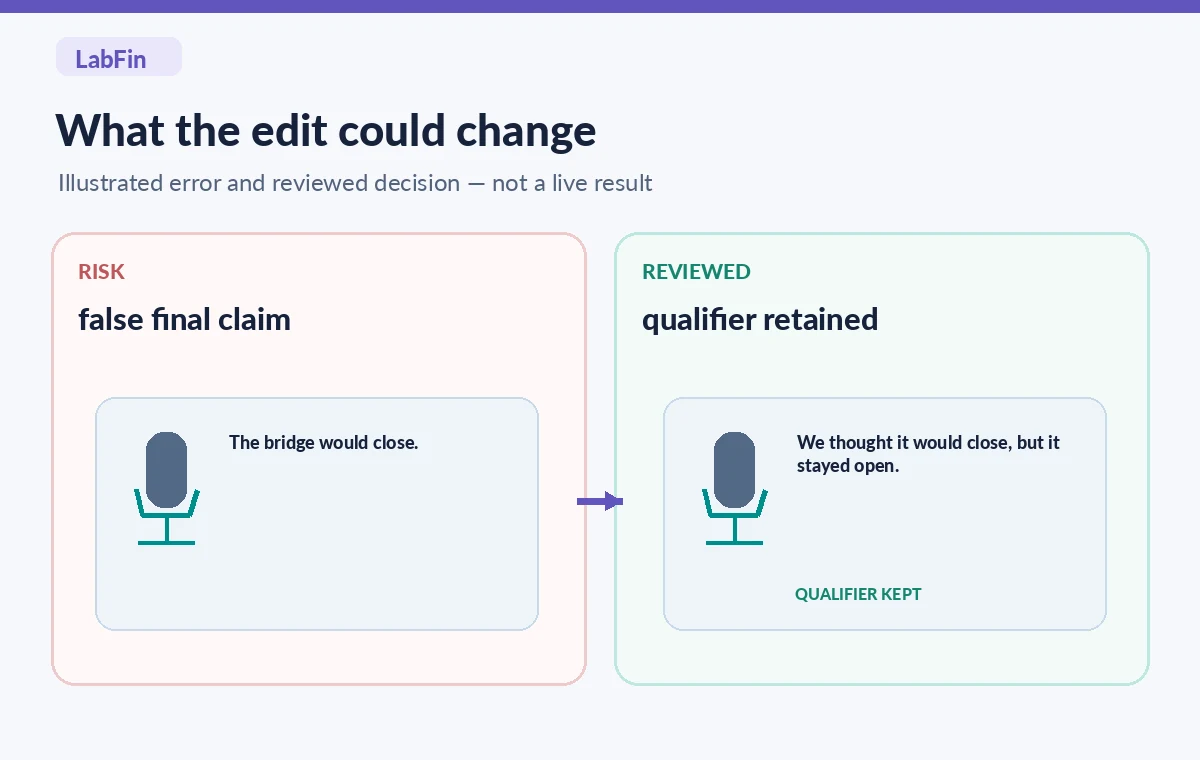
An oral-history interview is often much longer than the short excerpt a local museum can share. Editing by transcript seems convenient: highlight a sentence and remove it, and the video edit follows. But one discarded qualification can reverse a speaker’s meaning. Imagine an interviewee saying, ‘We thought the bridge would close, but it stayed open through winter.’ A careless cut might leave only ‘the bridge would close.’ Riverside’s transcript-based editor offers a productive route to a shorter interview, provided the original recording remains authoritative and the editor checks every quote in context. This guide uses an invented interview example, not an actual participant’s testimony.
Know the difference between transcript edits and quote approval
Riverside’s documentation explains that its editor automatically makes a transcript that can be used to remove sections or words from the recorded media. The editor displays removed text as struck-through material that can be restored; it also offers timeline editing for frame-accurate refinement. This gives editors a clear first pass, but the transcript is a machine-generated representation of speech. It may mishear names, dates, pauses, or a quiet negative. Removing text from the recording therefore requires more care than deleting an ordinary sentence from a memo.
Treat every published phrase as a quotation that must survive comparison with the source audio. An interviewee’s intent depends on emphasis and neighboring sentences, not just grammatical correctness. The words ‘we thought’ and ‘but’ can be essential to a factual claim. An editor who deletes them to shorten runtime risks presenting a prediction as an event that actually happened. Automated transcription can help locate the passage; it cannot certify its historical accuracy or editorial fairness.
Secure consent, source audio, and an edit log
Confirm what the interview subject consented to: recording, public clips, subtitles, attribution, and any sensitive topics. Use the organization’s actual release agreement; do not assume a participant’s consent to a long archive interview also covers promotional social clips. Preserve the original audio and video, the recorded date, speaker names as approved, and a source timecode for every proposed excerpt. Restrict access to unedited recordings where the release requires it.
Create an edit decision log with original start/end timecodes, the exact approved quote, reason for shortening, and reviewer sign-off. Working from a transcript can tempt editors to forget gestures or interruptions. Flag overlap with a second speaker and any place where a pause is informative. The log should make it possible for another curator to replay the original and understand why the clip was shortened, even if the project’s editor interface later changes.

Make the first transcript-based cut
Open the Riverside recording in its editor or upload approved outside media using the documented upload process. Review speaker assignments before using the transcript. Select a clearly disposable section, such as a long unrelated setup that is already covered elsewhere, then use the transcript’s delete function. Riverside documents that removed text remains visible in a gray strikethrough and can be clicked to restore it or used as a basis for refining the cut in the timeline. Keep the first version of the edit as a reversible working draft.
Use the AI tool selection checklist
Do not begin by deleting hedges, negations, or interruptions within the main historical claim. Start and end cuts at complete thoughts. If the material contains a personal anecdote about the bridge, choose a self-contained sequence that still includes the speaker’s uncertainty and later correction. The process diagram separates approved source, transcript selection, and contextual review. It does not pretend the editor can infer the subject’s approved interpretation from word matching alone.
Compare the original claim with the shorter edit
Read the proposed excerpt aloud while listening to the untouched recording. Underline each qualifier, negative, approximate date, and attribution. In the fictional bridge story, both ‘we thought’ and ‘but it stayed open’ are indispensable. An edit that combines distant phrases into one sentence may be syntactically smooth yet deceptive. Listen for changes in background sound or voice position that reveal a hard jump. A misleading transition can imply consecutive speech that did not occur.
The visual comparison here illustrates a bad cut that leaves ‘The bridge would close’ and a contextual excerpt that preserves the reversal. These are deliberately authored examples rather than results of a live Riverside test. When the original answer is genuinely contradictory, do not silently repair it by splicing together agreeable words. Either keep enough context for the audience to hear the uncertainty or ask the speaker whether a clarification can be recorded under the consent agreement.
Refine pacing in the timeline and review captions
Once a context-safe rough cut exists, use the timeline to inspect edit boundaries, breaths, and overlapping speech. Riverside’s support materials distinguish editing the transcript from editing the timeline, so switching views is part of the documented workflow. Avoid cuts that clip the first consonant of a new thought. Small pauses can reveal hesitation or emphasis in an oral history; silence is not automatically dead air. A tighter video may benefit from a short visual cutaway only when that material is authentic and clearly attributable.
See how to combine AI tools safely
Regenerate or correct captions from the final edited audio rather than blindly copying an earlier full-length transcript. Confirm spelling of the bridge name and other places against the museum’s notes, but do not alter what the person actually said to fit an external record. A corrected caption should be a faithful transcription, not a rewritten quote. Check text visibility on a phone, speaker turns, punctuation, and any summary text that might accidentally overstate what the clip establishes.
Approve the excerpt as a historical source
Have a reviewer who did not make the edit compare the published excerpt to the uncut recording at the exact logged timecodes. Use three distinct checks: factual wording, conversational context, and consent/public-use scope. A subject-matter expert can verify independent claims about the bridge; they cannot retroactively change the speaker’s actual words. If a claim is contested, an editorial note or surrounding narration may be appropriate, but it must be clearly separate from the recorded quotation.
Export a high-quality master and a distribution copy, recording version names and the approval date. Inspect the finished file for missing captions and audio/video sync rather than trusting the preview alone. Keep the original recording available under the archive’s retention policy. The safest workflow leaves a reversible trail from the final 35-second clip back to the hour-long source, so a reader or curator can verify its provenance later.

Avoid shortcuts that change meaning
Transcript-driven removal is less suitable when speakers interrupt one another, use heavy dialect, or make a claim whose qualification appears several minutes later. In those cases a manually selected longer excerpt or written transcript with editorial annotations can be more faithful. Do not create synthetic bridging speech or label a paraphrase as an archival quote. If the interviewee’s identity, consent, or rights are uncertain, do not release the excerpt while those matters remain unresolved.
No interview was uploaded to Riverside or shortened for this article. We did not conduct audio listening tests, assess a real consent form, or certify any historical claim. The diagrams are original hypothetical examples intended to focus the review on the lost ‘but’ and the cut boundary. The practical release condition is a documented comparison of final media to original source, with a human deciding that no important meaning has been changed.
How We Research
We checked Riverside’s transcript section-removal help page, editor feature overview, and transcription support index. Those sources support the remove/restore workflow and the distinction between transcript and timeline edits. The interview and quote were invented for instruction; no real subject, recording, output, consent, or quote-verification result is asserted.
Frequently Asked Questions
Riverside documents transcript-based removal that affects the edited recording. The deleted passage remains represented as struck-through text that can be restored.
Transcript corrections and media edits are different operations. Check the actual Riverside editor mode and compare captions with the unchanged audio before publishing.
It preserves context, exact speech, consent evidence, and timecodes. A reviewer needs the complete source to verify whether the shorter excerpt reverses or distorts a claim.
Not if doing so changes meaning. Preserve qualifiers, negation, and later corrections, or choose a longer self-contained excerpt that represents the person fairly.
Review both audio tracks and the timeline manually. Machine transcript selection alone may not preserve the order or context of overlapping remarks.