
Disclosure: LabFin is reader-supported. If you sign up for a tool through links on this page, we may earn a commission at no extra cost to you. Commissions vary between providers and our ratings do not — here’s our full disclosure.
How to use AI without sounding like AI comes down to substance more than word swaps. In a 2025 study, people who often write with ChatGPT spotted AI text by its vocabulary, but also by its formality and lack of original detail.
By majority vote, five such readers made just one error across the whole test set, even after paraphrasing and “humanizer” tools. So the fix is not a better disguise. Instead, it is putting back what a model cannot invent: your specifics, your opinions and your experience.
How to Use AI Without Sounding Like AI: The Short Answer
Draft from your own notes, and use AI to structure and edit rather than to invent. Then cut the stock vocabulary, add details only you know, vary the rhythm and read the result aloud.
Don’t rely on humanizer tools. In the same study, experienced readers still caught humanized AI text, and they beat most automated detectors. Detectors also misfire the other way: one Stanford study found they flagged most essays by non-native English writers as AI.
What Gives AI Text Away
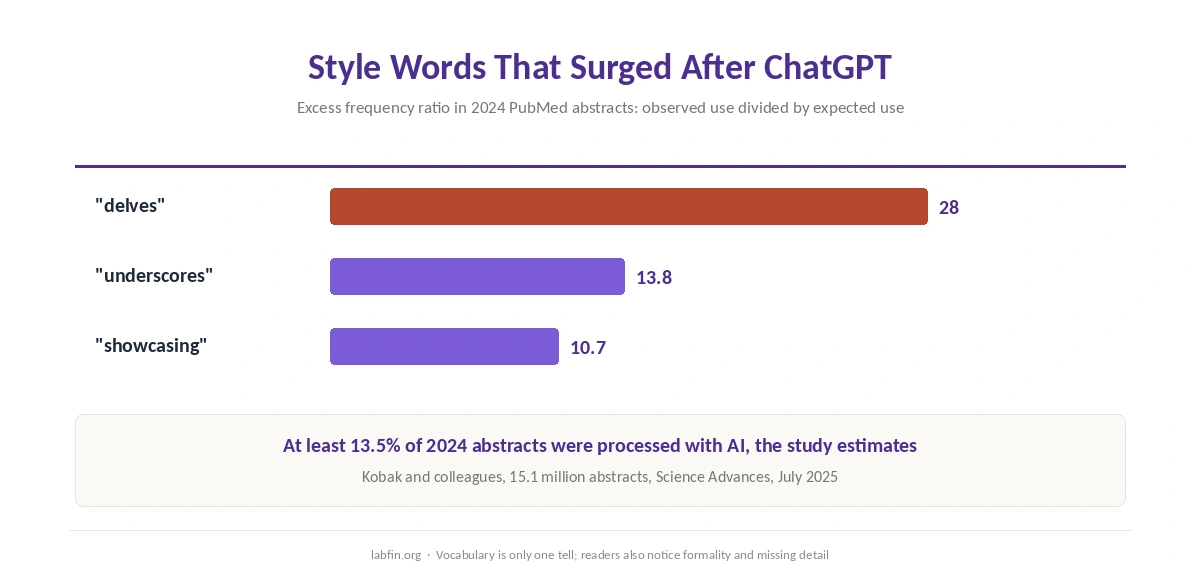
The clearest evidence comes from research abstracts. Dmitry Kobak and colleagues studied 15.1 million PubMed abstracts and found that certain style words surged after ChatGPT arrived. In 2024, for example, “delves” had an excess frequency ratio of 28, “underscores” 13.8 and “showcasing” 10.7, meaning observed use divided by expected use.
From those words alone, they estimated that at least 13.5% of 2024 abstracts were processed with AI, Science Advances published in July 2025. Unlike the pandemic’s excess words, which were nouns such as “respiratory”, these were mostly verbs and adjectives about style.
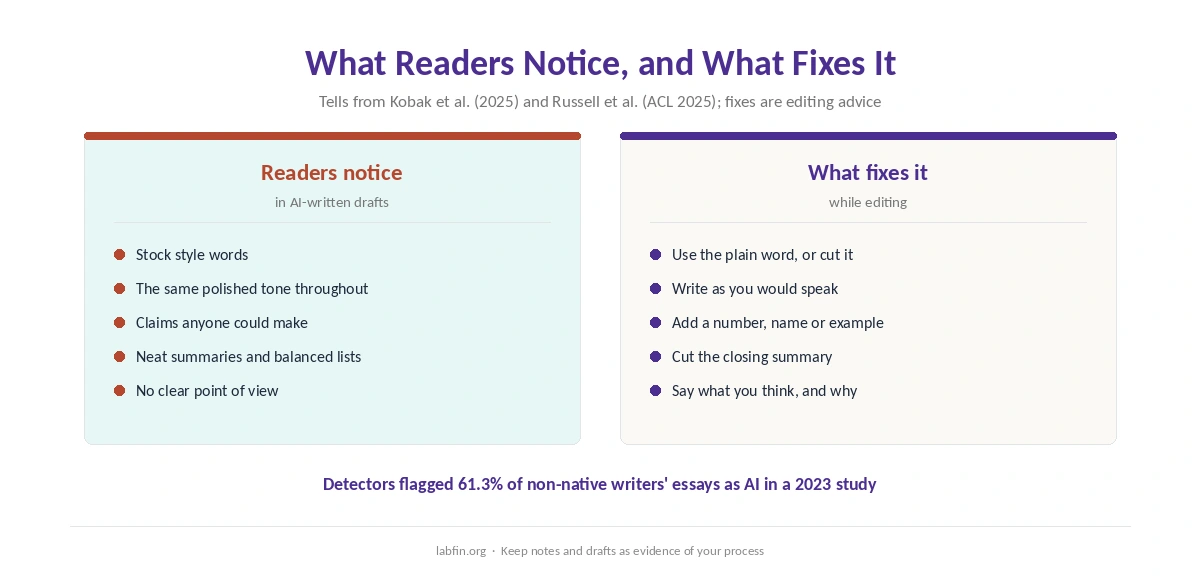
Vocabulary is only one tell, however. Jenna Russell and colleagues found that expert readers also noticed formality, a lack of originality and an even, tidy clarity that automated detectors struggle to measure. Their paper appeared at ACL 2025.
| What readers notice | Example | What fixes it |
|---|---|---|
| Stock style words | delves, underscores, showcasing, crucial | The plain word, or nothing |
| Even formality | Every paragraph in the same polished tone | Write as you would speak |
| No original detail | Claims anyone could make | A number, a name, an example you saw |
| Tidy symmetry | Neat summaries and balanced lists | Cut the summary; break the pattern |
How to Use AI Without Sounding Like AI, Step by Step
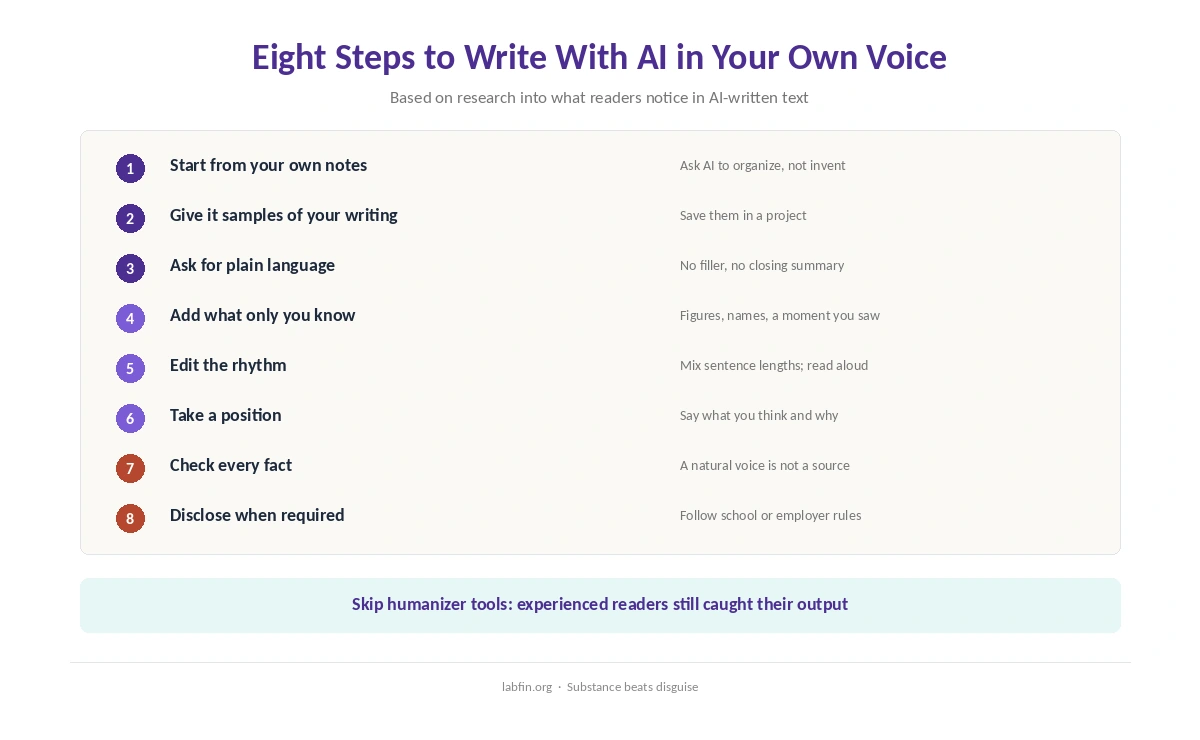
1. Start from your own notes. Write down what you know, think and have seen, even as rough bullet points. Then ask the AI to organize them, not to supply the ideas.
2. Give it samples of your writing. A project in ChatGPT or Claude can hold a few pieces you wrote, plus standing instructions about tone. Our guides to ChatGPT for writing and Claude for writing cover that setup.
3. Ask for plain language. Tell the model to avoid filler words and summaries, and to prefer short, concrete sentences. Even so, check the draft, because instructions reduce the tics rather than remove them. Our guide to writing better prompts covers clear instructions.
4. Add what only you know. Put in figures from your own work, names, dates and a moment you witnessed. These details are the clearest sign of a human author, and they also make the piece more useful.
5. Edit the rhythm. Mix short and long sentences, cut the closing summary, and remove hedges that say nothing. Then read the piece aloud, because stiff phrasing is easier to hear than to see.
6. Take a position. AI drafts tend to balance every view. Say what you think and why, and keep the caveats that actually matter.
7. Check every fact. A natural voice does not make a wrong figure right. Our guide to fact-checking AI output sets out the checks, and our page on reducing hallucinations covers prevention.
8. Disclose when the rules require it. Schools, journals and some employers have AI policies, so follow them rather than trying to hide AI use. Our list of the best AI for students notes which tools suit coursework.
Why Humanizer Tools Are the Wrong Fix
Humanizer tools rewrite AI text to slip past detectors. Yet Russell’s expert readers still caught paraphrased and humanized articles, and their majority vote outperformed most commercial and open-source detectors tested. Rewording, in other words, hides the vocabulary but not the missing substance. The better way to use AI without sounding like AI is editing, not disguise.
Detectors are a poor target anyway. In 2023, Weixin Liang and colleagues at Stanford tested seven detectors on TOEFL essays by non-native English writers. On average, the detectors labeled 61.3% of those human-written essays as AI, while classifying native writers’ essays almost perfectly, the journal Patterns reported.
⚠️ So a detector score says little about who wrote a text, especially for non-native writers. If a school or client uses one, keep your notes and drafts as evidence of your process.
Search Engines and Your Readers
Google’s Search Central guidance says it rewards helpful content however it is produced, while mass-produced pages made mainly to rank count as spam. Therefore, the goal is the same for search and for readers: original, accurate and useful writing.
For specific formats, see our list of the best AI for blogging. For messages, our list of the best AI for email writing compares the options. Students can also check our guide to ChatGPT for students for study-friendly settings.
How We Research
This guide on how to use AI without sounding like AI draws on Kobak and colleagues’ study in Science Advances, July 2025, the ACL 2025 paper by Russell and colleagues, and Liang and colleagues’ study in Patterns, 2023. We read them on October 2, 2026.
Google’s position comes from its Search Central documentation. We run no tests of our own, and our about page explains how we source. For tools that protect your manuscript, see our list of the best AI tools for writers.
AI Writing That Sounds Human: FAQ
Start from your own notes, give the AI samples of your writing, and cut stock words. Then add details only you know, vary sentence length and read the piece aloud before you publish.
Research on PubMed abstracts found style words such as “delves”, “underscores” and “showcasing” surged after ChatGPT arrived. Readers also notice even formality and a lack of original detail.
Not against experienced readers. In a 2025 study, frequent ChatGPT users still caught humanized AI text, and their majority vote beat most automated detectors.
They vary, and some misfire badly. A 2023 Stanford study found seven detectors flagged 61.3% of essays by non-native English writers as AI on average, while classifying native writers correctly.
Google says it rewards helpful content however it is made, but treats mass-produced pages made mainly to rank as spam.
The Verdict
To use AI without sounding like AI, write the parts AI cannot: your knowledge, your examples and your view. Let the model organize and tidy, then cut its stock phrases and read the result aloud.
Skip humanizer tools and detector scores. Experienced readers see through the first, and the second misfire too often to guide you.