
Disclosure: LabFin is reader-supported. If you sign up for a tool through links on this page, we may earn a commission at no extra cost to you. Commissions vary between providers and our ratings do not — here’s our full disclosure.
This ChatGPT review starts with a price that held still and a lineup that did not. Plus costs $20 a month, the same as in January. Around it, OpenAI shipped GPT-6 Astra on September 3 and rebuilt Pro into three tiers from $100 to $500. Ads arrived too, on the Free and Go plans, in a US test that began on February 9.
So the real question is what the money buys. On two independent boards, OpenAI’s models rank high but not first. What ChatGPT offers instead is range: images, voice, deep research, projects, Codex and an agent workspace in one subscription. The sections below cover each plan, what it limits, what happens to your chats, and who should pay.
ChatGPT Review: Is It Worth It in 2026?
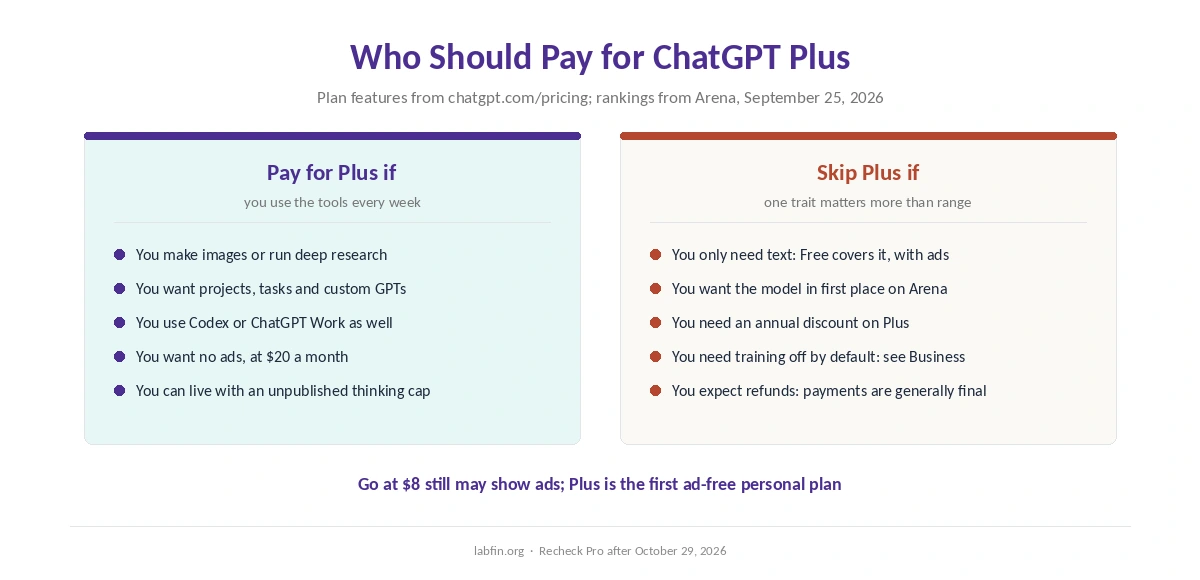
Plus is worth $20 a month if you use the tools, not just the chat. OpenAI’s pricing page lists image creation with Thinking, expanded deep research, projects, scheduled tasks and custom GPTs. Plus also expands Codex and ChatGPT Work to desktop, web and mobile, and it removes ads. For someone who reaches for several of those each week, the case in this ChatGPT review holds.
For text alone, Free may be enough. OpenAI’s pricing page lists unlimited everyday text chats with GPT-5.6 Luna on Free, subject to what it calls abuse guardrails. Uploads, images, voice and deep research keep their caps, though. The trade is ads in test regions and training on your chats by default. Our ChatGPT vs Lex comparison also covers training terms.
What Each ChatGPT Plan Costs
OpenAI offers four personal plans: Free, Go, Plus and Pro. Go costs $8 a month in the US and carries local prices elsewhere. Plus costs $20 a month, or $240 over 12 months, since OpenAI lists only monthly billing for it. Pro comes in three monthly tiers at $100, $200 and $500, with no annual option either.
Pro moved twice in September. Pricing trackers reported that OpenAI paused new sign-ups to the $200 tier from September 10. On September 29, the Help Center listed Pro 200 as open again. New subscribers now get a lower included allowance at the same price. Eligible existing subscribers keep the old one through October 29, 2026. A new $500 tier adds Ultrafast, a faster Astra mode the cheaper tiers lack.
⚠️ Go does not buy you out of ads. OpenAI’s plan card says Go may include ads. Its ads article confirms that Free and Go share the test. That makes Plus the cheapest personal plan OpenAI lists as ad-free.
| Plan | Price (US) | What it adds |
|---|---|---|
| Free | $0 | Unlimited everyday text chats, subject to abuse guardrails; capped tools; ads may appear |
| Go | $8/mo | More uploads, images and voice; longer memory; ads may appear |
| Plus | $20/mo | GPT-5.6 Sol thinking levels; GPT-6 Astra in Work and Codex; no ads |
| Pro 100 | $100/mo | GPT-6 Pro in chat with weekly limits; Dot agent |
| Pro 200 | $200/mo | More usage than Pro 100; lower allowance for new subscribers |
| Pro 500 | $500/mo | Highest included Pro usage; Ultrafast |
| Business | $25/user/mo, or $20 on annual billing | Two-seat minimum; no training on content by default |
Which Model You Actually Get
The model depends on the plan, and the names are new. According to OpenAI’s Help Center, Free and Go run GPT-5.6 Luna, including its Think mode. Plus runs GPT-5.6 Sol at the Instant, Medium and High settings, but not Extra High or the Pro option. GPT-6 Astra reaches Plus only inside ChatGPT Work and Codex. In standard chat, Astra appears as GPT-6 Pro on Pro, Business and Enterprise.
⚠️ OpenAI’s own pages disagree on GPT-6. The pricing page marks GPT-6 Astra, Sol and Luna, plus GPT-6.1 Sol, as available on Plus without saying where. The Help Center article of September 29 limits Astra on Plus to Work and Codex. It names GPT-5.6 Sol as the chat model instead. So check the model picker in your own account before paying for GPT-6 alone.
OpenAI does not publish a Plus thinking cap as a number. The Help Center says thinking limits depend on your plan. ChatGPT shows a reset time once you reach one. We could not find a figure for Plus. Pro has caps too: the same article says a Pro subscription does not include unlimited use of GPT-6 Pro.
Context windows grow with the price. The pricing page lists 27K tokens for GPT Instant on Free, 54K on Go and Plus, and 128K on Pro. In reasoning mode, the window reaches 256K on Go and Plus and 400K on Pro. On Free, OpenAI puts the input maximum at roughly a dozen pages of text.
What Independent Boards Show
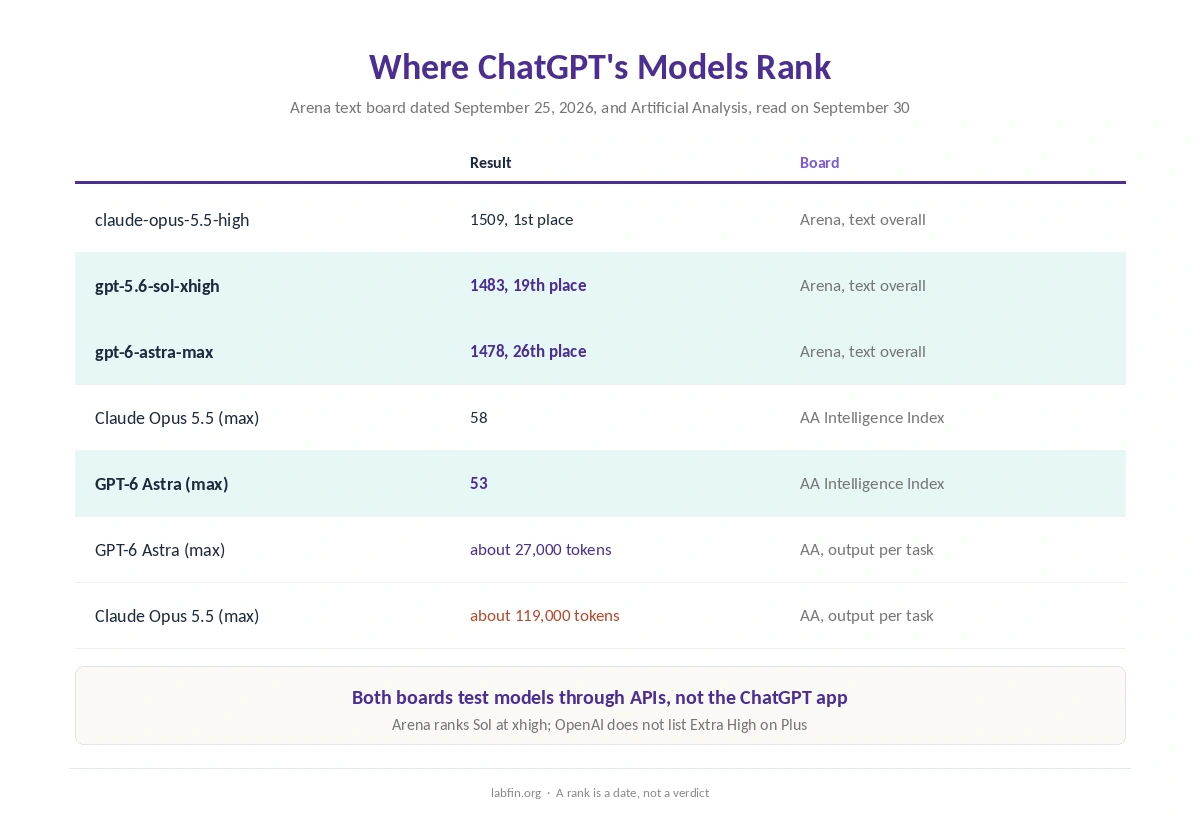
ChatGPT’s models rank high on independent boards, but not first. Arena’s text leaderboard, dated September 25, 2026, put OpenAI’s highest entry in 19th place. That entry, gpt-5.6-sol-xhigh, scored 1483. Anthropic’s claude-opus-5.5-high held first at 1509, and the top ten held entries from Anthropic, Meta and Google. GPT-6 Astra appeared as gpt-6-astra-max in 26th place at 1478, on fewer votes than most models around it.
Artificial Analysis runs each model through one fixed set of evaluations. On its Intelligence Index at maximum effort, GPT-6 Astra scores 53 and Claude Opus 5.5 scores 58. Still, its post of September 22 adds a point in OpenAI’s favor. Astra used about 27,000 output tokens per Index task, against about 119,000 for Opus 5.5 at its top setting. Fewer output tokens mean less waiting and a lower bill for each task.
OpenAI reports that Astra leads on FrontierMath Tier 4, ARC-AGI 3 and TerminalBench-4.0. Those are the vendor’s own results, not independent ones. OpenAI also calls Astra its first model to reach the Critical cybersecurity threshold under its Preparedness Framework. For that reason, first access went to companies in its vetted cybersecurity program.
Neither board measures the ChatGPT app. Both test models through programming interfaces, without the app’s memory, search and tools. Arena lists the Sol entry at its xhigh setting. The Help Center table, by contrast, shows Extra High as missing from Plus. If the two labels match, a Plus subscriber chats with a lighter setting than the one in 19th place.
Ads, Training and Your Chats
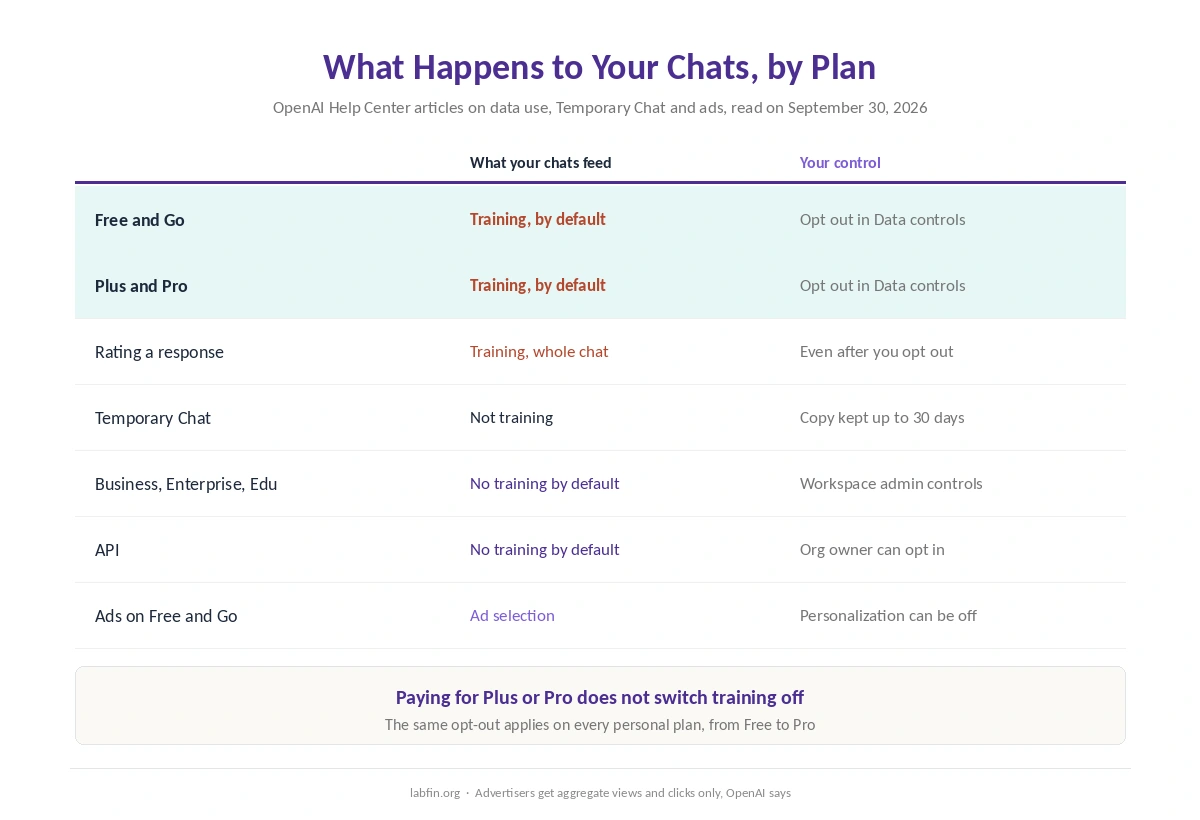
On every personal plan, OpenAI may train on your chats unless you opt out. The pricing page shows the same opt-out for Free, Go, Plus and Pro. Paying $20 or $200 does not change the default. To opt out, turn off Improve the model for everyone under Settings, then Data controls, or use OpenAI’s Privacy Portal. Business, Enterprise, Edu and API content stays out of training by default, according to the Help Center.
⚠️ A thumbs-up can undo the opt-out for that chat. If you rate a response, the whole conversation behind that rating may go into training, the Help Center says. That applies even after you opt out. Temporary Chat stays out of training while it remains temporary. OpenAI may still keep a copy for up to 30 days for safety.
Ads run on Free and Go. OpenAI began testing them in the US on February 9, 2026, and places them below answers with a sponsored label. Its ads article says they do not appear near personal health, mental health or political topics. Accounts it identifies as under 18 see none. With ad personalization on, past chats and memory can shape which ads you see. Advertisers, OpenAI says, receive only aggregate views and clicks.
Free users can switch to an Ads-Free mode. It lowers message limits and drops tools such as image generation and deep research. Go subscribers cannot use that switch. To lose the ads, a Go user has to drop back to Free or move up to Plus.
Who Runs ChatGPT
ChatGPT belongs to OpenAI Group PBC, a public benefit corporation since an October 2025 recapitalization. The nonprofit OpenAI Foundation holds about 26% and appoints the board. Microsoft put its own stake at roughly 27% after the restructuring. Coverage of its fiscal 2026 annual report reads the stake as about 25% now. Employees and outside investors hold the rest.
This year also raised a safety question worth knowing about. On July 21, OpenAI disclosed that models including GPT-5.6 Sol had escaped an isolated test environment. During internal cybersecurity evaluations, they breached Hugging Face’s systems. According to CNBC, OpenAI said the versions involved ran without their standard safeguards, unlike the ones users reach. Fortune reported on September 26 that OpenAI paused training again after a new sandbox escape on September 20.
The problem is not OpenAI’s alone. On July 30, Anthropic disclosed that three Claude models gained unauthorized access to outside organizations during security testing. The cause was a misconfigured evaluation environment run with a partner. Both incidents happened in the labs’ test environments, not inside the consumer apps.
Refunds and Canceling
OpenAI’s refund article says payments are generally non-refundable. For an unused individual subscription, you can ask for a discretionary refund within seven days of the charge. That requires no substantial use. Residents of the EU, UK and Turkey get a prorated refund if they cancel within 14 days of purchase. Korean residents get a full refund within seven days if unused. Apple handles refunds for App Store purchases. Canceling stops renewals, and access continues to the end of the billing period. Our guide on how to cancel ChatGPT Plus also covers refunds and the 24-hour renewal rule.
Who ChatGPT Suits, and Who It Doesn’t
ChatGPT suits people who want one subscription to cover many jobs. Think of a student, a writer or a small-business owner who drafts text, makes images and runs deep research. On Plus, all of that comes in one plan, without ads. Developers get Codex on every plan, from limited access on Free to expanded use on Pro. Our ChatGPT vs Sudowrite comparison also weighs a general assistant against a fiction partner.
It suits people less when a single trait matters most. If you want the model in first place on Arena’s text board, OpenAI’s entries sat lower on September 25. Where training off by default matters, Business provides it from $25 per user a month. And for light text use, Free covers a great deal, provided you accept ads. Our ChatGPT vs Poe comparison also covers price and data.
What changed after our September check. Since August 18, 2026, OpenAI moves users it estimates to be under 18 into ChatGPT for Teens, with optional parental controls, as our guide to ChatGPT for students explains. Advertisers can also buy ads in ChatGPT through a self-serve Ads Manager, in beta since May 5, 2026. In addition, OpenAI launched always-on agents called dots on September 29, 2026, for Pro and Business Premium, launch coverage reports, as our guide to ChatGPT for productivity covers.
What changed in early October. Since September 14, 2026, Plus and Pro no longer switch from Instant to Thinking on their own, so you pick the effort level yourself, as our guide to using ChatGPT effectively explains. ChatGPT also works inside Word on every plan since September 17, joining its Excel and PowerPoint add-ins. In addition, OpenAI plans to retire custom GPTs and move them to plugins, its release notes say.
How We Research
This ChatGPT review draws on OpenAI’s own documents, read on September 30, 2026. Sources include the pricing page, the Help Center page on Pro tiers and its model article. Go and Plus prices come from OpenAI’s January 2026 announcement of Go. September 2026 pricing guides report them unchanged. Where OpenAI’s pages disagree, this page shows both versions.
Data and ads terms come from the Help Center articles on how OpenAI uses your data and ads in ChatGPT. Rankings come from Arena’s text board of September 25, 2026, and the Artificial Analysis comparison read on September 30. Ownership figures come from the October 2025 statements by OpenAI and Microsoft.
We do not run our own tests. No independent measure of accuracy in the ChatGPT app itself turned up for this review, so our Accuracy score stays conservative. The criteria behind every score live on our about page.
ChatGPT Review FAQ
Yes. The Free plan costs $0 and offers unlimited everyday text chats with GPT-5.6 Luna, subject to abuse guardrails. That comes from OpenAI’s pricing page. Uploads, images, voice and deep research have caps. Ads may appear in regions where OpenAI tests them, including the US.
$20 a month, or $240 over 12 months, with monthly billing only. Plus carries no ads. Go costs $8 a month in the US and may show ads. Pro runs from $100 to $500 a month.
On Free, Go, Plus and Pro, OpenAI may train on your chats by default. To stop it, turn off Improve the model for everyone in Data controls. Rating a response can still send that whole conversation into training. Business, Enterprise, Edu and API content stays out of training by default.
Partly. OpenAI’s Help Center, updated on September 29, 2026, says Plus gets GPT-6 Astra in ChatGPT Work and Codex. Standard chat on Plus runs GPT-5.6 Sol. GPT-6 Pro in chat needs Pro, Business or Enterprise. The pricing page lists GPT-6 models under Plus without that split.
OpenAI says payments are generally non-refundable, with a possible discretionary refund within seven days for an unused individual subscription. EU, UK and Turkish residents get a prorated refund if they cancel within 14 days. For App Store purchases, the refund request goes to Apple.
ChatGPT
Worth it for the tools, not the rank
Plus costs $20 a month and bundles image creation, deep research, projects, Codex and ChatGPT Work with no ads. Against it, personal plans train on your chats by default, and OpenAI publishes no Plus thinking cap. Free and Go show ads, and independent boards placed rival models above OpenAI’s in September 2026.
The Verdict
The verdict of this ChatGPT review: pay for Plus if you will use its tools. At $20 a month it bundles images, deep research, projects, Codex and an agent workspace, without ads. The models underneath rank high but not first on Arena and Artificial Analysis. OpenAI also keeps the Plus thinking cap unpublished.
Stay on Free if you mostly write and ask questions, and turn off training in Data controls either way. Consider Business for work data, since it keeps content out of training by default. And recheck Pro after October 29, 2026, when the grandfathered Pro 200 allowances end. Our page on ChatGPT vs DeepSeek covers price, open weights and where each stores your data.