
The current object is not necessarily the approved version
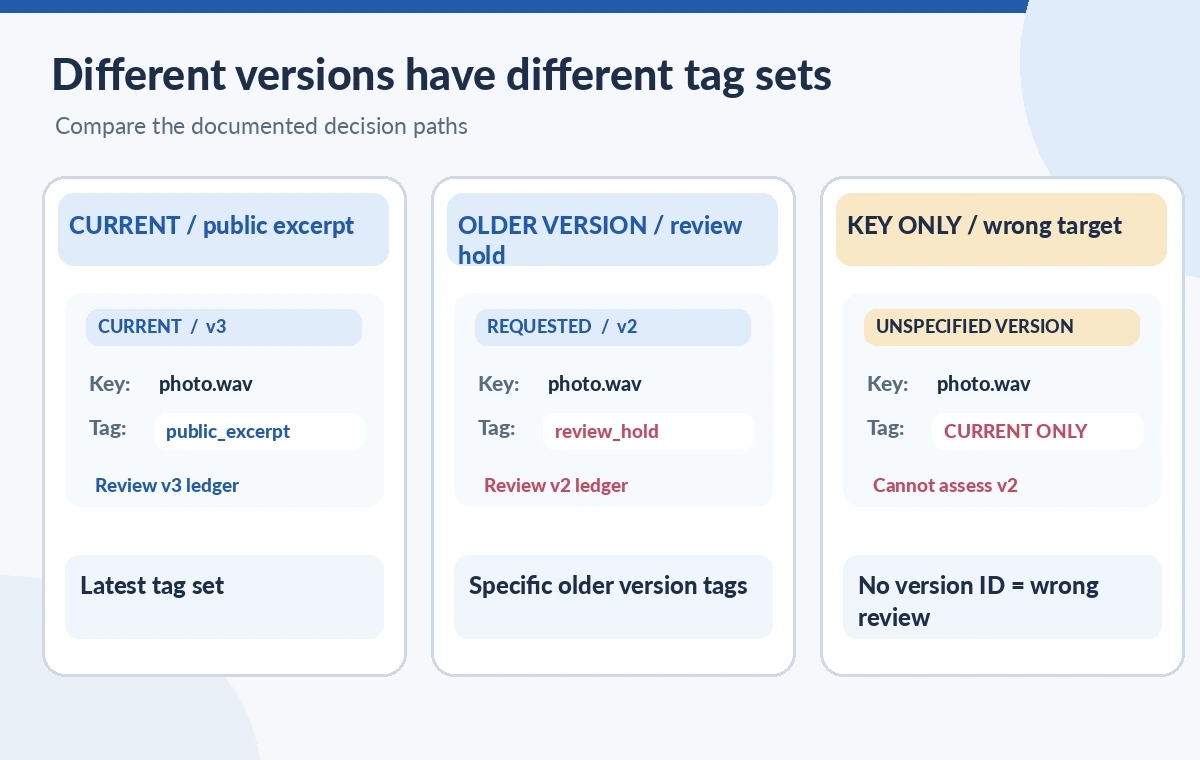
Suppose a museum maintains an audio interview in a versioned S3 bucket. A revised public excerpt is approved, while the full recording is restricted. The same object key can have different versions with different tag sets. An application that reads only the latest object tags risks attaching the latest rights label to an older recording. GetObjectTagging returns the tag set on an object; by default the operation targets the current version. A version-aware rights check must record the intended version ID and retrieve that version’s tags, then use the archive’s authoritative rights register for the actual release decision.
Read the tagging subresource, not the object body
GetObjectTagging is a GET against the object’s tagging subresource. Its response contains key-value tags rather than the file bytes. That makes it suitable for a bounded metadata inventory, but it does not prove that audio has been transcribed correctly, that a consent form is valid or that the object itself can be distributed. Distinguish S3 object tags from user-defined object metadata, bucket-level configuration, ACLs and Object Lock controls. The same word “rights” can appear in several systems with different meaning. Keep one authoritative review ledger and link S3 tags to it as informative attributes rather than legal conclusions.
Specify versionId when reviewing an older generation
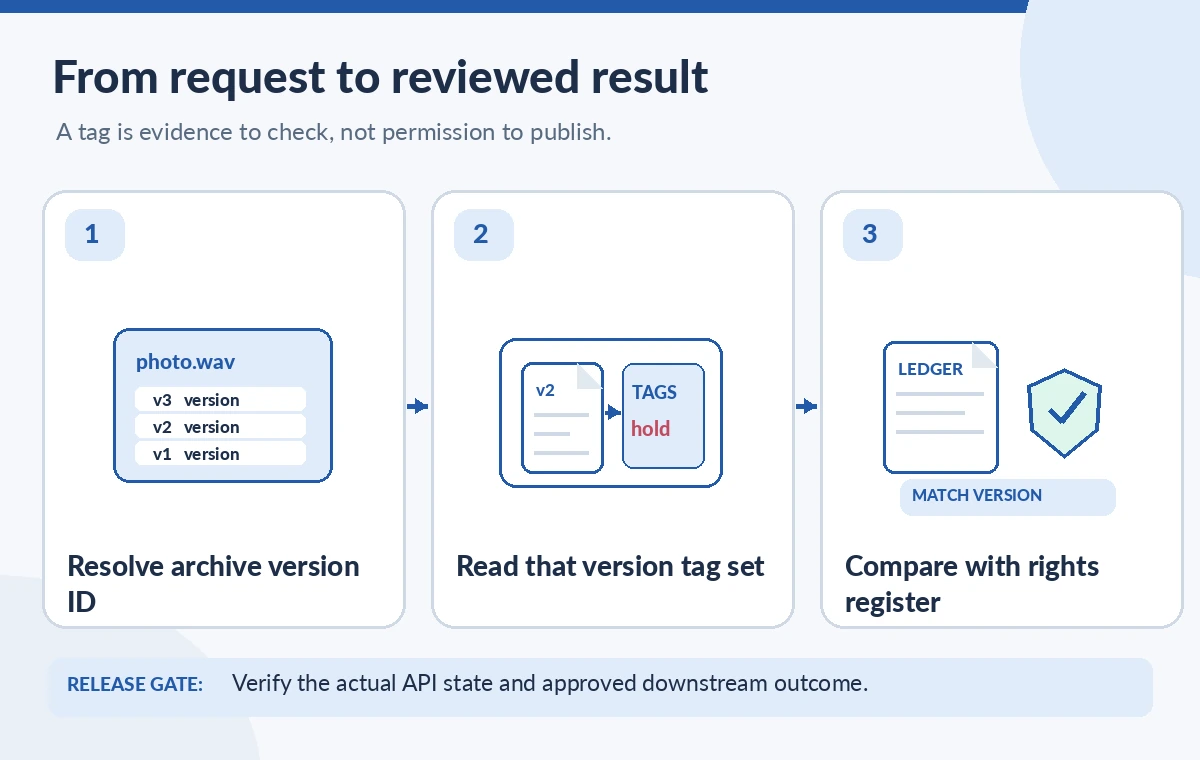
For an object with versioning enabled, pass the relevant versionId rather than assuming the latest version is the one awaiting release. Before calling the API, resolve the version ID from a trusted preservation inventory and confirm the bucket, key and expected owning account. The tag set on an older version may differ from the current one. Keep the returned tags with their associated version ID in your restricted audit record. Never display a generic “cleared” badge based solely on the current version’s tags if the download or exhibition page refers to a different version.
Use the right permissions for versioned reads
AWS documents s3:GetObjectTagging permission for the current tag retrieval path. To retrieve tags from another object version using versionId, the caller also requires s3:GetObjectVersionTagging. Distinguish permission denied from “no tags”: a failed request is not proof that rights restrictions are absent. Implement least-privilege read access, and keep public-facing services from receiving credentials that can modify object tags. A good operational design uses a restricted review role for version inspection and a separate publication gate controlled by records staff. Log failures as unresolved evidence instead of defaulting to approval.
Treat absent or ambiguous tags as a hold
An S3 object might have no relevant tags, or a tag might be misspelled, stale or copied from another context. Define an allowed vocabulary in the museum’s data policy, such as rights_review=pending or source_collection=oral_history, but avoid implying these examples are AWS-provided standard keys. Tags are application-defined strings. A missing tag should route to records review, not allow public release. If the rights status is maintained elsewhere, keep S3 tags synchronized through a documented process and detect disagreements. A technically valid tag response cannot resolve conflicting donor agreements or unclear license conditions.
Do not confuse tags with access enforcement
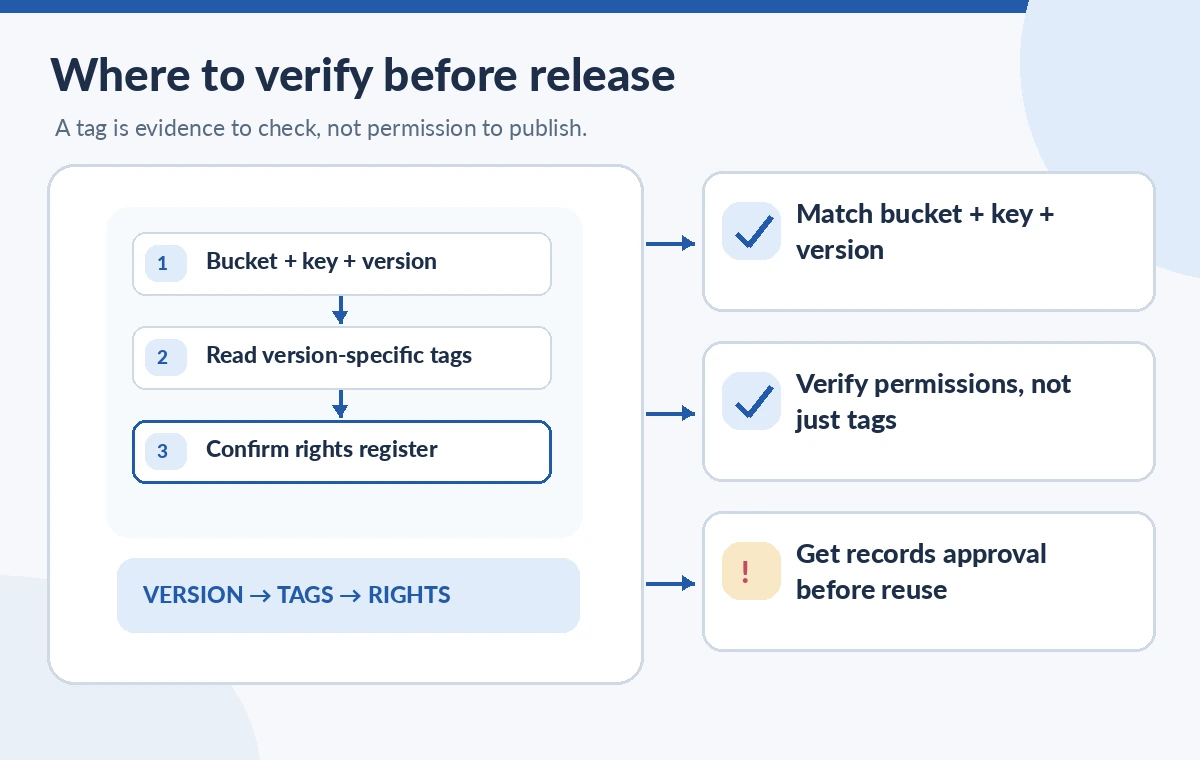
Tags can participate in IAM policy conditions and lifecycle rules when configured, but reading a tag does not establish that such a policy exists or that access is permitted. S3 may return tags successfully to an authorized operator while a public website still must deny object access. Similarly, a tag value that says approved does not override an Object Lock retention period, legal hold, consent restriction or organizational publication workflow. Verify the actual bucket policy, role permissions and review record separately. Use the illustrated checks to prevent metadata from being mistaken for authorization or a substitute for legal approval.
Compare current and older versions explicitly
A useful hypothetical worksheet has one row for the current object version and another for the specific preserved generation. Include bucket, key, version ID, returned tag pairs, rights-register ID and review outcome. If tag sets differ, block automation until an archivist resolves the discrepancy. The figures show a current version labeled for a public excerpt and an older generation still pending review. These are conceptual examples, not actual AWS objects or observed responses. They demonstrate why a simple key-only lookup is insufficient when a release pipeline chooses a noncurrent version.
Consider endpoint and bucket limitations
The GetObjectTagging API documentation notes that the operation is not supported for directory buckets. Account for bucket type and IAM resource conditions before writing a universal helper function. If a requester-pays configuration or expected-bucket-owner guard applies, review those requirements too. Do not guess whether a 403 means the object is missing, a version is invalid or access is denied: classify the error and reconcile it with authorized inventory metadata. Avoid bulk scanning protected archives from a public web worker. Run only within a documented permission boundary and never expose secret version IDs unnecessarily.
Build a safe prepublication check
Before releasing a photo or interview extract, resolve the exact version from the preservation ledger, fetch its tags with an approved role, compare them with the rights registry, and verify any legal hold or retention restriction in the separate controls that govern those concepts. Confirm that the intended derivative is the file actually being published. Only then request human editorial sign-off. Recheck if the file version or rights record changes. Automation can prepare a complete audit packet, but it should not convert a single S3 tag value into irrevocable permission to distribute cultural or personal material.
Record the limitations of this metadata audit
This guide describes API behavior from AWS documentation and a fictional oral-history workflow. We did not inspect a live bucket, copy protected interviews, read anyone’s consent records or perform a release. The diagrams deliberately distinguish current and noncurrent versions to illustrate retrieval logic, not the state of a particular archive. Because policies and tag conventions are organization-specific, ask records managers to define their schema and verify current AWS permissions before deployment. The audit is successful when every release decision has traceable evidence, not merely when GetObjectTagging returns HTTP 200.
How We Research
We prepared this November 11, 2026 documentation-based guide using Amazon S3 GetObjectTagging API; Amazon S3 Object Tagging user guide; Amazon S3 Versioning guide. We cross-checked the exact API field or environment variable against the official reference, then examined practical distinctions such as scope, errors, authentication, version selection and application-side review. Scenarios use fictional museum records and synthetic labels; diagrams depict concepts rather than captured interfaces or measured service results. We did not access a private API project, execute production changes, inspect protected archive objects, or run GitHub Actions. Service behavior, permission boundaries and API versions can change; consult current primary documentation and your organization’s approved policies before implementing a workflow.
Frequently Asked Questions
No. It reads the object tagging subresource and returns tag key-value pairs, not the object content.
AWS targets the current object version by default; use a specific versionId to inspect a preserved older generation.
AWS requires s3:GetObjectVersionTagging for version-specific tag access, in addition to understanding the normal GetObjectTagging permissions.
No. Tags are application metadata and do not replace the authoritative rights register, access policy or consent decision.
The API documentation states that this operation is not supported for directory buckets.