
A temporary exhibit can create a permanent-looking index
Imagine that a collections team uploads approved exhibit policy notes to an OpenAI vector store so staff can search them while preparing an exhibition. The exhibition ends, yet the search container remains attached to an internal assistant because nobody owns its retirement date. That creates unnecessary maintenance and possible ongoing indexed-storage expense. OpenAI supports an expires_after policy on vector stores to manage this lifecycle. The policy is a technical expiration rule for the indexed retrieval container, not a legal destruction instruction for institutional records. Start by distinguishing approved source documents, uploaded File objects, vector_store.file associations, and the assistant that queries the store. They are separate things with separate owners and audit duties. This article uses an invented museum scenario, not a live OpenAI account.
Identify the source of truth before touching expiry
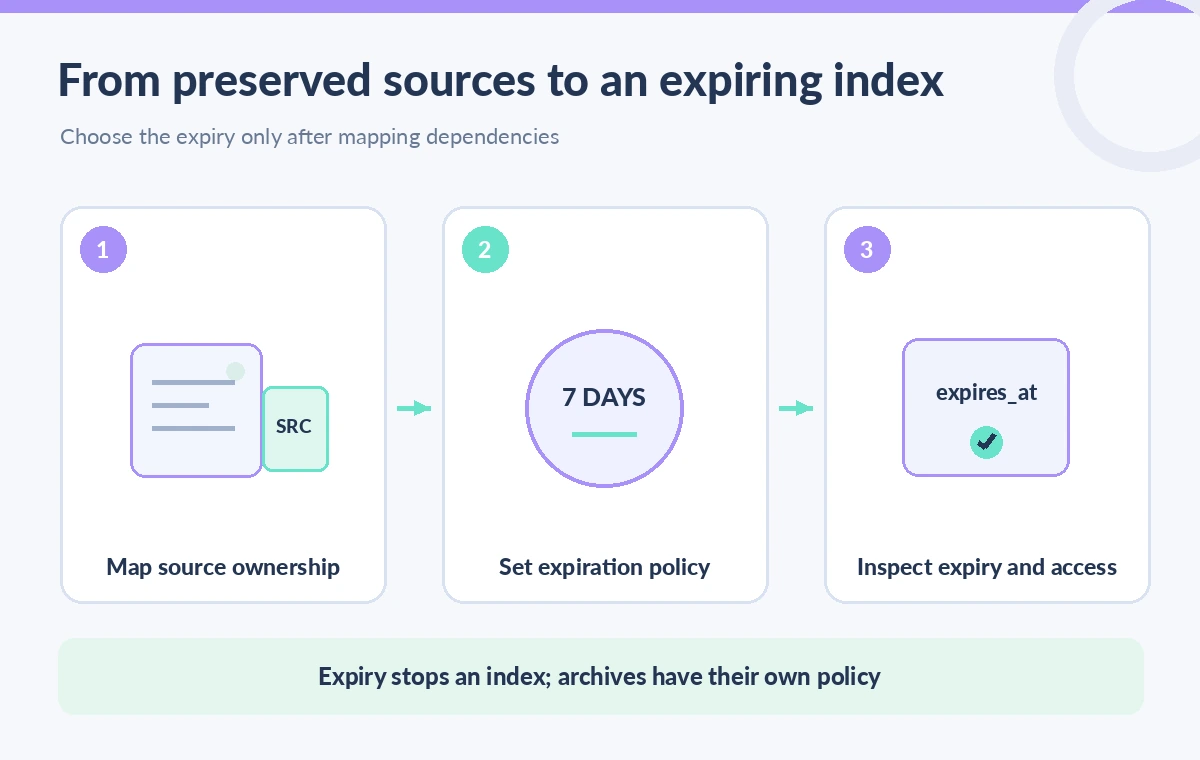
Record the authoritative document repository, preservation schedule, rights restrictions, store identifier, and applications that reference the index. A vector store holds searchable chunks and embeddings created from attached files; it should rarely be your only preserved record. Confirm that the underlying policy documents remain accessible in the approved archive and can be reindexed if needed. Include a responsible owner for the retrieval configuration rather than assuming the last person who uploaded a PDF will still be available. Inventory both routine staff searches and less visible automated retrieval jobs. An idle museum project can appear finished while a scheduled policy check still depends on the indexed material. Map those dependencies before setting an expiration window.
Use expires_after with the supported anchor
The OpenAI retrieval guide documents expires_after with an anchor of last_active_at and a days value. The vector-store API reference lists supported days from 1 to 365 and identifies last_active_at as the supported anchor. This means the deadline is based on the store’s last activity, rather than an arbitrary date typed into an editorial spreadsheet. For example, a hypothetical seven-day inactivity policy can be expressed as expires_after: {anchor: “last_active_at”, days: 7}. The number is an administrative choice, not a default recommendation for all institutions. A project with infrequent but essential monthly checks needs a different review. Do not assume that opening a project dashboard necessarily constitutes retrieval activity.
Inspect last_active_at, expires_at, and status together
After configuring the policy, retrieve the vector-store object through an authorized API client. The published schema includes last_active_at, expires_at, expires_after, file_counts, usage_bytes, and status; the last can include completed, in_progress, or expired. Treat these as related observations rather than a single green signal. A store can have completed indexing while still being a poor source because a file upload failed or the index contains an obsolete revision. A null or absent last-active timestamp should prompt an explicit check of actual store creation and use. Capture the store ID, policy, and review owner in internal change records, not full extracted text or confidential document names in an open ticket.
Understand what OpenAI says expires
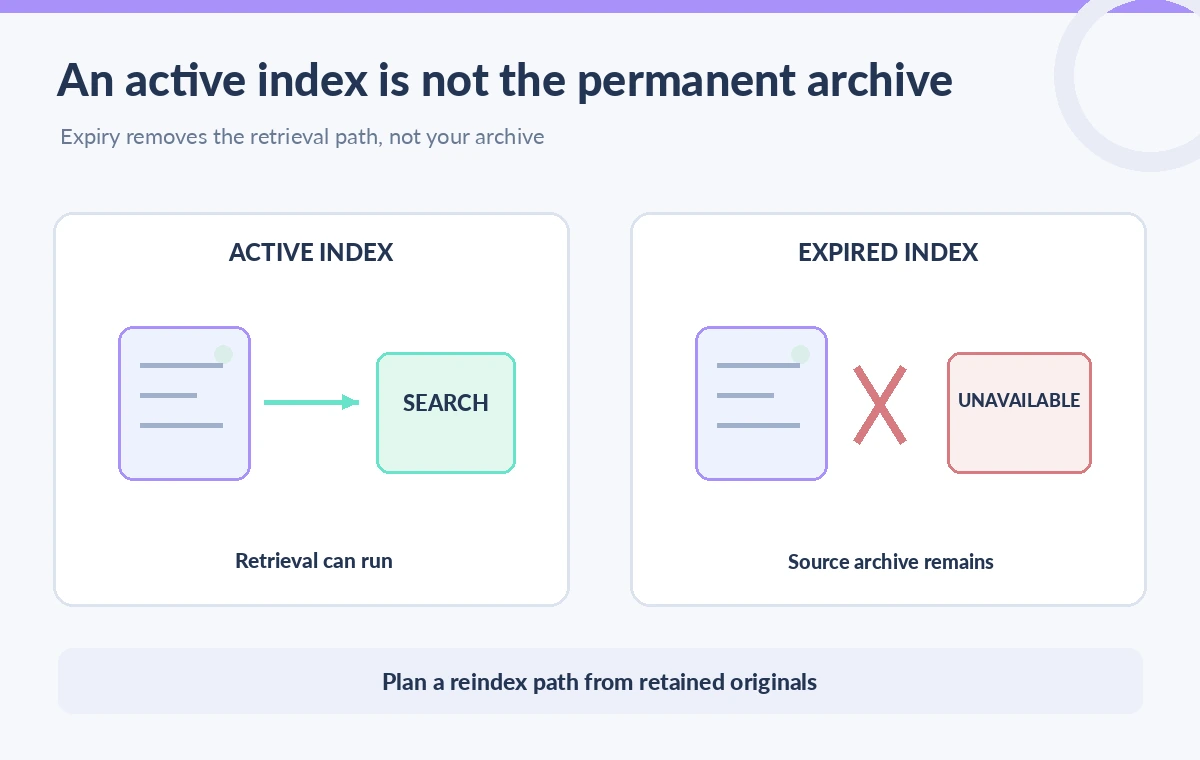
OpenAI’s retrieval documentation says that when a vector store expires, its associated vector_store.file objects are deleted and storage charges for that store stop. That statement is specific to the vector-store association and indexed-storage lifecycle. It must not be rewritten as a guarantee that the original Files API objects, the institution’s source repository, backups, or legally retained records have been destroyed. Equally, an expired store should not remain silently listed as a ready retrieval source. The search client should recognize an unavailable or expired index, halt evidence-dependent answers, and route staff to an approved source. The comparison illustration distinguishes an active retrieval path from an expired index while leaving the preservation archive untouched.
Separate indexed storage charges from governance
The guide describes vector-store storage charges based on parsed chunks and embeddings, so retiring an unused index can reduce avoidable storage. It does not prove that every trace of a project has disappeared from every system, nor does it substitute for privacy, records management, or vendor-account governance. For a grant audit, record the authorized retirement purpose, policy change, relevant source identifiers, and the date staff verified that retrieval no longer depends on the store. Do not publish exact project IDs or document titles simply to demonstrate cost savings. Also avoid promising a billing reduction before a store actually expires and the relevant usage figures have been checked in the account.
Plan for reactivation, rebuilding, and broken citations
A museum might need a note again after the exhibition closes. Design a reindexing procedure from the preserved originals instead of treating expiry as something that can be undone by a browser refresh. Keep a controlled map from archive item identifiers to approved search-source metadata, verify the newest revisions, and follow the indexing completion state before restoring a staff search. Any citations in old reports should still identify their archived source documents independently of temporary vector-store IDs. If the assistant receives a missing or expired-store error, make its response explicitly state that source retrieval is unavailable. The worst outcome is a polished unsourced policy answer appearing because the search tool quietly failed.
Put privacy and authorization gates around retirement
A retention change has security implications in both directions. Setting an overly long policy can leave sensitive search material indexed beyond the intended project window; choosing one that is too short can break required internal reviews. Ask the collection owner, information security lead, and records manager which documents may be indexed and when access should cease. Limit API credentials and monitor changes to store assignments so another workspace cannot quietly repurpose an old index. For each planned removal, record approval without copying confidential passages into a ticket. Our checklist shows three independent gates: the source archive exists, the expiry date is understood, and the search client has a safe fallback.

A practical acceptance test for an idle project
Before using this pattern in production, choose a non-sensitive test corpus and confirm the create or update response includes the intended expires_after policy. Later, inspect last_active_at, expected expires_at, and status from the actual API rather than inferring expiry from the wall clock alone. Verify that an approved staff query works while the store is active and that your application refuses an answer when the store becomes unavailable. Rebuild from the test source if a project must resume. Write down who checks usage_bytes after expiry and who decides whether the original uploaded File objects need separate lifecycle handling. No expiration behavior or savings figure has been measured for this article.
How We Research
Our primary named official sources were: OpenAI Retrieval guide — Expiration policies; OpenAI Create vector store API; OpenAI Retrieve vector store API. We read OpenAI’s current retrieval guidance and vector-store create/retrieve references for expiration, last activity, store status, and indexed-file behavior. We did not create a store, observe scheduled expiry, measure charges, or examine any institution’s documents. The retention scenario and drawings are hypothetical. Readers should verify current deployment-specific documentation and their own permissions before adopting a workflow. Any figures are original instructional diagrams, not actual vendor screenshots or observed results.
Frequently Asked Questions
OpenAI documents expiry of the vector store and associated vector_store.file objects. Do not assume the original archival documents, unrelated file resources, or backups are deleted by this setting.
The published vector-store schema specifies last_active_at as the supported anchor, with a days value from 1 through 365. Check the current API reference before deployment.
No. expires_at is an API field about the retrieval container. Institutional retention obligations and approved destruction schedules are separate decisions.
It should stop claiming it checked missing evidence, show that retrieval is unavailable, and direct staff to the approved archive or a reviewed reindexing workflow.
No measured savings are claimed here. Check whether the store actually expired and use official usage and billing information to confirm any change.