
An invisible multipart transfer can keep consuming space
Imagine a collection technician moving large oral-history WAV files into an archive bucket. A workstation loses connectivity midway through one multipart upload, and a replacement transfer succeeds under a different upload ID. The completed master appears in the catalog, but leftover parts from the abandoned transfer can remain in S3 and accrue storage charges. Amazon S3 only assembles an object after a successful CompleteMultipartUpload. Incomplete parts should not be mistaken for a recoverable finished master. Cleanup is useful, but an overly short window could interrupt a legitimate long-running ingest.
Separate an object from an upload ID
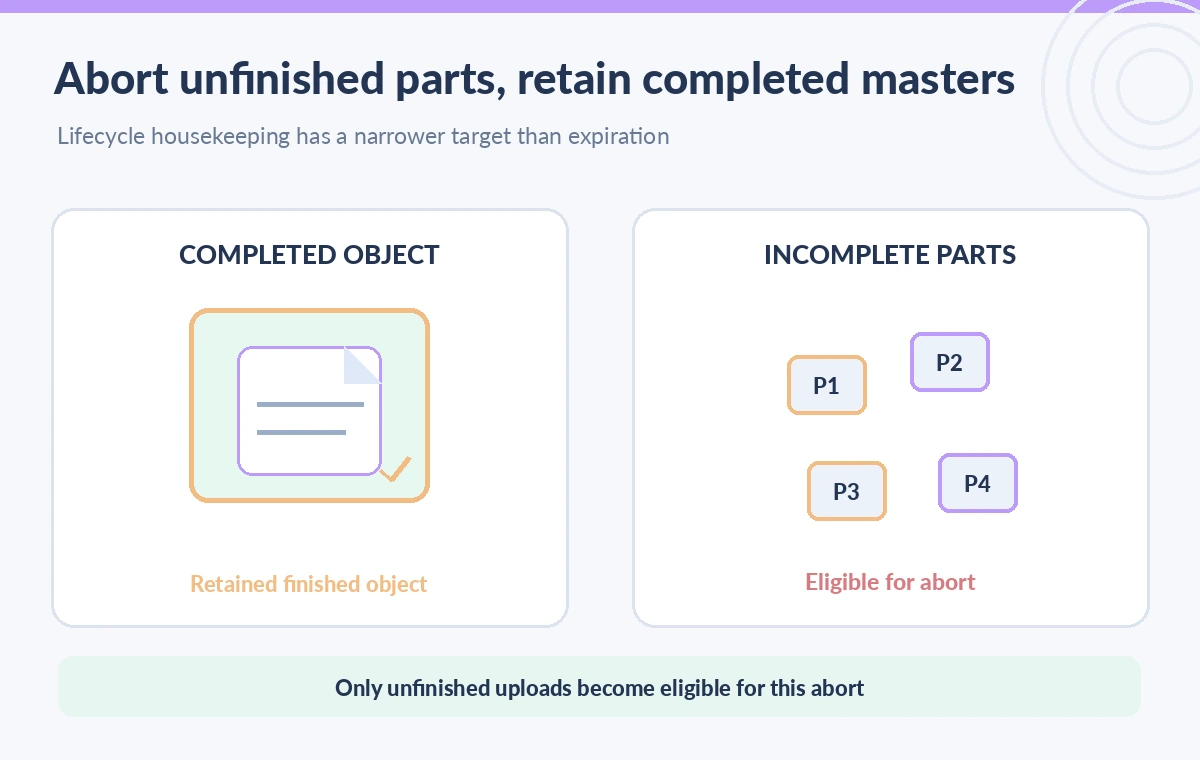
Multipart uploads are identified by an upload ID and a key. Parts belonging to an uncompleted upload are a different state from a completed object available to ordinary GetObject requests. Before cleanup, map the upload process used by the preservation system: who initiates uploads, how often transfers resume, and whether nightly jobs can extend across days. Record the intended object key, checksum verification method, and manifest entry for each completed master. An aborted, incomplete upload cannot be completed later with the same ID, so do not assume this is a reversible pause button.
Use the specifically named lifecycle action
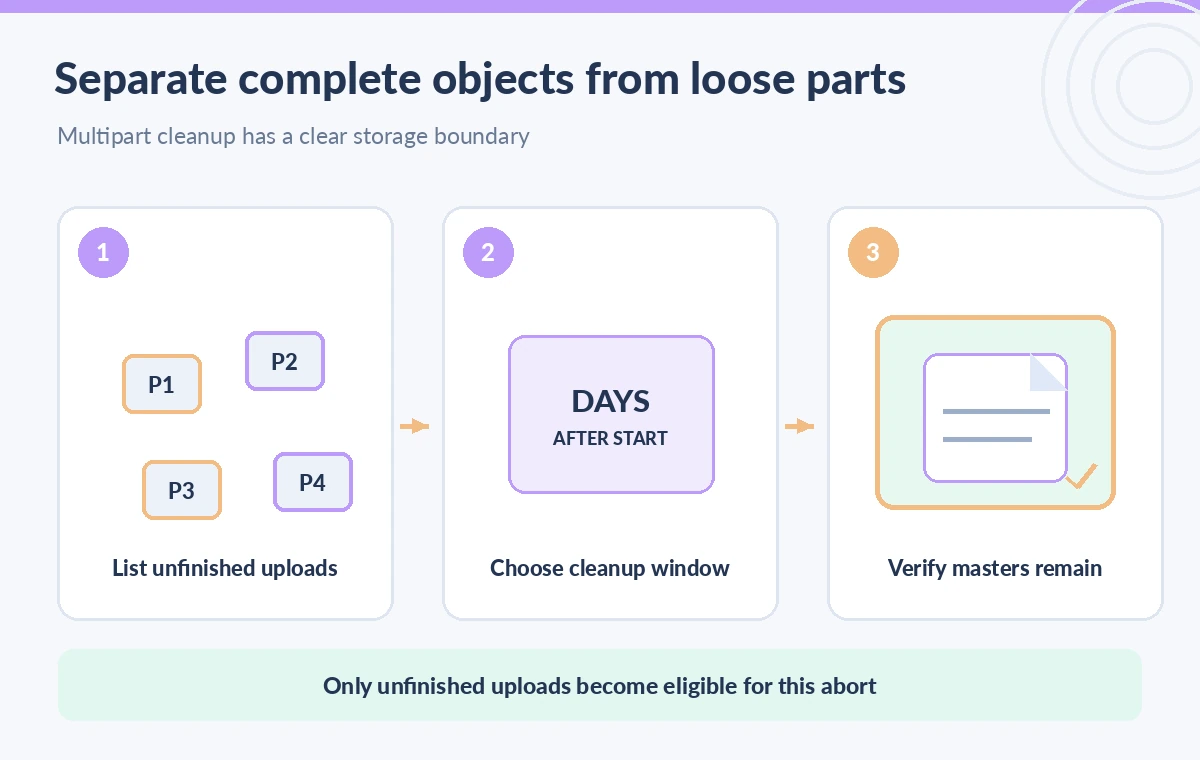
The AWS S3 User Guide describes a bucket lifecycle action named AbortIncompleteMultipartUpload, configured with DaysAfterInitiation. An illustrative rule may make unfinished uploads eligible for abort after seven days; that is a policy example, not a universal requirement. The lifecycle system can clean abandoned parts from existing and future multipart uploads that meet the rule. The action does not delete a completed object, and it is distinct from lifecycle object expiration. Confirm your ingest job’s maximum legitimate duration before selecting the number of days.
Understand what the rule is allowed to filter
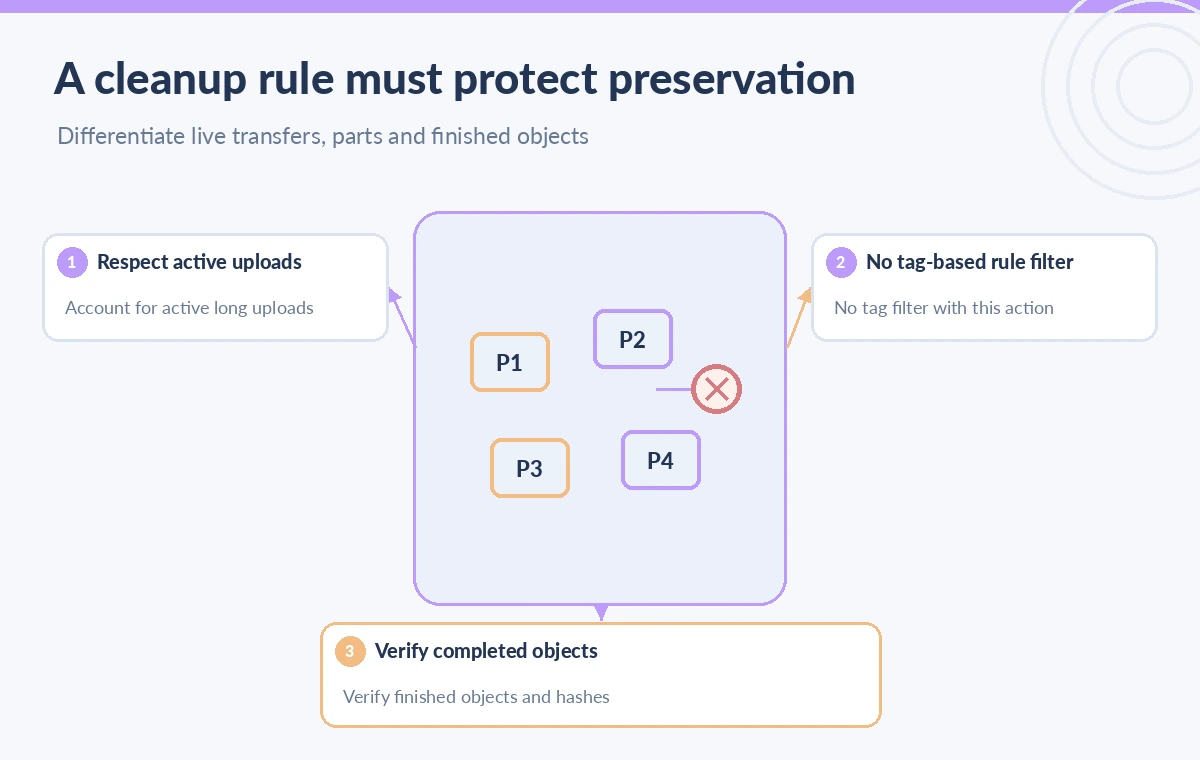
S3 lifecycle rules can apply to a chosen object-key prefix. However, AWS explicitly notes that a rule using AbortIncompleteMultipartUpload cannot specify an object-tag-based filter. A collection team that relies on tags like preserve=true should not assume that tag will exempt unfinished uploads from this cleanup. Instead, design prefixes and timing that match the ingest process, and review any overlapping lifecycle rules with the bucket owner. Treat different preservation classes separately where warranted. A seemingly narrow tag condition can lead to an invalid configuration or an incorrect operational assumption.
Do not assume cleanup runs at the second of eligibility
A lifecycle action makes unfinished uploads eligible when they exceed the configured interval; it does not promise instantaneous removal at a specified clock time. Do not build a monitoring dashboard that calls the cleanup a failure merely because bytes persist briefly beyond the threshold. Independently track long-running upload IDs, parts and failed completion attempts, and measure storage changes only when the service has processed the action. A hypothetical seven-day illustration is not an observed archive-bucket result. Verify actual outcomes using your own S3 inventory and billing diagnostics.
Protect slow but legitimate ingest sessions
Very large video or audio master uploads may be intentionally multipart and can span maintenance windows. Ask technicians for the longest supported transfer and retry policy, then add a defensible buffer. If a task is expected to resume after several days, an overly aggressive lifecycle threshold may delete its parts before completion. The workflow should record the transfer state and initiate a new upload when a previous ID has been aborted rather than pretending the old parts can be reused. Keep at least one verified source master until the completed destination passes checksums and preservation review.
Distinguish automatic lifecycle from manual abort
S3 also provides AbortMultipartUpload for an explicit upload ID. AWS notes that concurrent part uploads can still finish while an abort is in progress, and further cleanup or ListParts verification may be needed. That is different from defining a routine bucket lifecycle policy. Do not issue broad manual abort requests as a first response to an ambiguous transfer dashboard. Investigate task ownership and the last update, then either complete a viable upload or intentionally abandon it. Record the decision and preserve the original source copy until the new completed object has been validated.
Confirm the finished archive was not confused with leftovers
After the rule is approved, inspect a controlled test case with one completed object and one intentionally unfinished multipart upload. Confirm that the completed object remains accessible and unchanged after the incomplete upload becomes eligible for cleanup. Check the completed object’s checksum or approved verification procedure separately from a mere successful HTTP status. Note that ETag should not automatically be treated as a plain MD5 checksum for multipart objects. Retain the preservation ledger, rights metadata, and source-file inventory independently of lifecycle housekeeping.
Define ownership of the cleanup policy
Name a storage administrator who can approve lifecycle changes, a preservation owner who knows the required ingest windows, and an operator who can monitor multipart transfer failures. Keep the rule reviewable as configuration, and periodically compare its effective prefix and day threshold with current software behavior. The business success criterion is not only lower stranded-part storage; it is also zero known damage to completed preservation masters. If a transfer fails after cleanup, use the source copy and documented retry process rather than making claims that S3 will restore removed parts.
Make cost reporting precise
Unused multipart parts consume storage while an incomplete transfer persists, but cleanup savings depend on actual stored part bytes and how long they remain. Do not claim a fixed percentage reduction or turn a single cleanup event into a universal cost forecast. Review the available multipart-upload listings and S3 storage reports using the organization’s approved tools, then distinguish this cost category from completed object storage, replication, requests, and retrieval. If an archive team needs a cost estimate, label the assumptions and time range clearly. The cleanup goal is preventable stranded-part accumulation, not a promise that finished archive storage charges disappear.
What to do when a transfer fails after the rule changes
If operators report that legitimate uploads are unexpectedly aborted, stop and inspect the initiation time, selected lifecycle prefix, upload software retry schedule, and whether the transfer ever completed. Do not deactivate unrelated bucket preservation controls in a rush. Roll back the specific lifecycle configuration under change control, extend the intended window if justified, and restart failed uploads from source files with correct upload IDs. Preserve logs showing which objects were completed and which uploads remained partial. Before resuming routine ingestion, run a controlled test of both a long upload and an intentionally abandoned one. The result should be operationally explainable, not merely a lower storage graph.
How We Research
Our primary named official sources were: Amazon S3 User Guide — Configuring cleanup of incomplete multipart uploads; Amazon S3 User Guide — Lifecycle configuration elements; Amazon S3 User Guide — Aborting a multipart upload. We checked AWS documentation on multipart completion, billable parts, lifecycle abort eligibility, restrictions on tag-based filters, and the difference between incomplete uploads and completed objects. No AWS bucket or billing record was accessed; diagrams show conceptual upload states. Readers should verify current environment-specific documentation and permissions before adopting a workflow. The figures are original teaching diagrams, not vendor screenshots or measured results.
Frequently Asked Questions
No. AWS states the action removes parts from eligible incomplete multipart uploads, not completed objects.
No. Seven days is a common documented example; choose a window suited to legitimate upload duration and your operational policy.
No. AWS documents that the AbortIncompleteMultipartUpload lifecycle action cannot be specified in a rule with a tag-based filter.
No. After abort, that upload ID cannot be completed; create a new upload from a verified source if needed.
No. Verify that the completed object exists and independently check its integrity and archival acceptance criteria.