
Label the Job, Not the Person in the File
A local museum uses an AI assistant to draft a short description for each incoming artifact donation. The editor wants to see which collection workflow produced a response when a description later needs correction. OpenAI’s Responses API has an optional metadata object that attaches key-value strings to a response, making structured labels available for management and lookup. That convenience creates a privacy trap: a human-readable donor name, home address or object appraisal does not belong in a request label merely because it is easy to search. The better design connects an anonymous workflow label to a separate, access-controlled collection record. Metadata helps locate a run; it does not approve the resulting description or reveal where the historical claim came from.
Understand the Object and Its Limits
According to the API reference, metadata supports up to sixteen key-value pairs on a response object. Keys have a maximum length of 64 characters; values can be up to 512 characters, and values are strings. Do not treat metadata as a nested document store or unlimited collection of tags. A useful example is a key such as workflow with value intake-caption, plus collection_stage with value draft-review. Keep those labels short and from an allowlist. The model does not need a donor’s address in metadata to draft an accessible caption. Response metadata is different from model input, the output text, an API request identifier and the museum’s authenticated collection database. Each has a separate purpose and its own security and retention policy.
Choose a Minimal Tagging Contract Before Coding
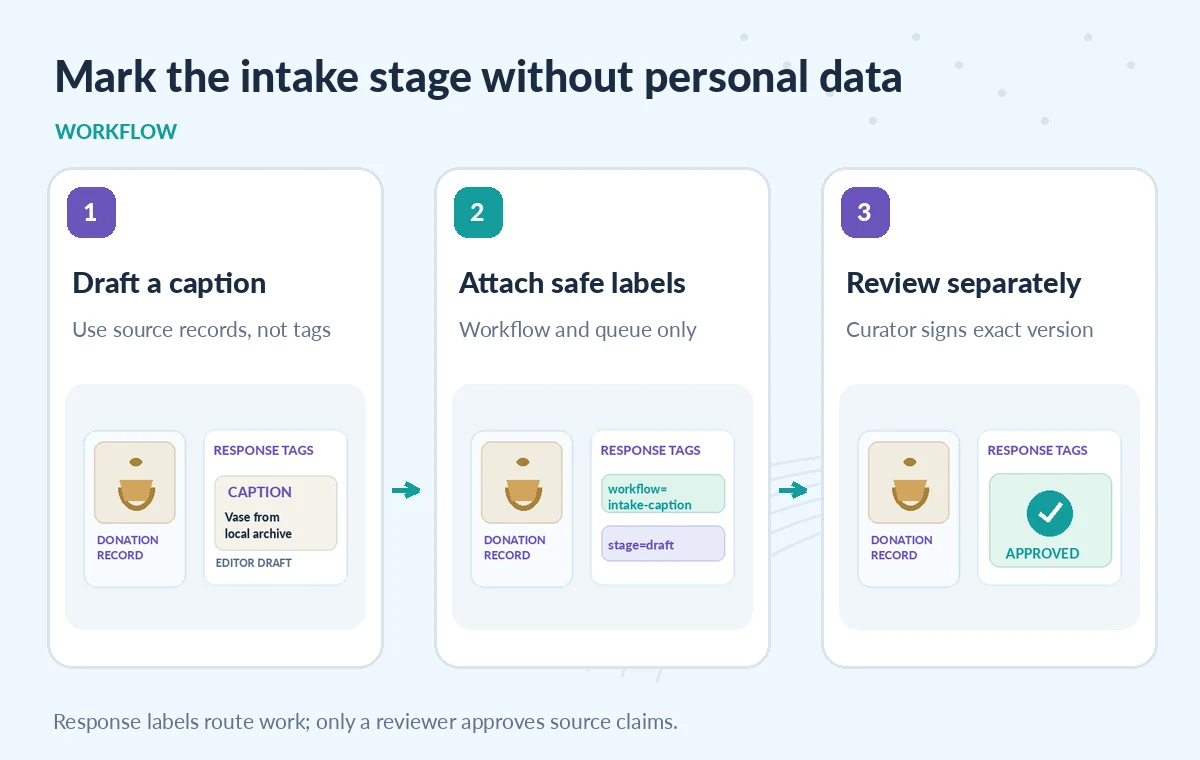
Define a small contract shared by the intake service and the reviewer dashboard. Useful keys might be workflow, schema_version, review_queue and environment. A synthetic request can carry workflow=intake-caption, review_queue=paintings and environment=staging. For any join back to a sensitive record, use an opaque internal reference maintained only in a database that already enforces the museum’s access permissions. Avoid emails, postal addresses, direct accession commentary, secret tokens or complete transcription strings in metadata values. Allowlist both keys and acceptable categorical values. A stable label may reveal operational details even without a person’s name, so log it only where staff actually need it. If different collections have confidentiality rules, review those tags before deploying.
Attach Metadata to the Correct Response
The application supplies metadata alongside its other top-level Responses request parameters. It should generate the labels on a trusted server after validating the caller’s role and selected task. Avoid asking the language model to invent the metadata values: a model-generated collection ID may be plausible and wrong. When the request succeeds, store the returned response ID next to the internal job record with the declared stage and time. If the API call fails, write an error status in your own monitoring system; don’t silently label the operation successful. Some response data is stored by the API depending on request settings and applicable retention terms. Treat metadata visibility, response retention and your own internal log retention as distinct decisions to review with your privacy lead.
Compare a Safe Label With Two Misleading Alternatives
Imagine three hypothetical records. The first uses donor_name=Mary Example and street_address=12 Main Street; it is searchable but places personal details in a tool that does not need them. The second uses approved=yes merely because the model returned a fluent caption. It is concise but falsely equates generation with editorial authorization. The third uses workflow=intake-caption and review_stage=awaiting-human, joined privately to an access-controlled record. It expresses the technical state without claiming a curator has signed off. These are illustrations of labels, not real API results. A dashboard should display the original source record and approval trail separately, rather than treating arbitrary response tags as authoritative evidence of donation rights or accepted provenance.

Keep a Proper Audit Trail Outside the Model
A responsible intake log records the request initiator, allowed operation, source record revision, response ID, model configuration, timestamp and the human review decision. Place it in a museum-controlled system with explicit access restrictions and deletion rules. The API metadata can help staff locate the response that belongs to an incident, but it should not be the only source of truth for who reviewed an artifact or when a public page changed. In particular, a user able to set metadata must not be able to set a real approval flag. Enforce the approval transition through authenticated staff action, with a distinct audit event. Recording a response ID also does not itself prove that source images, donor agreements or legal permissions were correct.
Design for Missing, Invalid and Reused Tags
Software should reject unknown keys before calling the API, truncate nothing silently and flag labels that exceed the documented limits. Build a fallback for requests without optional metadata: an internal request ID and a review-queue entry can still provide traceability. Test two captions arriving simultaneously, a retry after a timeout, a response attached to the wrong object and a changed schema version. Avoid recycling a generic label as though it uniquely identifies an individual donation. If a timeout occurs after a request was submitted, reconcile its response ID or status instead of blindly creating duplicate public drafts. For this example, no authenticated service was called and no actual donor records were processed.
Exercise the Workflow With Fictional Donations
Use a staging environment with a made-up vase, a fictional donor and harmless captions. Inspect the outgoing metadata object for exactly the approved keys and acceptable lengths. Confirm that the curator cannot mark a record published simply by changing a tag. Verify that logs exclude full donor correspondence and that staff access controls work when searching response IDs. Exercise malformed values, an oversized field, missing review_stage and a mistaken association between two records. Save screenshots of your own review system only when policy permits; do not present a simulated dashboard as an authentic OpenAI interface or a measured production outcome. This is a reproducible QA design, not a report of a live benchmark.

Publish Only After the Independent Curatorial Gate
When the AI caption is complete, the item should still be in a draft queue. A curator compares it with the accession record, inspects names and dates, checks donor restrictions and approves an exact version. Only that event can authorize publishing. Track the curator’s decision in the collection management system and keep the response metadata as supporting routing information, not public proof. Schedule a periodic audit to detect orphan response IDs, excess tags, stale review states and accidental personal information. The essential distinction is simple: tagging helps staff find an AI run, while evidence and human authorization determine what the museum may say in public.
How We Research
For this guide, we reviewed the official product documentation on November 8, 2026: OpenAI Responses create API, OpenAI Responses overview, OpenAI data controls for the API. We checked the named setting or feature against its published behavior, mapped the documented constraints to the specific hypothetical scenario, and reviewed whether the topic duplicated titles in the supplied LabFin WordPress inventory or prior B0267–B0276 ZIPs. No authenticated vendor service was run; we did not perform a benchmark, observe real customer data, verify third-party rights or claim operational outcomes. All illustrated records and comparisons are teaching examples. Confirm product documentation and security requirements again before implementing a workflow in a real organization.
Frequently Asked Questions
The Responses API reference documents up to sixteen key-value pairs per response; each key and value also has a length limit.
Avoid personal information and sensitive commentary. Use low-risk categorical labels and keep identifying record joins in an access-controlled museum database.
No. It is structured information attached to an API object, not a substitute for input instructions, source retrieval or evidence checks.
A string can carry a label, but it should not be accepted as an authoritative approval. Require a separate authenticated human workflow.
Use an independent internal request or job record and reconcile the API outcome. Do not infer success from a planned label.