
A Claude Project is best thought of as a small workspace with reusable instructions and reference material, not a magic shared memory for every conversation. That distinction matters for writing teams, researchers and anyone working through the same information in multiple sessions. A project can reduce repeated setup, but inaccurate source files can also make the same mistake recur.
Anthropic currently describes Projects as available on free and paid Claude accounts, with plan-dependent limits and additional team-sharing controls. This guide stays on the practical work: selecting knowledge, setting instructions, organizing chats and measuring whether answers consistently use the right source. It does not assume that Claude has reviewed your private files unless you actually provide them.
Choose a narrow project outcome before uploading anything
Define the job in one sentence: “Help our team draft release notes from approved product documentation” is stronger than “Know everything about our company.” List what a successful response must contain, which sources it may use and which decisions still require a human. Narrow scope makes both instructions and source review manageable.
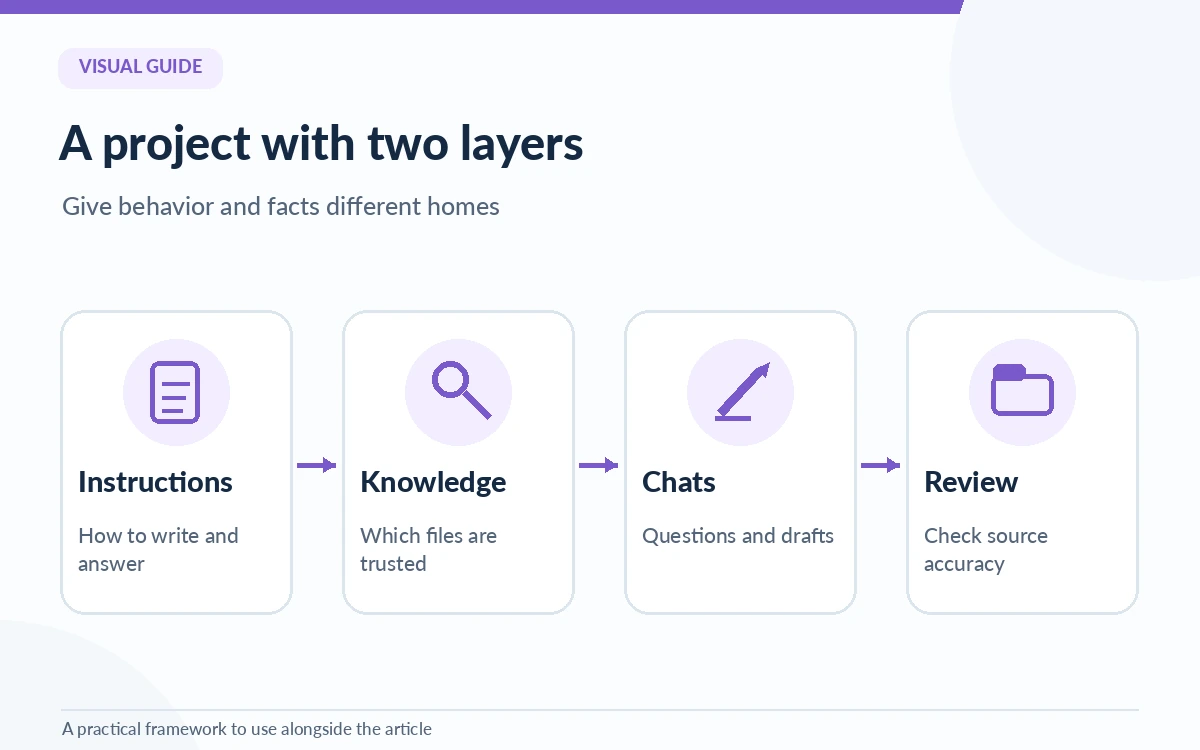
Give the project a descriptive name and short description for people. Anthropic says the name and description are not themselves passed to Claude as instructions. If the assistant must follow a rule, place it in project instructions; if it must rely on a fact, make that fact available in project knowledge.
Separate project instructions from source material
Instructions describe behavior: audience, tone, permitted tasks, citation expectations, how to handle missing evidence and when to ask for clarification. Source material contains facts: policies, glossaries, product specifications, examples or a current style guide. Put these in separate places so a policy update does not require editing a long prompt.
An example instruction is: “Write for US customers. Cite the title and section of the supplied source when stating a policy. If sources conflict, identify the conflict instead of choosing a convenient answer. Do not invent dates or prices.” Test that rule with an intentionally missing answer before inviting colleagues.
Create the project and add only reviewed knowledge
In Claude, open Projects and create a new project. Add the material you want reused across chats through the project knowledge area, and set project instructions separately. Start with a small pack: one authoritative policy file, one glossary and one approved example. Keep a visible version date in each document.
A file being present does not make it correct or universally relevant. Remove duplicates and outdated copies, label which document takes precedence and avoid uploading customer secrets just to improve writing. With larger knowledge bases, Anthropic documents retrieval behavior under certain paid-plan conditions; do not promise that every line is always loaded into a response.
Work with long documents in ClaudeUnderstand what carries across separate chats
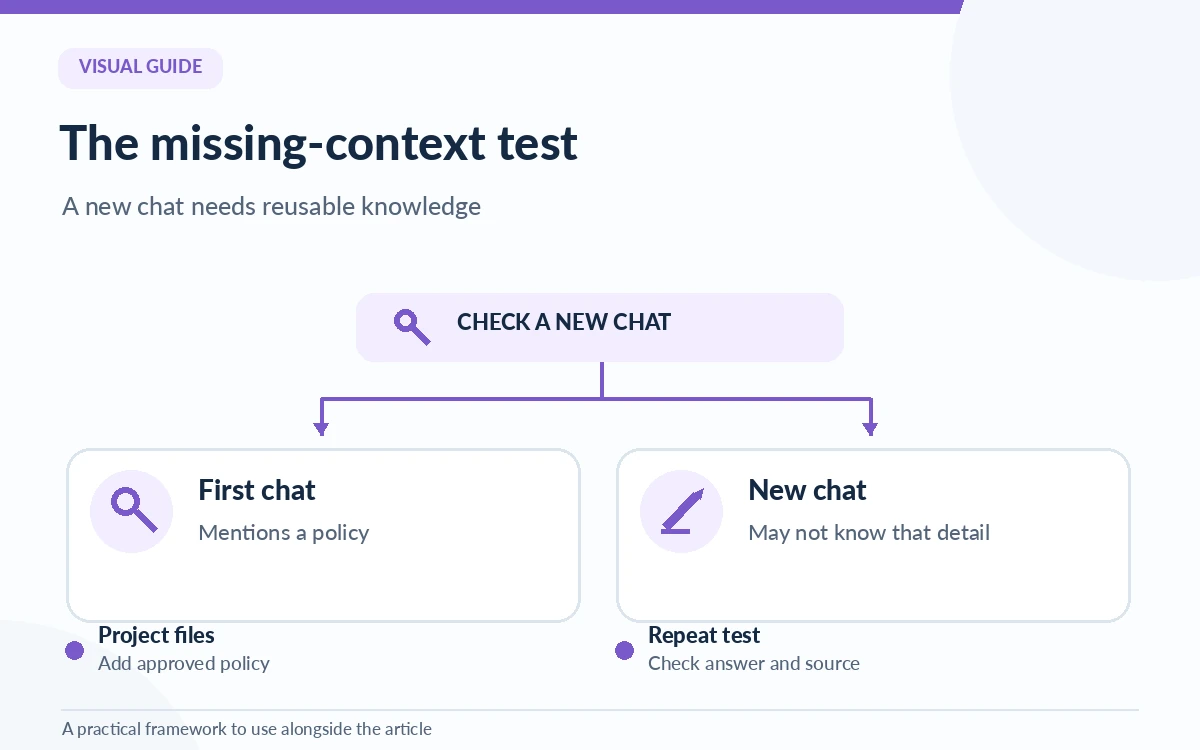
Anthropic distinguishes shared project knowledge from ordinary individual chat context. Information mentioned in one conversation should not be assumed available in a second conversation merely because both are in the same project. If a recurring rule or fact is important, add it explicitly to the knowledge base or the project instructions.
Project-specific memory features can also exist, but availability and controls differ by account and may change. Treat memory as a convenience, not a compliance archive or authoritative source. Run a new-chat test using a question the original chat answered; if the new chat cannot cite the correct file, fix the reusable context instead of relying on recollection.
Use a three-question acceptance test
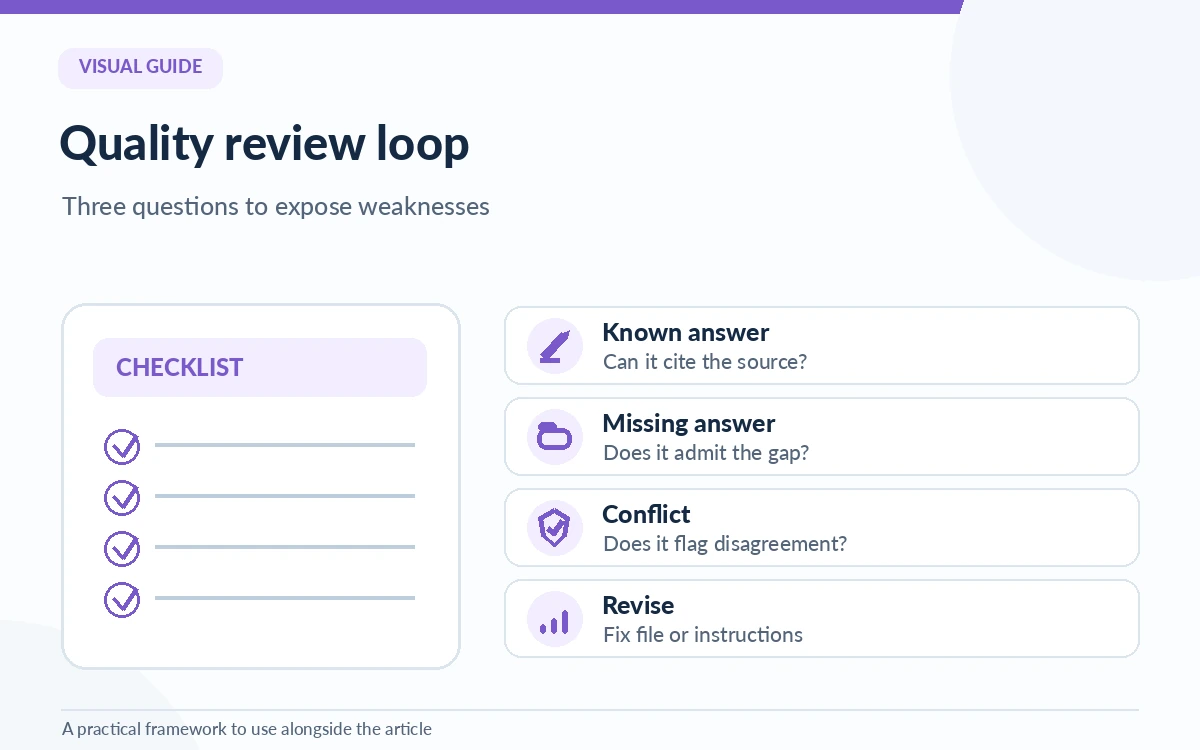
Give the project one routine question with a clear answer in its files, one question whose answer is absent and one question with intentionally conflicting source passages. A reliable project should handle all three: ground the first, admit uncertainty on the second and surface the conflict on the third. This tests trustworthiness better than judging whether the prose sounds polished.
Keep a simple review record noting the prompt, expected evidence, actual citation and correction. When a problem appears, decide whether to repair the instruction, replace a file or narrow the task. Resist adding a new sweeping instruction for every mistake: long rule piles create their own contradictions.
Collaborate without giving everyone editing rights
On accounts that support project sharing, distinguish people who need to read and use the workspace from those who may change instructions or reference files. Anthropic documents view and edit roles for Team and Enterprise environments. A shared knowledge base becomes a common dependency; changes should have an owner and an identifiable review date.
For sensitive teams, check organizational privacy and retention rules before enabling sharing. Use sanitized examples where possible, and identify who approves changes to the knowledge. You may prefer separate projects for policy drafts, public-facing copy and restricted internal analysis rather than combining unrelated access requirements.
Understand Claude usage limitsMaintain project knowledge like a living document
Pick a review trigger: a product release, policy revision, ownership change or recurring error in the acceptance test. Archive superseded references outside the active knowledge pack, replace them with the approved version and rerun the three-question check. Update project instructions only when behavior must change, not whenever a fact changes.
The most useful performance measure is not chat length or apparent confidence. Ask whether the answer is traceable to the latest approved source and whether a new teammate can reproduce it from a fresh project chat. That makes Claude Projects valuable as a documented workflow rather than merely a collection of saved conversations.
How We Research
We reviewed Anthropic’s project setup and management documentation, its Projects overview and its project retrieval explanation on October 26, 2026. The acceptance questions and maintenance cadence here are independent editorial recommendations, not Anthropic benchmarks or a claim that we logged into each plan. Availability varies by account.
Frequently Asked Questions
Anthropic currently says projects are available on free accounts, with a limit of five projects for free users. Team sharing and some advanced capabilities depend on plan and organization settings.
Do not assume so. Anthropic specifically says chat context is not automatically shared across project conversations unless it is placed in project knowledge; memory settings are a separate feature.
No. Use concise behavioral rules in instructions and place reviewed factual documents in project knowledge. Separate the two so a changing policy can be updated without rewriting the behavior prompt.
Only after checking your organization’s authorization, account privacy settings and the platform’s current data-handling terms. The fact that a file can be uploaded is not permission to share sensitive information.
Test a supported question, an unsupported question and conflicting sources in fresh chats. Review whether answers cite the right evidence and acknowledge gaps, not only whether the writing sounds confident.