
Google Cloud Vision Handwriting OCR can support a practical workflow, but only when the source records and release decisions remain independently checkable. This guide uses a hypothetical community organization scenario to show where automated suggestions end and human verification begins. The diagrams explain the intended process; they are not screenshots of an actual account, benchmark results, or proof that any customer data was processed. Start with a small authorized dataset and keep the original evidence accessible throughout the review.
Start from the handwritten card, not the spreadsheet
Picture a community seed exchange with handwritten cards naming the plant, packet count, planting depth, and donor contact. A curved “1” can resemble a “7,” and a margin note may change the meaning of a quantity.
The task is to make a searchable, reviewable transcription; it is not to let optical character recognition authorize stock totals or reveal donor information. Start with five representative photographed cards that the group has permission to process. Preserve the originals and agree which fields may be public before moving any extracted text into a shared sheet.
Choose document text detection for handwriting
Google Cloud Vision’s DOCUMENT_TEXT_DETECTION feature is intended for dense text and documents, including handwriting. Its full text annotation includes a hierarchy such as pages, blocks, paragraphs, words, and symbols.
That structure is useful for tracing a questionable value back to an image region. It should not be mistaken for a form-specific understanding of the seed exchange’s columns, and it does not establish whether a handwritten note is correct. Use the current REST or client-library documentation for request shapes and supported file formats instead of treating a picture of the API response as proof of a successful run.
Prepare legible source images responsibly
Photograph each card in consistent light, square to the page, without fingers or objects covering the final digits. Keep the entire margin even when it seems empty: a struck-out count or replacement number may sit outside a neat field box.
Assign an internal image ID and retain an unchanged copy for human review. If cards include telephone numbers or addresses, restrict access to the raw images and consider a separate public export with those fields omitted. OCR quality depends on the source; increasing the resolution cannot reliably reconstruct writing that was never captured.

Send the appropriate OCR request
For an image workflow, request DOCUMENT_TEXT_DETECTION using the Cloud Vision API and the approved project configuration. The service documentation describes local image content and Cloud Storage sources.
Language hints are optional; the Google guide notes that leaving them empty usually permits useful automatic detection, and an inappropriate hint can hurt results. Do not send private donor cards to an experimental environment merely to try a different hint. Track request status and store the output linked to the source ID; avoid writing raw personal details into application debugging logs.
Map detected text to the original physical fields
OCR can return a line of recognized words even when it cannot reliably identify which printed box each belongs to. Build a review layer that shows the card crop beside a proposed field value.
If the packet count is ambiguous, mark it “needs review” rather than selecting the most convenient digit. A handwritten dash, crossed-out word, or arrow may indicate revision, not punctuation. When the model finds text in the card margin, do not automatically merge that text into the nearest field: a separate note might refer to planting depth, not stock.
Illustrate uncertainty rather than fabricate precision
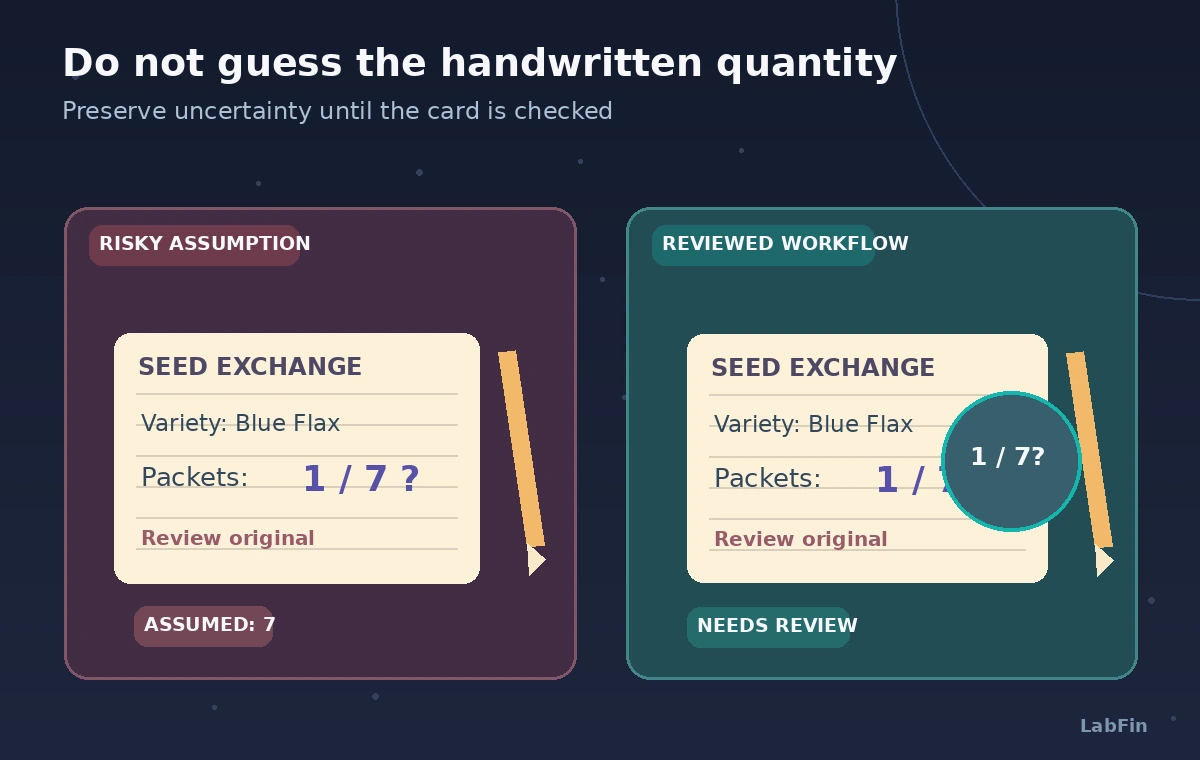
The comparison image depicts a stylized handwritten mark that could be read as 1 or 7. The unsafe side silently commits to one number; the reviewed side retains uncertainty and asks a volunteer to inspect the source.
This is an instructional drawing, not a report of Vision’s recognition rate. Confirm repeated field names, units, and whether an old count was struck through. A single wrong digit can propagate into an inventory total, so require sign-off for quantities that trigger purchasing or public availability claims.
Protect donors and distinguish private from public data
Some cards may carry a grower’s phone number, health-related gardening notes, or a home collection address. Even if the OCR service finds that text, it should not follow the seed description onto a public listing.
Determine who can access the original, the machine transcription, and the approved public record. Apply retention and deletion rules to uploaded images and derived JSON; a copied phone number can remain in logs or backups after it disappears from the front end. Get appropriate consent and check regional handling requirements before processing real cards.
Run a review table that keeps the uncertainties
For each record, capture source image ID, proposed crop, OCR text, reviewed text, reviewer initials or role, and a status such as confirmed, corrected, or unreadable. Do not replace an empty field with the digit zero.
Zero packets, missing count, and an illegible count are different states for inventory. If the review process involves another volunteer, display only the fields that person needs. A compact data dictionary will prevent a later CSV export from conflating unknown and confirmed values, especially when a spreadsheet formula encounters blank cells.
Test edge cases before routine scanning
Choose examples with a crossed-out number, a multi-word crop name, a decimal planting depth, and two forms of the same handwritten letter. Confirm that the reviewer can zoom to the exact source region and that corrections do not overwrite the unmodified source file. Check output field order when scanning the back of a card or a card with rotated text. The quality diagram marks the suspect symbol, margin annotation, and privacy boundary; it does not claim the service passed these tests for a real collection.

Publish a reviewed record, not raw machine text
Only confirmed fields should populate the public seed list. Keep unreviewed stock as unknown and describe uncertain horticultural advice as a note to verify against a trusted planting reference.
A transcription can be accurate to the handwriting and still be wrong about planting conditions. Use the original card and named human reviewer as the accountability path, and preserve the OCR version for audit without presenting it as a tested accuracy benchmark. The scenario is hypothetical and uses no real donor cards, API run, or measured OCR output.
How We Research
For this November 2026 article, we reviewed these named vendor-maintained sources: Google Cloud Vision: Detect handwriting, Google Cloud Vision: Features list, Google Cloud Vision: Detect text in images. We used their documented API operations, configuration guidance, and stated limitations to design a fictional teaching workflow, then cross-checked the scenario for confused approvals, unsupported results, and missing source identity. We did not call any paid API, train models, process private records, conduct user interviews, inspect a real vendor account, or measure precision, speed, or savings. Illustrations are educational and use invented example records, not live screenshots. Before using production data, check current pricing, regional availability, access controls, retention rules, and the relevant service change log.
Frequently Asked Questions
Google documents DOCUMENT_TEXT_DETECTION for dense text and handwriting. It returns structured text annotation rather than validated inventory fields.
Not reliably for every ambiguous mark. Inspect the original card crop and mark unclear quantities as pending review.
No. Google notes that omitting language hints often works well with automatic detection; an incorrect hint can hurt results.
No. Unknown, unreadable, and confirmed zero must remain different inventory states.
Only material you are authorized to disclose. Keep contact details and other personal information out of public exports unless consent and policy permit it.