
A nonprofit wants to quote a donor’s account of restoring a neighborhood garden. The story contains an email address, a local volunteer code and a friend’s phone number. Google Sensitive Data Protection provides reusable de-identification templates so a team can apply a consistent transformation instead of hand-editing each excerpt in a different way. But a configured replacement only affects what its detection rules find; it cannot judge consent or infer every private reference. This tutorial uses invented names and fields and does not claim that any real donor interview was processed.
Define the public excerpt before scanning
Begin with the intended audience and the exact reason an interview should be shared. A public annual report, a research-only transcript and an internal development note have different disclosure needs. Identify which parts of the story require the speaker’s consent and which personal details are irrelevant to that purpose. Keep the original recording and permission paperwork in a separate, controlled repository. The publication copy should have its own review status and explicit source revision.
A donor may consent to a name credit but not to a home address or a third party’s medical history. De-identification does not create permission for material that should not have been disclosed. Build a small synthetic excerpt with a standard email address, a nonstandard volunteer code and a context-sensitive location. Ask the privacy reviewer to mark what must be removed, what may remain and what needs a separate approval before any API configuration is considered.
Pair an inspection policy with the transformation
Sensitive Data Protection supports inspection templates that specify what to detect and separate de-identification templates that specify what to do to detected content. The former answers ‘what looks sensitive?’ and the latter answers ‘how should this finding change?’ The distinction matters when names, organization identifiers and local reference numbers share similar formats. Standard infoTypes are useful starting points, but your institution may need custom detectors for donor codes and collection labels.

For example, a fictional code DONOR-AX9 might be personally linkable within the nonprofit even though it does not resemble a phone number. Test a custom detector against unrelated catalog IDs so the tool does not obliterate legitimate provenance. Review false negatives and false positives before applying a template broadly. A low count of detected items may mean the sample is clean, but it may also mean the detectors do not match the document’s local conventions.
Create a reusable de-identification template
Google describes de-identification templates as saved DeidentifyConfig objects with metadata. A template can define infoType transformations for free text or record transformations for structured data; image-related redaction also has its own configuration. Choose the type that matches the material to be processed. For a narrative quote, consider replacing a detected email with an infoType label while retaining surrounding words. For a spreadsheet, transforming a whole confidential column may be more appropriate.
Name and version the template based on its purpose, not a particular interviewee. Use restricted IAM roles for template creation and invocation, and document the resource location for data governance. The API can reference the template by resource name. Do not place an unrestricted template identifier in a public tool that accepts arbitrary private transcripts. Templates centralize consistency but also centralize mistakes: a bad transformation becomes repeatable across every job that uses it.
Make the failure visible in a three-state comparison
A meaningful diagram should show a fictional sentence that includes an email address and a donor-specific code. The intermediate view replaces the email with EMAIL_ADDRESS but leaves the local code exposed because it was not detected. In the final view, the local detector has been added, the code is removed and the remaining garden-restoration sentence stays intelligible. These are fabricated educational states, not measured Google Cloud results.
Do not turn the whole excerpt into black rectangles merely to make it look secure. Over-redaction can erase the reason for the quotation, while under-redaction can disclose identifiers when combined with a date or a small neighborhood. Check indirect identifiers, names of other people and references to locations or events against the publication purpose. A person should read the complete resulting paragraph rather than inspecting redaction counts alone.
Separate reversible transformation from deletion
The API offers different primitive transformations, including removal, masking, replacement with infoType names and certain cryptographic operations. Those options carry different privacy and utility implications. Replacing an email with EMAIL_ADDRESS is not equivalent to anonymization if the rest of the story still identifies someone. A reversible token requires key handling and a lawful plan for who can restore the value. Choose the least revealing transformation compatible with the real editorial need.

A shared excerpt should not silently inherit original metadata, file titles or embedded comments. Audit source attachments, exported PDFs and any speech or image files linked from the page. A text-only transformation does not remove a spoken address in the original audio. If the final page offers a recording, review and edit that media separately, and make the consent status visible to the release reviewer.
Test templates on purpose-built counterexamples
Prepare a test sheet covering standard emails, local donor codes, initials, family names, dates and similarly shaped nonprivate archive IDs. Write an expected outcome for each item. Re-run tests after changing detectors or transformation rules, and inspect both missed private content and incorrect removal of legitimate collection identifiers. A single sample does not establish general reliability across accents, handwriting, OCR artifacts and informal speech.
Use fake data and limit who sees the source-to-output comparison. Report failures as individual examples and reasons rather than inventing detection accuracy percentages. Include a case where a publication editor intentionally keeps a consented display name: automated de-identification should not overwrite that decision without review. A reviewed policy exception should be recorded rather than hidden inside a prompt or a brittle text replacement rule.
Account for operational and privacy limits
Confirm current data-processing location, pricing, quotas, authorization and logging behavior before integrating the service with production interviews. Google documents API operations for creating and referencing de-identification templates, but an API response does not certify legal compliance. Minimize payload retention and avoid logging the original sensitive text in ordinary application traces. Protect template administration separately from everyday redaction requests.
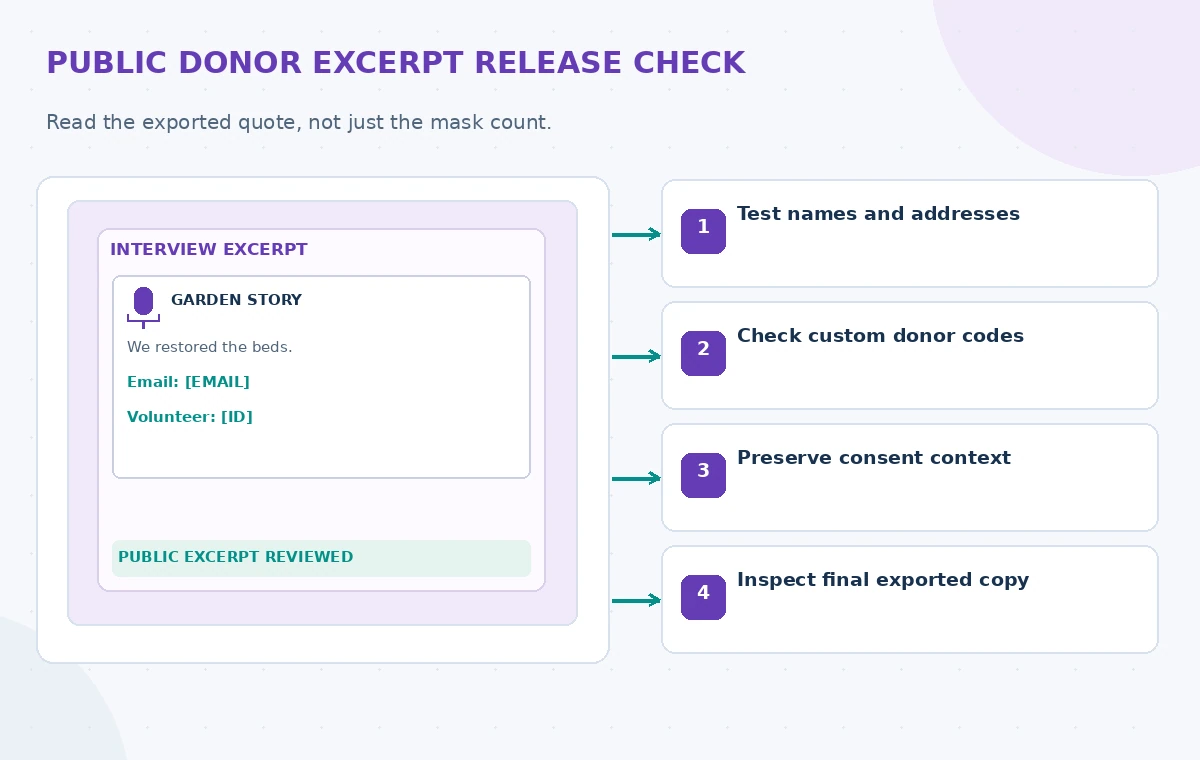
Plan a stop condition for a failed template lookup, partial transformation, unsupported format or unexpectedly empty finding list. Never ship the original excerpt as a fallback if de-identification fails. Keep the original and public version linked by an internal revision record, not a public trace containing the sensitive values. Review whether third-party names and archival permissions require a separate release approval.
Publish a source-linked, consent-aware proof
The final reviewer should see the source record identifier, approved purpose, current template version, inspection findings summary and the actual public excerpt. Verify that no concealed text, spreadsheet property or media transcript reintroduces removed details. Make the narrative read naturally without silently changing the donor’s substantive meaning; when a precise claim cannot be retained safely, use an approved paraphrase or omit it rather than inventing replacement facts.
This guide uses invented examples, not live Google Cloud output or a legal determination. De-identification is a preparation step within a broader release process. Success means a person with appropriate authority approves the specific, understandable excerpt and the sharing rights—not that the API reports a completed job or a number of masked characters.
How We Research
For this November 2026 article, we examined three named official references: Google: Create de-identification templates; Google: De-identification templates REST reference; Google: Sensitive Data Protection API. We compared documented configuration, request behavior and limitations with a fictional nonprofit use case. The resulting narrative and diagrams are an editorial design exercise. We did not use real records, invoke vendor services, test accuracy, time API responses, conduct a security audit, or obtain actual publication rights. An implementation should recheck model, region, account, IAM, costs, privacy law, source status and the organization’s approval policy before processing any real material.
Frequently Asked Questions
No. Inspection defines what to find; de-identification defines transformations to apply.
Not necessarily. Custom detectors and human review may be needed.
No. Context and other identifiers can still identify a speaker.
The service distinguishes infoType and record transformations; choose and test the appropriate type.
No. Privacy processing does not replace permissions, consent or editorial review.