
A dispatched thumbnail job is not a finished thumbnail
Suppose a museum queues an image derivative for a new exhibit kiosk. A queue dashboard shows an attempted task, but the publication database has no approved thumbnail. It is tempting to count each dispatch as a completed transformation. That would disguise dropped responses, worker crashes and tasks whose handlers replied before durable storage was confirmed.
Cloud Tasks gives useful attempt metadata, but a queue is not an archive ledger. A task might be retried after a timeout even if a handler partially completed its work. Build separate concepts for scheduled, dispatched, responded, output stored and human-approved. Only the latter states can justify updating the public exhibition catalog.
Identify firstAttempt and lastAttempt precisely
The Cloud Tasks v2 Task resource documents firstAttempt and lastAttempt as output-only Attempt objects. It states that firstAttempt retains only dispatchTime; other Attempt details from the first attempt are not retained. Therefore a firstAttempt field cannot tell an auditor the full first HTTP status or why the initial worker failed.
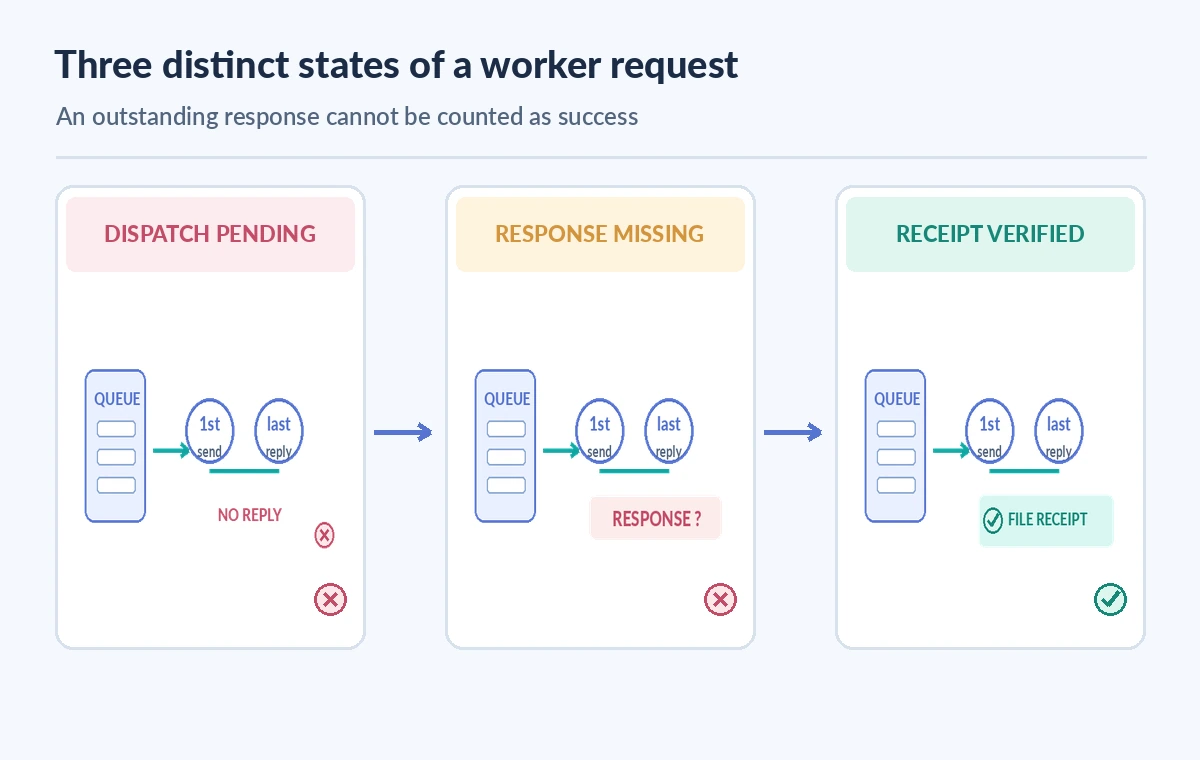
By contrast, lastAttempt contains the status of the last attempt, with documented scheduleTime, dispatchTime, responseTime and responseStatus fields where available. A missing value does not automatically mean success or failure. It may mean the attempt has not yet happened, is running or the task is in a state that lacks that observation.
Contrast dispatchCount with responseCount
The Task schema defines dispatchCount as the number of dispatched attempts, including requests that have not yet received a response. responseCount counts attempts for which a response was received. They describe queue observations, not unique business operations, and neither is proof that a valid image derivative was committed.
In an illustrative audit record, dispatchCount might exceed responseCount while a worker request is in flight. Do not present that difference as a confirmed number of failed uploads. It could reflect outstanding attempts, transport behavior or retry timing. Investigate the worker and queue logs using approved identifiers and a bounded time window.

Read attempt timestamps as separate events
scheduleTime records when an attempt was scheduled, dispatchTime when it was sent, and responseTime when a response was received. A long gap between scheduled and dispatched is not the same as slow worker execution; it can reflect queue capacity, rate limits or the time a queue remained paused. Avoid labeling each interval simply latency.
A worker can also spend time writing to storage after the queue-facing request begins. In a robust design it acknowledges successful work only after the durable output and idempotency record are committed. A 2xx HTTP response by itself cannot certify that the image content meets size, rights or accessibility requirements.
Make a three-state comparison that a reviewer can understand
A task waiting in the queue has no completed delivery, a dispatched task with no responseTime still lacks a verified reply, and a task whose output exists in storage and has a reviewed receipt satisfies a separate business checkpoint. The conceptual graphic depicts those different states rather than simulated live Cloud Tasks telemetry.
Use a unique job ID to connect queue state to a source image version and expected derivative. In the museum database, preserve a stable derivative key and a processing revision. Do not rely on a task name alone as the final asset identity, because a retry or replacement task may refer to the same intended business outcome.
Use GetTask carefully while a task still exists
Google documents projects.locations.queues.tasks.get for retrieving a task and its responseView option. BASIC is the default and omits potentially sensitive content. FULL requires cloudtasks.tasks.fullView. Avoid granting full payload access merely to investigate timestamps when the basic view and sanitized worker logs are sufficient.
Successfully executed or exhausted tasks are deleted from Cloud Tasks, and the GetTask method can return NOT_FOUND for them. That is a key audit limitation: a missing task is not proof that the thumbnail was accepted, nor does it by itself prove it never ran. Durable operational evidence must live in a separate authorized system.
Correlate a worker receipt without duplicating output
The worker should generate or recognize an idempotency key derived from the approved source version and derivative specification. It can store a receipt identifying the resulting object key, processing revision, checksum method and validation status. On a retry, it consults that state instead of creating a second public asset unconditionally.
If the original handler wrote a file but the queue timed out before receiving its response, the next attempt may legitimately see the existing output. The safe behavior is to compare it with expected metadata and mark the operation reconciled, not blindly run the costly transformation again or claim both attempts generated different images.
Handle status ambiguity and response codes honestly
responseStatus is an Attempt field describing the last worker response when that response exists. It should be logged alongside responseTime and the queue-specific task identifier rather than transformed into a generic successful label. A temporary 503, a timeout and a valid application-level rejection require different remediation even if all lead to retries.
Keep transport authentication separate from diagnostics. Cloud Tasks request headers are useful context but are not sufficient authority for a handler. Validate tokens and routing by the documented target configuration, then authorize the requested transformation using server-side policy. Do not place raw personal or archival source material in retry dashboards.
Rehearse the failure paths before exposing an approval badge
Use synthetic jobs for a clean delivery, a slow worker, a response that never reaches the queue, a duplicate attempt and an already-finished output. Confirm that the dashboard never translates dispatchCount into a count of successful files. Deliberately verify what the operator sees after GetTask returns NOT_FOUND.
A useful test ensures that the firstAttempt display shows only the first dispatch timestamp, not a fabricated first response. Another confirms that an absent responseTime is labeled unknown or in progress. These are recommended fixture checks, not experiments conducted for this article.

Release a derivative only after two distinct confirmations
The technical confirmation is a stored, version-matched object with appropriate integrity and output checks. The editorial confirmation is an authorized review of content, rights, crop, alt text and intended public location. Neither confirmation can be inferred directly from the Task attempt object, no matter how tidy the queue dashboard looks.
This document is based on official Google Cloud Tasks API references and a hypothetical museum pipeline. We did not operate a queue, measure retry rates or retrieve private task payloads. Review API access controls and service behavior in your own region before using these fields in incident response.
How We Research
For this November 11, 2026 desk review we checked named primary documentation: Google Cloud Tasks Task and Attempt resource; Google Cloud Tasks GetTask method; Cloud Tasks monitoring documentation. We compared the vendor-defined fields and limits with a fictional museum workflow, identified states that the API cannot prove, and designed original diagrams to show the boundaries. We did not access a live customer account, upload or modify files, run API calls, inspect private records, verify service performance, or claim empirical success rates. Preview features, permissions and product behavior can change; confirm current release notes, your organization’s contracts, and human legal or editorial approval before deploying.
Frequently Asked Questions
No. Google documents that only its dispatchTime is retained in firstAttempt.
The dispatch count includes sent attempts that have not received a response; the difference is not a confirmed count of failed business operations.
No. Cloud Tasks deletes tasks after successful execution or retry exhaustion, so check the separate worker receipt and output object.
It omits fields that may be large or sensitive; FULL retrieval requires an additional IAM permission.
No. Attempt data describes queue execution, not the institution’s copyright or editorial review.