
The timeout that looks like a failed export
A museum digitization service queues an HTTP task to turn a large photographic scan into several delivery sizes. The worker uploads the images and records a manifest. On a slow day, the request reaches its dispatch deadline before Cloud Tasks receives a success response. An operations dashboard marks the attempt as failed and the task may run again. But the first worker may still be writing files. If the second attempt chooses new object names or sends another completion email, an ordinary timeout can create multiple apparently valid exports. Cloud Tasks dispatchDeadline controls how long the service waits for an attempt, not a universal guarantee that downstream work has stopped. Design around the uncertainty before increasing the timeout.
Use the documented HTTP deadline range
In the Cloud Tasks v2 Task resource, dispatchDeadline is a duration string expressed in seconds, such as “600s”. For HTTP tasks, the documented default is ten minutes and the allowed range is 15 seconds through 30 minutes. App Engine tasks have different timing rules and must not be treated as identical. When the deadline is reached, Cloud Tasks stops listening for the response, marks the attempt DEADLINE_EXCEEDED and applies the configured retry policy. The worker may or may not react to the canceled request. Choose a realistic deadline based on the worker’s own timeout and workload design; a maximum-length task is not automatically a robust export pipeline.
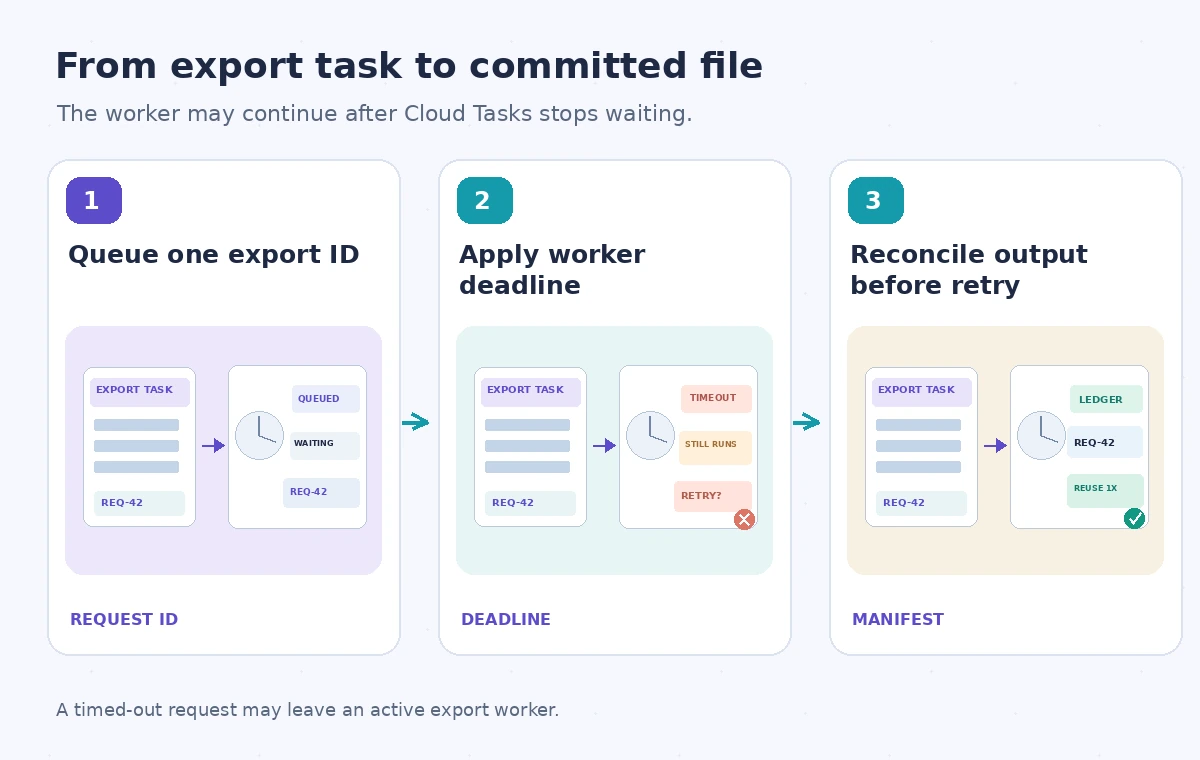
Separate request acknowledgment from artifact completion
The export workflow should have its own stable export_request_id, for example a hash of the accession, source generation, transformation profile and requested destination. Store this ID in a transactional ledger with states such as queued, processing, complete and review-required. The task handler checks the ledger before starting any file write. It reserves or renews the work item using a concurrency-safe operation, then writes images under deterministic temporary keys. Only after validating the expected files does it commit one approved output manifest. The HTTP response acknowledges the attempt, while the durable ledger establishes whether the business operation completed. These signals should never be conflated in a curator’s dashboard.
Match the deadline to the real execution stages
Break one export into measurable phases: fetch source, verify source version, transform each image, upload derivatives and commit the manifest. If a single request frequently approaches the HTTP deadline, consider smaller independently retryable tasks rather than relying on a longer wait. Set the handler’s own timeout to a coordinated value and leave room for a clean acknowledgment; the documented behavior still requires safe recovery if timing races occur. Keep record of which stage ran and which output keys were written. Use a synthetic large image fixture to verify cleanup and restart behavior. A successful test should include both a normal response and an intentional deadline exceedance, without assuming the worker was immediately terminated.
Compare a slow, failed and reconciled attempt
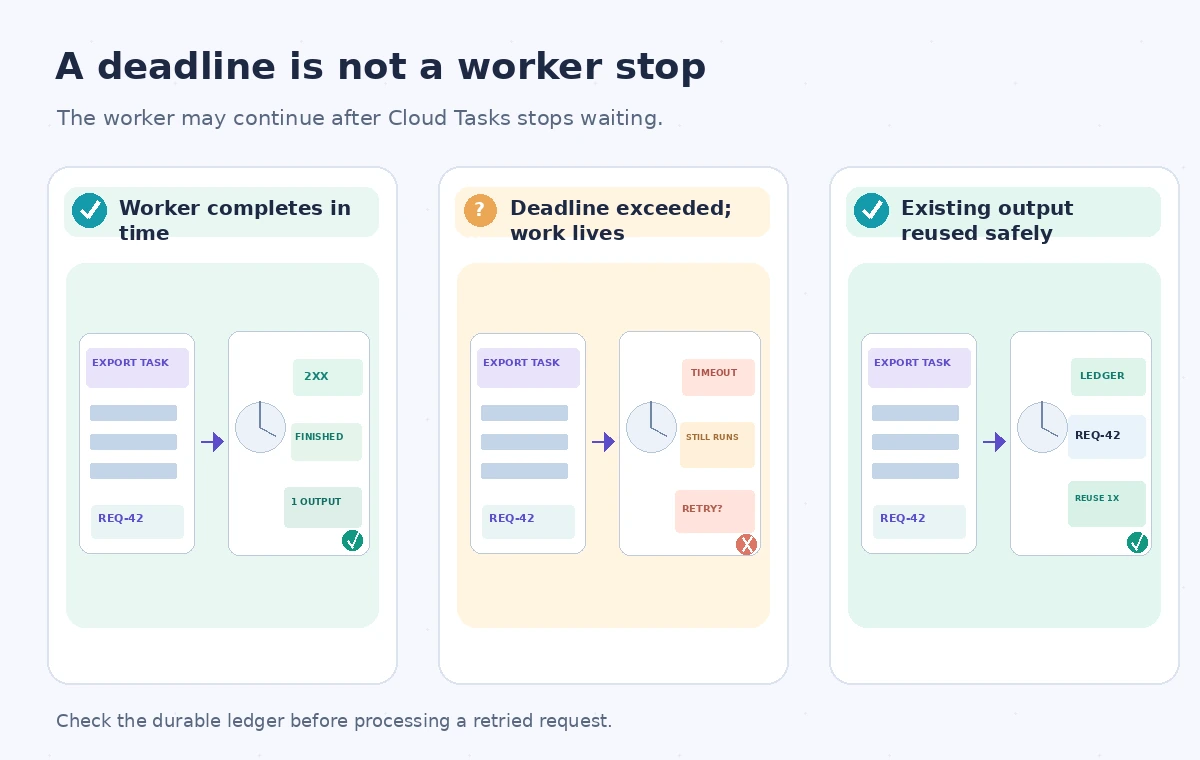
One illustrative state shows a worker finishing and returning a success status before the deadline. The second shows an attempt whose deadline expires even though a background upload is still progressing; Cloud Tasks is free to retry according to its policy. The third shows a replayed attempt finding an already completed export_request_id and returning the existing manifest rather than creating a duplicate export. These are design scenarios, not claimed observations of a live museum queue. The visual comparison should make the overlapping-worker danger explicit. Increasing a number in the task configuration alone would leave the duplicate-export failure mode intact.
Use retries without multiplying notifications
Cloud Tasks considers a non-2xx response or an attempt without a successful response by its deadline eligible for retry, subject to queue and task retry settings. Workers therefore need idempotent side effects. For the example, an email should be sent only after a durable completion marker is committed, and its notification ID should be recorded independently so two attempts cannot announce the same export twice. Prefer a separate notification task tied to the completed manifest. A webhook that returns 200 before its output is durable can lose recovery opportunities, while a worker that waits until every optional action finishes can increase timeout races. Define the acknowledgment boundary deliberately.
Check storage and source-generation consistency
An export may be duplicated not only by retry timing but also by reading different versions of a source scan. Pin the input generation or equivalent immutable source reference and include it in the export ID. Verify the expected image count, dimensions, checksum policy and derivative rights metadata before marking a manifest complete. If a worker sees an existing output with a conflicting source generation, do not silently reuse it; put the item into an investigation state. Temporary objects should have a cleanup policy that never removes a completed or under-review master. Record the output destination separately from success status so a museum archivist can open the exact files being approved.
Build a recovery drill with realistic failures
Run a staging exercise with a short supported deadline and a worker that deliberately continues long enough to expose the race. Use synthetic scans, a fake email endpoint and a ledger that can be inspected without privileged production access. Trigger one task, allow its response to time out, and let a later attempt encounter the same request ID. Check that only one committed manifest and one final notification exist even if temporary artifacts were produced more than once. Repeat with a worker crash before commit and with an upload that partially succeeds. Document where the operator must intervene instead of automatically retrying a rights-sensitive export.
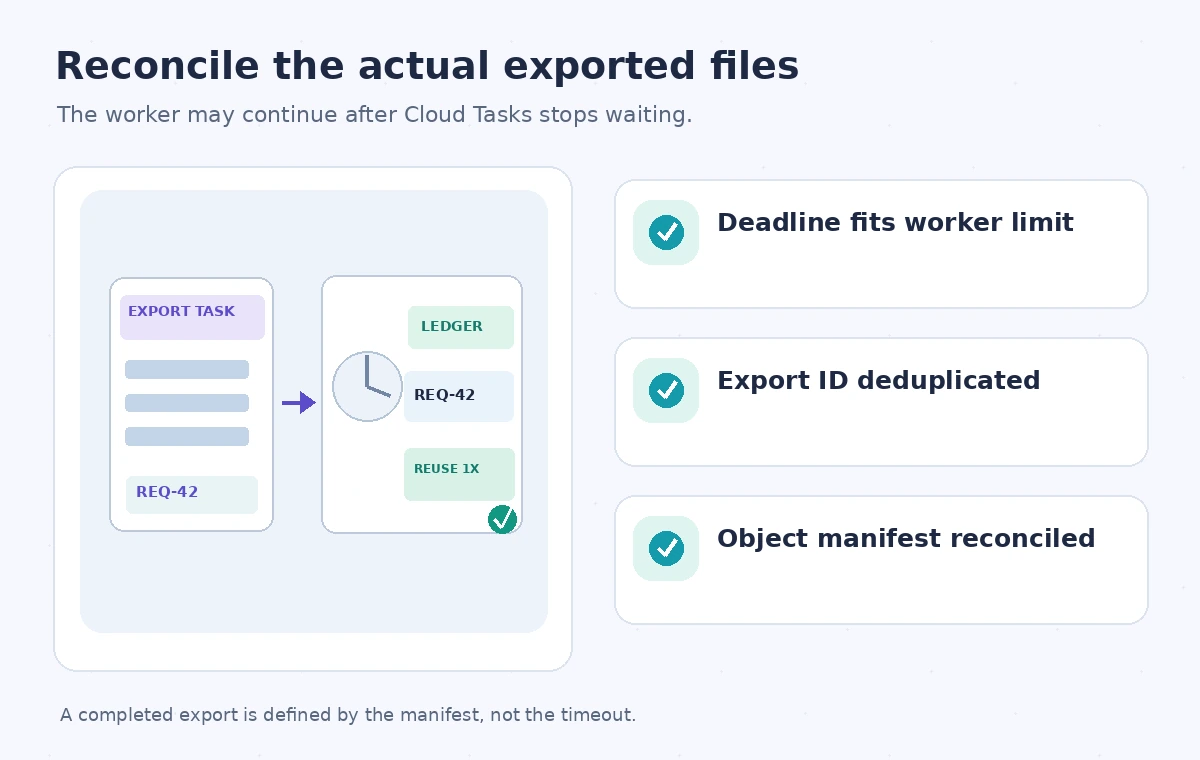
Give staff a verifiable completion signal
A collection manager should see the export request, approved source version, derivative list, manifest checksum and a timestamp for the committed operation. The queue’s attempt count and DEADLINE_EXCEEDED status are useful diagnostics but cannot be the whole acceptance decision. If the durable state is still processing after an ambiguous timeout, show review-required and reconcile actual storage before dispatching another manual request. Revisit the worker design when scan sizes, transformations or deadline limits change. This approach makes timeout handling a repeatable workflow rather than a guess about which of two workers finished first, and it avoids claiming a live performance result that was never measured.
How We Research
For this guide we consulted the official documentation: Cloud Tasks REST Task resource; Understand Cloud Tasks. We compared named fields, supported behaviors and stated limitations, then developed an instructional museum scenario with explicit failure states. We did not run a live vendor API benchmark, inspect a production museum system, or measure vendor performance. The workflow and illustrations are proposed review steps; verify API-version support and your organization’s current policy before applying them.
Frequently Asked Questions
Google documents ten minutes by default, with an allowed range of 15 seconds to 30 minutes.
Not necessarily. It stops listening for the response, but the worker can continue processing.
A deadline-exceeded attempt is failed and may be retried according to configured retry behavior.
Use one deterministic export ID, concurrency-safe ledger and committed manifest that every attempt checks.
No. Check durable manifest, source generation, artifact integrity and editorial approval separately.