
Three small museum websites use similar checks for broken links, accessible alt text and approved exhibit dates, but maintainers have copied their GitHub Actions YAML into every repository. A reusable workflow can centralize tested steps through `workflow_call` while letting each site pass carefully defined inputs. Centralizing logic is not the same as centralizing access to credentials or permission to deploy. This hypothetical guide explains how to reduce copy-and-paste drift while retaining independent reviews and protected publication rules.
Choose what belongs in a reusable workflow
Start with tasks that have a stable contract across sites: linting content schema, checking required source links, validating image dimensions, running unit tests or producing an audit artifact. Keep project-specific publication commands outside the shared component unless the release process has separate authorization. A reusable workflow is invoked by another workflow as a job, not pasted as an arbitrary shell command.
Map the three fictional sites to their input data: one has a ceramics directory, another a natural-history exhibit list, and the third a bilingual events page. They can share a link-checking policy while using different content paths. Define the checks and output artifact names before migrating YAML. If two sites legitimately use different editorial rules, document the difference instead of forcing one hidden conditional to guess.
Define a typed workflow_call interface
GitHub requires a reusable workflow in `.github/workflows` with `on: workflow_call`. Inputs may be explicitly typed as string, number or boolean, and secrets can be declared as part of the call contract. Select narrow inputs such as a relative content path or a test profile. Validate those values before interpolation into scripts, because caller-supplied strings are not inherently trustworthy.
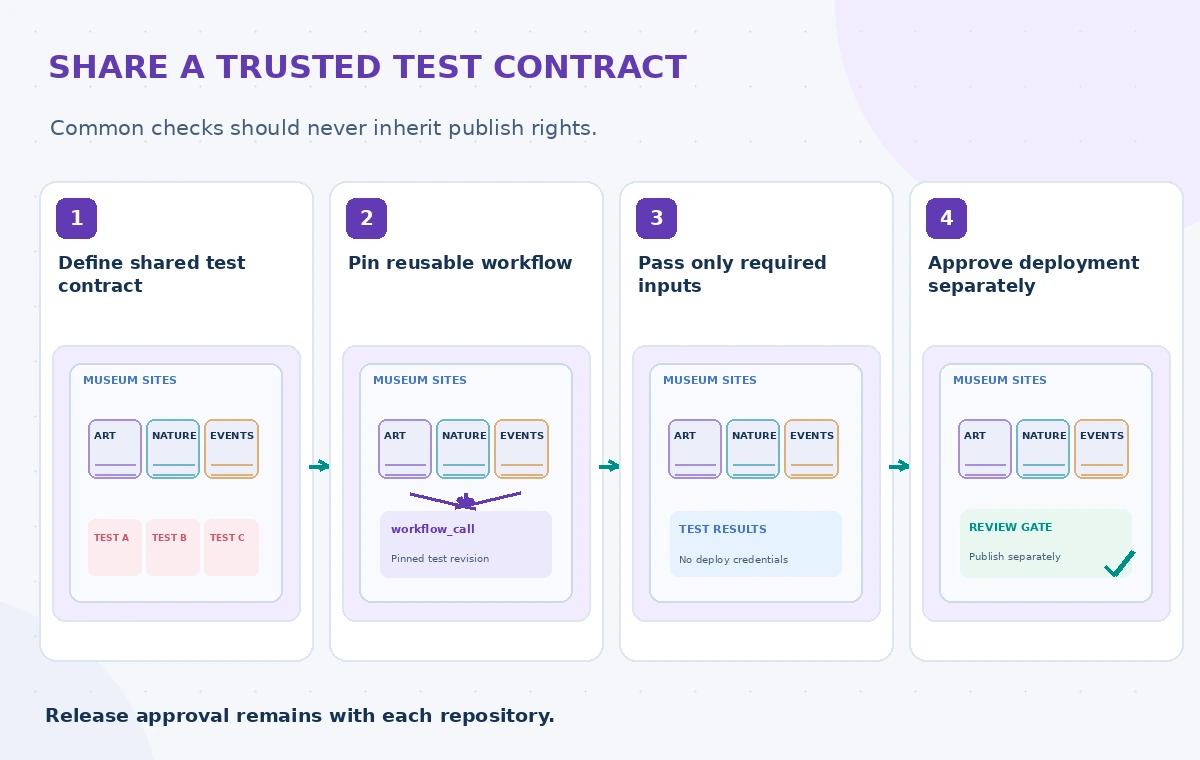
A Boolean flag like “run accessibility checks” should not silently mean “also publish the site.” Use separate workflow and job names for test versus release responsibilities. Document what a successful test run means and what it does not: a passing checker may confirm the presence of alt text but cannot verify every image description against the actual exhibit.
Pin the called workflow and its actions
A caller can reference another workflow by branch, tag or commit SHA. For a critical release path, prefer a reviewed immutable commit to reduce the risk of the called logic changing unexpectedly. Pin dependent actions according to your organization’s policy and review changes to the shared workflow as carefully as changes to site code. Record which revision each site invoked.
A reusable workflow referenced by a moving branch makes updates easy but also changes test behavior for multiple repositories at once. Establish a deliberate upgrade schedule: test the new revision on a staging branch, inspect the diff, then update each caller. A single shared workflow should improve consistency, not create an unreviewed point of failure.
Pass the minimum permissions and secrets
GitHub documents named secrets and the `secrets: inherit` option for eligible organization or enterprise workflows. Inheritance is convenient but can expose more credentials than the shared test requires. Declare the minimum token permissions and pass narrowly scoped secrets only when absolutely necessary. A read-only content checker generally should not receive a production deployment credential.
Nested reusable workflows cannot elevate permissions that the caller did not grant. Also, environment secrets are not passed through `on.workflow_call` as normal secret declarations; reviewers need to understand environment ownership at the job boundary. Never assume a called workflow is safer just because its file lives in a central repository. Apply repository-level access controls and inspect the calling context.
Compare copy-pasted checks with a shared contract
Draw the original state as three similar but divergent files, the intermediate state as one reviewed test workflow called with different input paths, and the release state as a separate publication approval. This shows what centralization actually changes: test logic and reporting. It does not combine site repositories or transfer their deployment secrets into one shared job.

Run the same permitted fixture set through each caller. Confirm expected failures for expired exhibition dates, empty alt text and malformed front matter. A unified test may still miss context-specific issues, such as a venue name changed after the event was canceled. Make every result traceable to the site commit, reusable workflow revision and test configuration.
Treat inputs and artifacts as untrusted
Pull requests and external contributions may supply file paths, metadata or test files. Even if the reusable workflow itself is reviewed, executing caller-controlled content with elevated permissions can break the boundary. Keep untrusted checks in low-permission jobs, verify artifact integrity and avoid evaluating arbitrary shell expressions from user data.
Do not use a shared workflow to fetch and execute unrestricted scripts from the caller simply because the file is named “build.” Validate inputs and use fixed commands. If a test artifact crosses into a more privileged release job, independently check its source commit and provenance. A green result does not authorize deployment of whatever bytes appear in a downloaded archive.
Separate passing tests from permission to publish
Keep production deployments behind branch protection, repository rules and environment reviewers appropriate to the site. A reusable test workflow can return status and artifacts, but it should not decide whether the museum has permission to publish a photograph or whether an accessibility statement is current. Editorial approval is a separate record with named responsibility.

For a cancelled public program, passing HTML lint cannot make the date correct. Require source-of-truth confirmation before release, and have the protected deployment step consume the exact reviewed commit. When an approval expires or a source changes, rerun both automated checks and editorial review rather than assuming a historical green check is sufficient.
Roll out progressively and document ownership
Migrate one site first, compare old and new test outcomes on a fixed set of allowed examples, then expand. Keep a changelog of shared workflow versions and a plan to revert callers if a regression appears. Give both code owners and site editors a clear route to report false passes or overly broad checks.
Review workflow revision pins, token permissions and input schema after platform changes. Test a forked pull request scenario where applicable to confirm it cannot access secrets or deploy. These diagrams illustrate general trust boundaries and hypothetical sites only; no actual GitHub repositories, security scans or deployment runs were used to produce this article.
How We Research
For this November 2026 article, we reviewed official vendor sources: GitHub Docs: Reuse workflows; GitHub Docs: Workflow syntax; GitHub Docs: Secure use of GitHub Actions. We checked documented feature scope, parameters, examples, and limitations against a clearly hypothetical nonprofit workflow. No private records were processed, live vendor tests were claimed, measured performance reported, or publication authorization granted. All accompanying illustrations are original conceptual teaching graphics, not product screenshots or experimental results. Before deployment, recheck the current API documentation, eligibility, availability, security requirements, data rights, and site-specific policies.
Frequently Asked Questions
No. A reusable workflow is invoked at the job level through workflow_call; a composite action packages steps.
In certain organization or enterprise contexts, yes, but explicitly passing only necessary secrets is usually safer.
No. Permissions can be maintained or reduced across nested reusable workflows, not elevated.
No. Publication needs its own policy, authorization and editorial checks.
For sensitive workflows, prefer a reviewed immutable commit or a carefully governed update process.