
Why sharing a test workflow is not permission to share secrets
A museum maintains several captioned exhibit sites that use the same accessibility QA steps. A reusable GitHub Actions workflow can run those checks across projects, saving maintenance effort. But the site repository may also hold credentials for publication, cloud storage or private content feeds. The caption test generally needs no production publishing secret. Reusable workflows are called from a job using workflow_call definitions and can receive declared inputs and secrets. The important question is not just whether the shared workflow runs, but what credentials it receives and whether it can trigger deployment. The sample pipeline here is illustrative. We did not access repositories, run CI or test a live secret, and the diagrams are not GitHub screenshots.
Declare the interface before connecting a caller
In the reusable workflow, place on.workflow_call under the workflow’s trigger definition. Define required inputs such as a caption-fixture path or test locale, with the appropriate type. If a secret really is needed, declare a specifically named secret with the documented required setting. A caption checker that validates synthetic text should usually avoid secret input entirely. Keep the interface minimal and document exactly why any exceptional credential is required. Do not encode secrets in ordinary with inputs or environment variable literals in source-controlled YAML. The called workflow can refer to the secrets context when the caller makes them available, but an input declaration is not permission to retrieve arbitrary organization credentials.
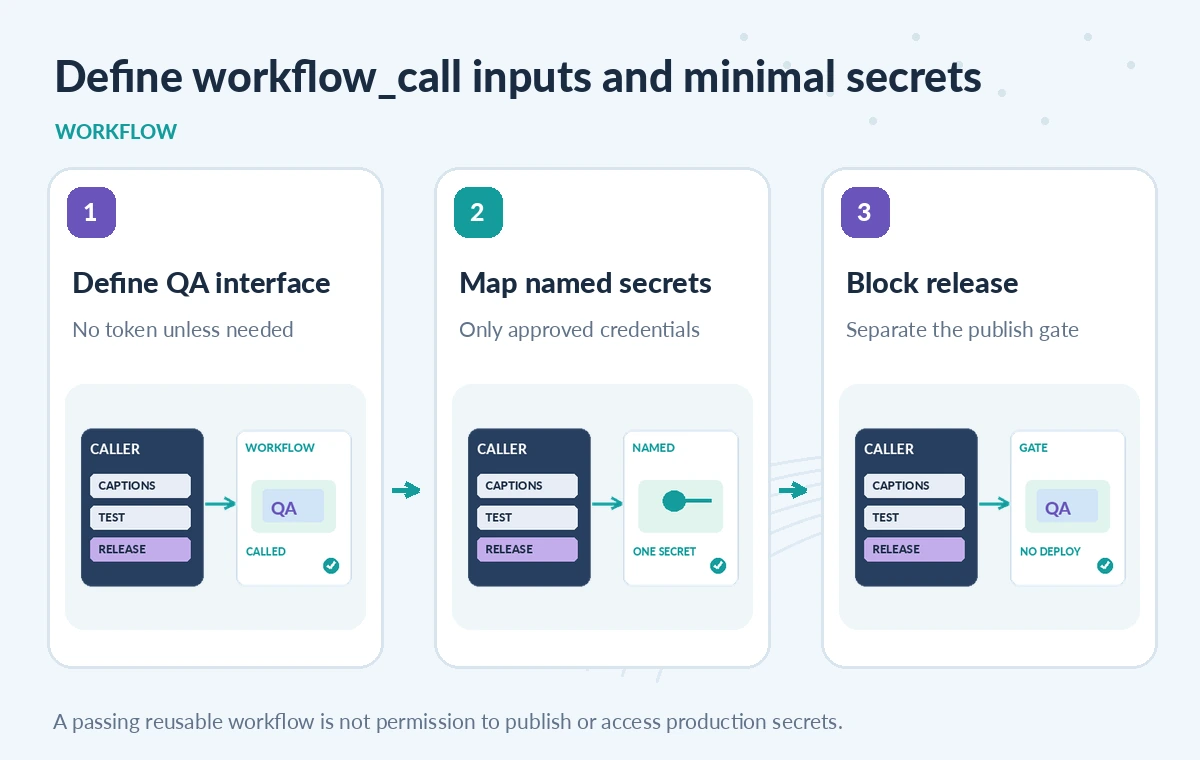
Prefer named secret mappings over secrets: inherit
GitHub supports passing selected secrets explicitly, or inheriting available secrets for eligible same-organization or enterprise reusable workflows. The inherit form can be convenient, yet it widens the set of available credentials and makes code review harder. For a caption QA job, prefer a named map with only the credential that job demonstrably requires. If no credential is required, omit the secrets map. A reviewer should examine both the caller and called workflow files, not just the one line invoking the reusable workflow. Remember that repository and organization secret visibility policies also matter. A secret that is available to a workflow should not be assumed safe to expose to every action the workflow executes.
Model the boundaries in a nested call chain
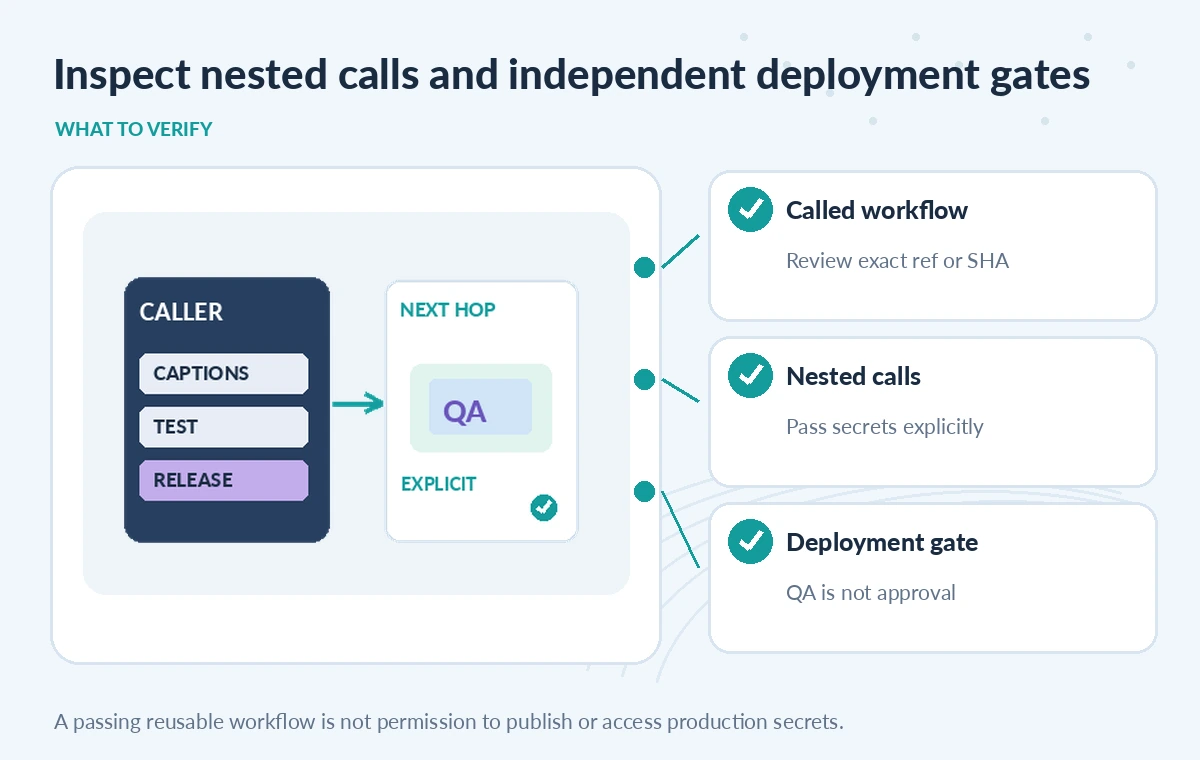
Reusable workflows can call other reusable workflows. GitHub documentation explains that secrets passed to one called workflow are not automatically passed to the next; a nested call must pass them again using its own secrets mapping. Draw the chain as a series of boundaries: public site caller, centralized caption QA workflow and a downstream optional publishing workflow. The first two should not be a shortcut for granting the third access to deployment credentials. Verify permissions at each hop. A permission granted to an earlier workflow cannot simply be elevated in a later call beyond the caller’s token permission ceiling. Explicitly pass only the minimal values needed for each dependency, and keep the release process behind a separate approval gate.
Distinguish repository secrets from environment secrets
GitHub environment secrets interact with reusable workflows differently from standard repository secrets. The job in a called workflow may specify an environment, while the caller job that invokes the reusable workflow cannot use the environment keyword in the same way. Environment-level values can take precedence when names collide. This makes ambiguous names such as TOKEN especially dangerous. Choose descriptive names, separate test and production environments, and audit exactly which environment applies to each job. Do not assume a secret was transmitted merely because a reusable workflow declared it as required: the documentation distinguishes the presence of a passed secret from whether it has a nonempty value. Test missing-secret failure paths with safe fixtures before release.
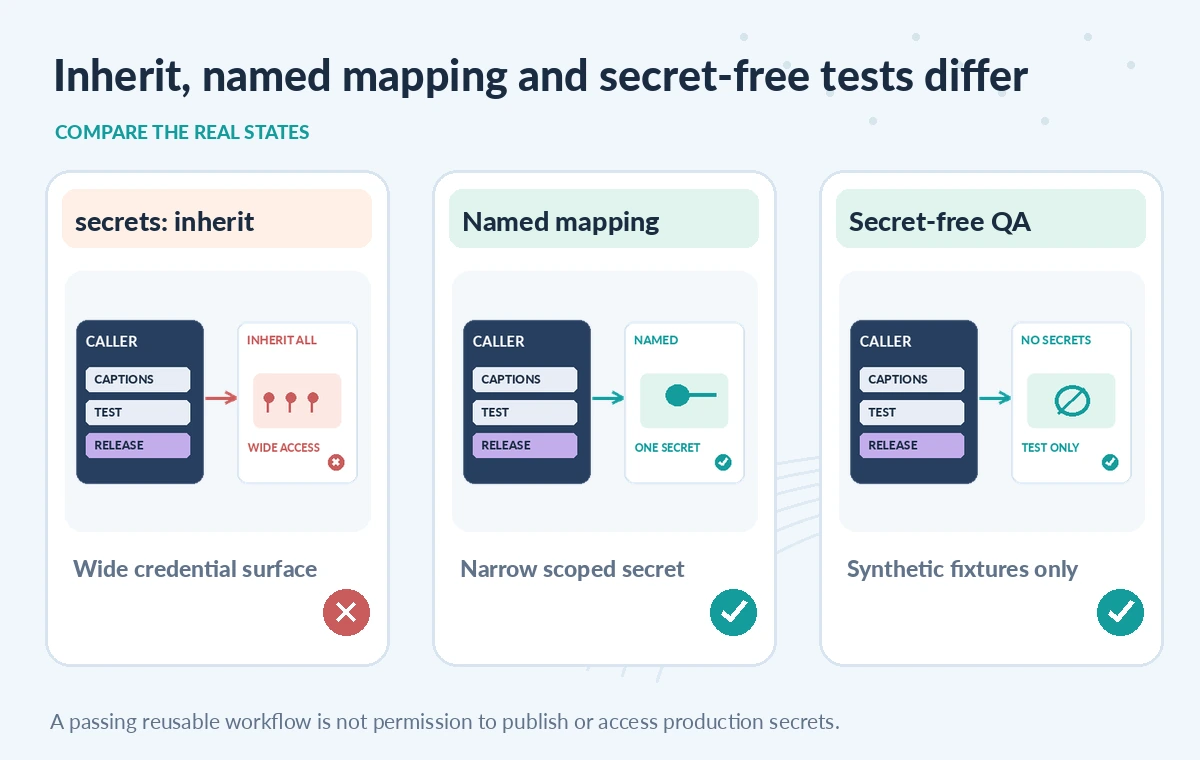
Compare inherited, explicit and absent credentials
Three illustrated designs help explain the choice. An inherited-secret call gives a shared QA workflow access to more available secrets than the check needs. An explicit mapping passes only a documented staging credential when the check genuinely needs one. A secret-free call uses fixtures and read-only steps, offering the smallest credential surface. None of the diagrams represents an actual GitHub run. In every design, also examine GITHUB_TOKEN permissions and the actions used by the workflow. A job with read-only configuration is not safe merely because it declares few secrets if it checks out untrusted code with sensitive context. Restrict execution of scripts and dependencies to trusted sources, and keep deployment credentials out of forks and ordinary pull-request test paths.
Pin the reusable workflow and review external actions
Calling a shared workflow by a moving branch can change its implementation without changing the caller file. For higher-risk release paths, reference an approved commit SHA and review changes before updating it. The GitHub documentation describes how refs behave on reruns, including differences between rerunning all jobs and only failed jobs. Use consistent action pinning policies and a dependency review process for third-party actions. Avoid embedding a private repository token simply to retrieve a publicly available caption fixture. If a reusable workflow requires access to another repository, scope that access to the smallest necessary resource and verify the repository’s permitted use rather than using a broad personal token.
Test the permission boundary, not only the captions
The workflow’s pass status says whether the configured checks ran, not whether its secrets were appropriately restricted. Create safe test callers that deliberately omit an optional credential, pass an allowed named secret and attempt a call that should be denied by policy. Confirm failures are reported clearly and do not print secret material. Check that nested workflows cannot unexpectedly receive the publishing secret. Use GitHub’s logs and repository security settings to audit which workflow revision executed, but never expose raw environment values in debug output. For caption quality, inspect language fixtures and accessibility assertions separately. A green test job is neither a content approval nor a deploy authorization.
Hand off a minimal, reviewable release design
A good release handoff identifies the calling repository, reusable workflow ref, declared inputs, required secret names, GITHUB_TOKEN permissions, nested calls and the independent deployment approval step. Include a simple reason for each secret and a plan for rotation and emergency revocation. The project editor should know which caption languages passed and where the QA evidence lives, without receiving cloud credentials. Re-check the shared workflow interface whenever it changes. Reusable workflows are a maintainability feature; safe permission boundaries are an architectural responsibility. A successful handoff makes it easy to run the same tests everywhere while keeping the authority to publish or access sensitive records tightly controlled.
How We Research
For this guide, we reviewed the official product documentation on November 8, 2026: GitHub Reuse Workflows Guide, GitHub Workflow Syntax Reference, GitHub Using Secrets in Actions. We checked the named setting or feature against its published behavior, mapped the documented constraints to the specific hypothetical scenario, and reviewed whether the topic duplicated titles in the supplied LabFin WordPress inventory or earlier LabFin draft article packages. No authenticated vendor service was run; we did not perform a benchmark, observe real customer data, verify third-party rights or claim operational outcomes. All illustrated records and comparisons are teaching examples. Confirm product documentation and security requirements again before implementing a workflow in a real organization.
Frequently Asked Questions
Generally they must be passed explicitly or inherited through the supported same-organization or enterprise mechanism.
Only when the broad inheritance is deliberately reviewed; explicit named mapping is safer for narrowly scoped QA.
No. Secrets must be passed again to a further nested workflow when needed.
The reusable workflow job handles environment configuration; review GitHub documentation for environment-secret precedence.
No. It proves that selected checks passed, not that content was approved or credentials appropriately scoped.