
The Green Pipeline With a Missing Validation Job
A museum rebuilds a public search index from collection records. The pipeline runs an OCR-import check, a private-record filter test, and a publishing job. A change to the workflow skips the private-record check by mistake. The release job must not interpret that skip as a pass merely because no error was raised. A missing check is different from a successful one, especially when a search index might expose records not cleared for public discovery. GitHub Actions provides job dependency relationships through `needs`, conditional execution through `if`, and a `needs.
Define the Required Prerequisites Explicitly
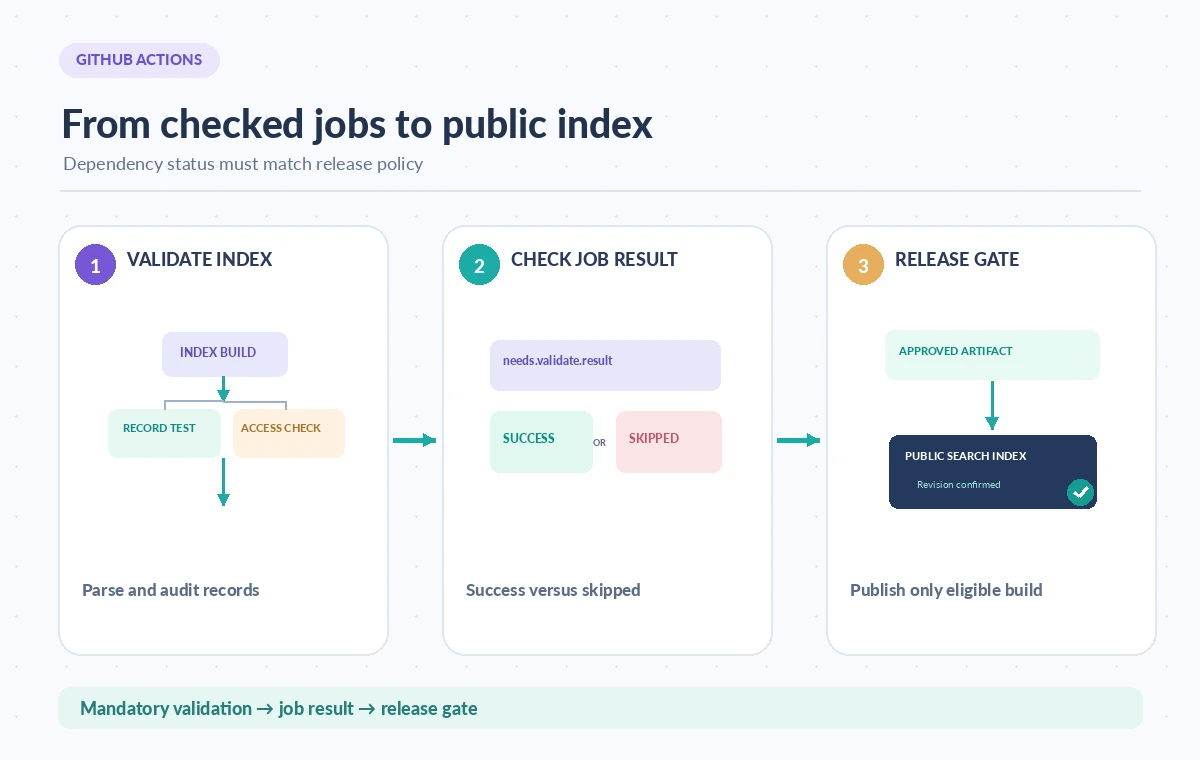
Write down which checks are mandatory before a public index can be updated: input schema validation, restricted-record filtering, and a review of the generated index artifact. Separate optional quality reports from mandatory blockers. A deployment job should declare direct dependencies with `needs` so its status evaluation is based on known named jobs rather than on a vague “the workflow looks green” assumption. GitHub documents that dependent jobs generally require prerequisite jobs to succeed; failure or skip can propagate and skip downstream jobs unless a condition changes the behavior. That default is useful, but developers sometimes add `always()` while building a reporting stage. If the same always-running stage also publishes data, it may inadvertently bypass the intended release gate. State the policy in machine-checkable expressions and independently review the actual dependencies.
Inspect needs.result With the Right Scope
The `needs` context contains information about direct dependencies of the current job. Its `.result` value can be `success`, `failure`, `cancelled`, or `skipped`. Do not assume it summarizes every job in the workflow, including distant transitive dependencies. If a validation task is release-critical, make it an explicit dependency of the publishing job or create a dedicated gate that aggregates the specific outcomes the organization requires. A sensible policy is to allow publishing only if each named required job reports `success` and the validated artifact matches the one selected for release. A skipped result should be handled as “not verified,” regardless of why a workflow condition skipped the job. This does not make the workflow immune to malicious or mistaken YAML changes; protect the workflow itself through branch review and repository permissions.
Make Reporting Separate From Permission to Release
It is valuable to generate a report even after a failed test. GitHub’s expression documentation describes status functions such as `always()` and `!cancelled()` for jobs or steps that need special execution behavior. Its guidance cautions against indiscriminately using `always()` for operations that could hang and recommends `!cancelled()` in certain circumstances. Use these functions deliberately for log collection or cleanup, not as blanket authorization for deployment. The report job can summarize failures and skipped checks without triggering the public-write operation. The deploy job can use a stricter condition that requires all mandatory dependencies to show successful results. That separation makes it easier for staff to see what happened without weakening the release rule. Keep the workflow readable; a clever expression that only one engineer understands is harder to audit during an urgent incident.
Compare Skipped, Successful, and Released States
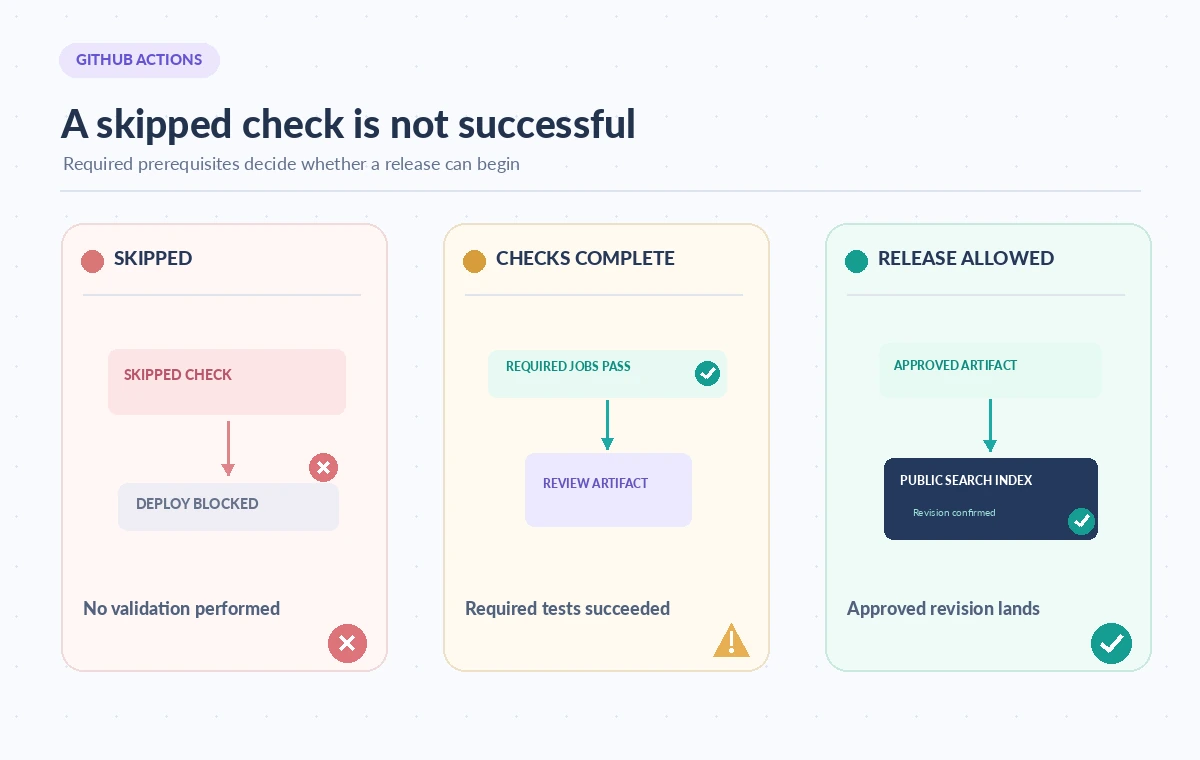
In the comparison drawing, a skipped private-record check is red and stops the chain. A completed validation path is the next state, but it does not alone demonstrate that the public index changed. The third state adds a reviewed artifact and a confirmed public revision marker. These are operationally distinct events, and the dashboard should not call the first two “live.” Use an immutable or content-addressed artifact reference when feasible. The publish job should consume the artifact built and checked by the expected run, not rebuild from whatever files happen to be on the runner later. After deployment, compare the served index manifest or revision ID with the reviewed artifact. Neither `needs.result` nor a GitHub success badge verifies what an external search service currently serves.
Handle Conditional and Canceled Jobs Clearly
Matrix, branch and path filters can make jobs optional in some contexts. A job can be correctly skipped for a pull request that cannot deploy, but a production release should not silently treat that same skip as satisfactory validation. Document when each check is mandatory and encode separate paths for preview runs and production publishing. Review conditions whenever the repository’s branch naming or event triggers change. Cancellation adds another important distinction. A canceled prerequisite may have done partial work, and a canceled publishing job may have altered some external files before stopping. A green later job cannot retroactively undo that state. If a deployment is interrupted, require reconciliation of the live index and the reviewed artifact before a new release, rather than assuming that canceling a run restored the prior version.
Test the Negative Cases Before the First Write
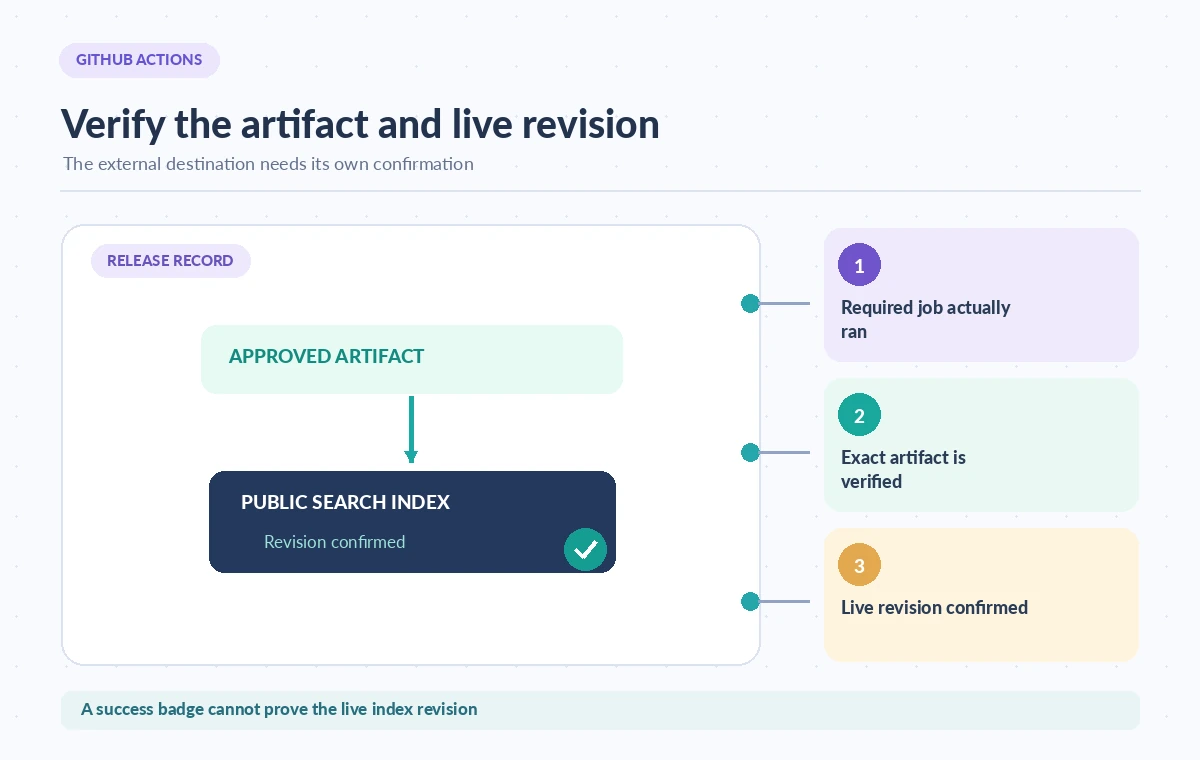
Prepare a test workflow using dummy index files and a harmless destination. Force one prerequisite to fail, another to skip, and then cancel a running job. Confirm that the public-write stage does not run in any prohibited state. Run a happy path in which all prerequisites succeed and check that the artifact and revision marker are preserved through the handoff. These are recommended test cases, not completed measurements. Test a misconfiguration too: a required job is renamed but the gate still references an older name. A robust workflow review should catch the missing dependency at the configuration level. Also inspect what happens when a report job succeeds after another job fails. Its summary can be green without implying that all required validations passed. Keep both the job-outcome list and the release decision visible.
Protect the Workflow, Artifact, and External Index
Source-code review and protected environments add a second layer to the status expression. Limit repository write permissions, keep cloud credentials out of untrusted pull-request contexts, and require appropriate approval for production actions. The deployment should have the minimum external permissions necessary to update the index. Avoid printing private records or secrets in logs simply to make a failed gate easier to diagnose. The final release checklist asks whether every required validation actually completed successfully, whether the exact artifact passed review, and whether the deployed index revision matches that artifact. If any answer is missing, the safe result is “hold for review.” GitHub Actions dependency status is an important signal, but the museum still needs source integrity, protection of private records and a verified deployment outcome.
How We Research
We checked the named primary documentation on November 8, 2026: GitHub: Contexts reference, needs, GitHub: Using jobs in a workflow, GitHub: Expressions and status functions. Our source review focused on the supported feature, input and result semantics, and the practical failure paths used in this fictional scenario. We also compared the proposed title with the WordPress title inventory supplied by LabFin. We did not connect to a product account, submit a live API request, measure accuracy, test regional availability or verify actual client outcomes. Artwork and example records are original conceptual illustrations. Confirm the current feature and model support, terms, costs, permissions and privacy requirements before implementation.
Frequently Asked Questions
GitHub documents success, failure, cancelled and skipped for directly dependent jobs.
No. A skip means the job did not complete its validation, and a mandatory release check should not accept it.
No. The needs context covers direct dependencies, so make release-critical checks explicit.
Not necessarily. Reports may run after failures, but deployment should require the success of every mandatory prerequisite.
No. Verify the revision or artifact hash at the external destination after the write.