
A volunteer writer has a short, original story about a lighthouse keeper, a curious child and a stormy night. She wants an accessible audio edition that a family can follow by chapter and that volunteers can revise if a name is mispronounced. ElevenLabs Audiobooks is a dedicated workflow for uploading a manuscript, choosing single- or multi-cast narration, refining the script, generating audio and exporting individual chapters or a complete project. The challenge is not simply hearing a pleasant synthetic voice. It is to preserve the author’s words, avoid confusing a character’s voice with the narrator’s and document exactly what was checked before distribution. This article uses a fictional manuscript and original story diagrams, not a generated audiobook or live listening result.
Start with a licensed, proofread manuscript
Use an original manuscript or a work for which the full audio adaptation rights have been secured. Confirm that illustrations, poems, epigraphs and borrowed dialogue are also cleared for spoken distribution. Prepare a clean draft with distinct chapter headings, consistent speaker labels and words that should never be modernized or paraphrased. For the lighthouse story, mark the keeper’s recurring phrase, the child’s unusual place name and the exact weather warning that drives the plot. Those are factual-in-story anchors. Keep the manuscript source as a separate read-only file. If a coauthor or illustrator contributed protected wording, confirm who approves a public audio edition. AI narration does not transfer ownership of the written material or excuse an unauthorized voice imitation.
Choose the dedicated Audiobooks workflow and input format
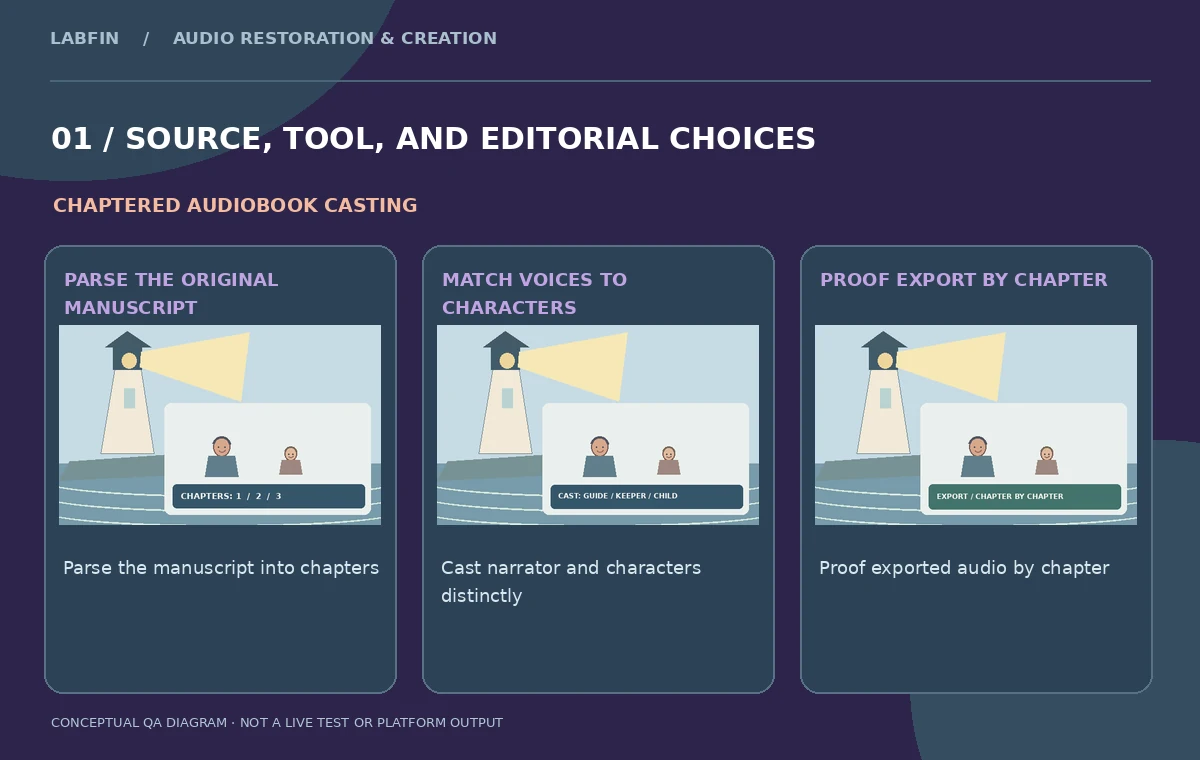
ElevenLabs documents a dedicated Audiobooks product that accepts EPUB and PDF uploads, with single-cast and multi-cast narration options. Its editor can parse and organize chapters and detect characters in a multi-cast manuscript. Do not confuse that product with legacy Voiceover Studio, which its documentation says was sunset in May 2026, or with a generic one-line text-to-speech box. Select the workflow that fits an audiobook rather than merely a quick voice clip. Check account eligibility and any current generation costs before uploading a manuscript. For sensitive unpublished writing, review privacy and retention terms independently and do not use an unapproved public sharing option. The example’s three chapter cards are a planning visualization, not parsed output from a real upload.
Review chapter parsing before spending generation credits
After importing, inspect the chapter list against the original manuscript. A parser may treat a decorative heading, poem break or front-matter note as a new chapter. Rename or reorder items so the story’s beginning, middle and ending follow the approved reading order. The official guide explains that chapters can be managed manually or detected during import. Confirm that scene breaks remain intelligible and that paragraph boundaries do not split a single sentence across incompatible generation chunks. Note the desired pause after chapter titles and before a new speaker. Keep a miniature chapter manifest with chapter number, intended title, first sentence and expected final line. That helps detect missing paragraphs after export without relying on a guessed duration.
Cast narrators and characters without imitating real people
For a multi-cast project, ElevenLabs says Character Casting can suggest voices for detected characters and can change a selected character voice across the project. Audition with the same two lines from the story rather than comparing unrelated examples. The keeper should sound distinct from the child, but both must remain intelligible and appropriate for the audience. Avoid prompts that demand the sound of a real celebrity or a private individual. If one named character has lines inside another character’s dialogue, check whether the system assigns them to the correct speaker. Keep a casting table with narrator, keeper and child, a brief descriptive voice intent and an editor approval column. Automatic detection is a starting point, not a casting director’s sign-off.
Proof names, punctuation and emotional delivery
A chapter can contain words whose normal pronunciation differs from the fictional world’s intended form. ElevenLabs Audiobooks supports pronunciation rules and previews, but an isolated preview can sound fine while a sentence remains awkward. Test the difficult name in its full line. Check acronym expansion, dates, contractions, invented place names and dialogue attributions. Use a text-versus-audio proof sheet to identify words that changed meaning, were dropped or were repeated. Emotion should support the author, not smuggle a new interpretation into a neutral sentence. An unexpectedly dramatic whisper during a safety warning might confuse young listeners. If an engine misreads a passage, correct the text or regenerate the relevant paragraph, then replay before and after the edit in context.

Manage music and sound effects with a light editorial hand
The official Audiobooks documentation allows additional music and sound effects on separate timeline tracks. A distant bell or a quiet storm bed could help establish the lighthouse, but they should never hide a plot-critical instruction or replace the story’s prose with invented action. Review ownership of every added sound, including generated effects under the product’s current terms. For audiences who have difficulty following speech against music, provide a narration-forward edition when possible. Evaluate background effects on a phone speaker as well as headphones. When the scene moves between indoor and outdoor locations, use intentional fades and avoid sudden loudness jumps. The audio should be accessible even when the listener ignores all effects and hears only the narrator and characters.
Export by chapter and check the full listening experience
ElevenLabs documents export scopes for a whole project or individual chapters, plus MP3, WAV, a chapter-based ZIP, subtitles and timeline data options. The interface can finish ungenerated passages during export and consume credits, so review generation status first. Listen to the beginning and end of every exported chapter and verify that the count and order match the manuscript. Compare lengths and titles with the chapter manifest, but do not interpret a length difference alone as proof of a missing sentence. Check for abrupt reverb changes, speaker swaps, clipped endings and duplicated paragraphs. Before uploading to a listening service, confirm that any subtitles or text files use the approved manuscript wording rather than an intermediate draft.

Keep a provenance and accessibility handoff
Deliver the manuscript, permission records, voice casting map, pronunciation rules, chapter manifest, final audio and listening corrections. Document that narration was synthetically generated and avoid implying that the author or real actors recorded it. If a human later updates a chapter, preserve a new version rather than silently replacing an old file in a way that confuses listeners. Check the platform’s current export and publishing requirements independently, including whether individual distribution channels need separate artwork or metadata. A useful audiobook workflow makes the story easy to navigate, preserves the intended character identities and gives future editors a trustworthy way to correct a chapter without rebuilding an opaque, unreviewable project.
How We Research
This ElevenLabs Audiobooks guide is independent editorial guidance grounded in official documentation: ElevenLabs Audiobooks guide; ElevenCreative Studio overview; ElevenLabs Studio audio project chapters. The illustrated scenario is a fictional original three-chapter children’s story with a narrator, a lighthouse keeper and a curious child. We checked the vendor-described capabilities and important eligibility conditions, then mapped a sequence of editorial reviews that readers can repeat with their own authorized media. The images are original teaching diagrams, not product UI screenshots, generated exports, results of a live account test, or measured benchmarks. We did not upload private recordings, access a paid vendor account, run a real A/B experiment, measure performance, or verify hypothetical timecodes. Retain source assets, check current plan availability and privacy settings, and review exported media and metadata before publication.
Frequently Asked Questions
Its current dedicated Audiobooks guide lists EPUB and PDF manuscript uploads.
The documented multi-cast workflow uses Character Casting, which still needs human review.
Yes. ElevenLabs documents full-project and individual-chapter exports, including chapter-based files.
No. ElevenLabs says the legacy Voiceover Studio was sunset in May 2026; use its current Audiobooks or Studio product.
No. Read along, proof names, review the complete render and maintain source and revision records.