
An AI-generated research summary cannot repair a poorly specified search. If a query asks about adult clinical trials but the results contain animal studies, case reports and student surveys, the first problem is retrieval rather than writing style. Consensus provides filters for study design, date, setting and more, making it possible to ask a sharper question before reading the answer.
This guide focuses on those filters, not on Consensus’s overall review or pricing. Its central principle is to build criteria from the research question, test how those criteria change the result set, and preserve enough detail that another reader could reproduce the search. A highly filtered result may still omit important studies.
Turn a broad topic into a searchable question
Begin with the population, exposure or intervention, comparison and outcome. For example, “Does a brief movement break improve attention in adults doing office work?” is more actionable than “Is exercise good for concentration?” Add the study setting or eligible dates only if those attributes matter to the decision. These elements guide both query wording and your filter selections.
Write down essential and optional criteria separately. An essential criterion may be human adults rather than children; an optional criterion may be papers published since 2021. If the first search returns too few relevant studies, loosen optional restrictions before changing the core population or outcome. That avoids accidentally answering a different question.
Start with a baseline search before filtering
Consensus documentation accepts natural-language questions, titles, authors, DOI queries and Boolean operators. Run a broad, accurate query first and inspect the most relevant results. Save the search wording and date. This gives you a baseline for noticing which papers disappear when you narrow the result set.
Use Boolean strings only when they clarify a concept: for instance, “sleep AND (shift workers OR nurses)” can collect related occupational groups. Do not add long chains of poorly researched synonyms just because a search engine permits them. Check whether your target field uses a controlled vocabulary or alternative spellings that need to be considered.

Use study design filters to match the claim
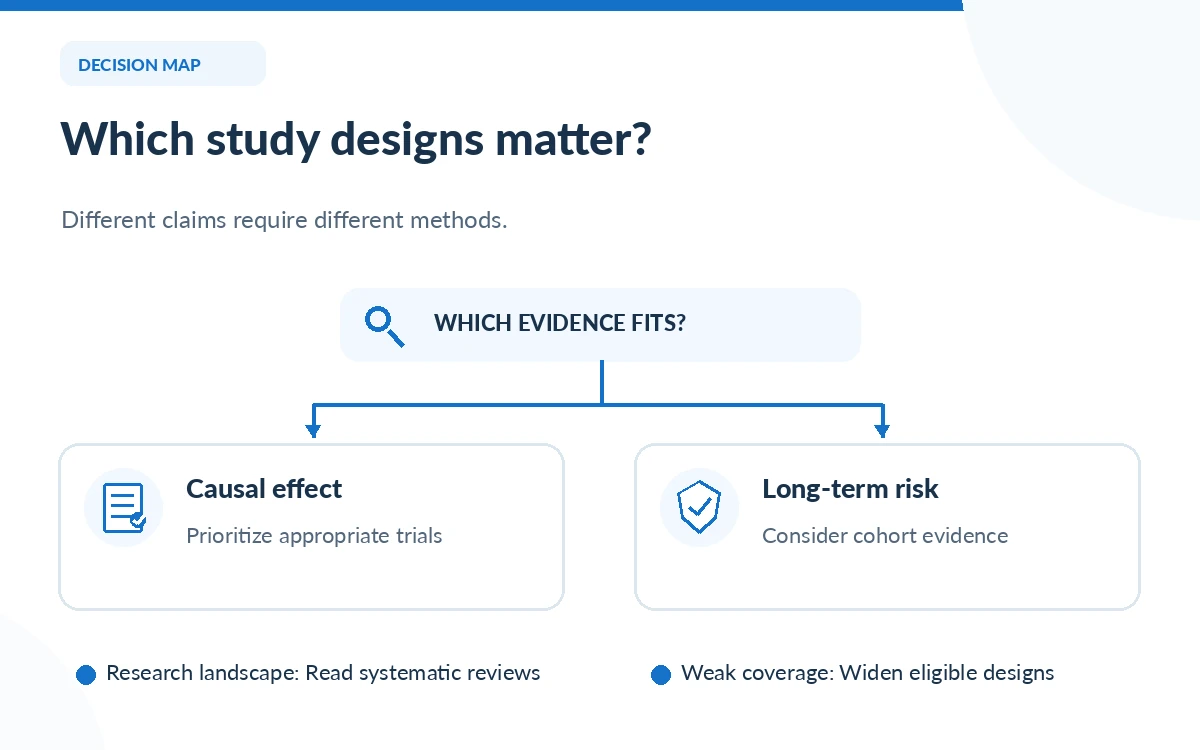
The official Advanced Search Filters guide describes categories including randomized controlled trials, nonrandomized experiments, cohort studies, case-control designs, systematic reviews and meta-analyses. Use a randomized-trial filter when your question concerns causal effects of an intervention, but do not exclude observational evidence when a trial is infeasible, unethical or outside the scope.
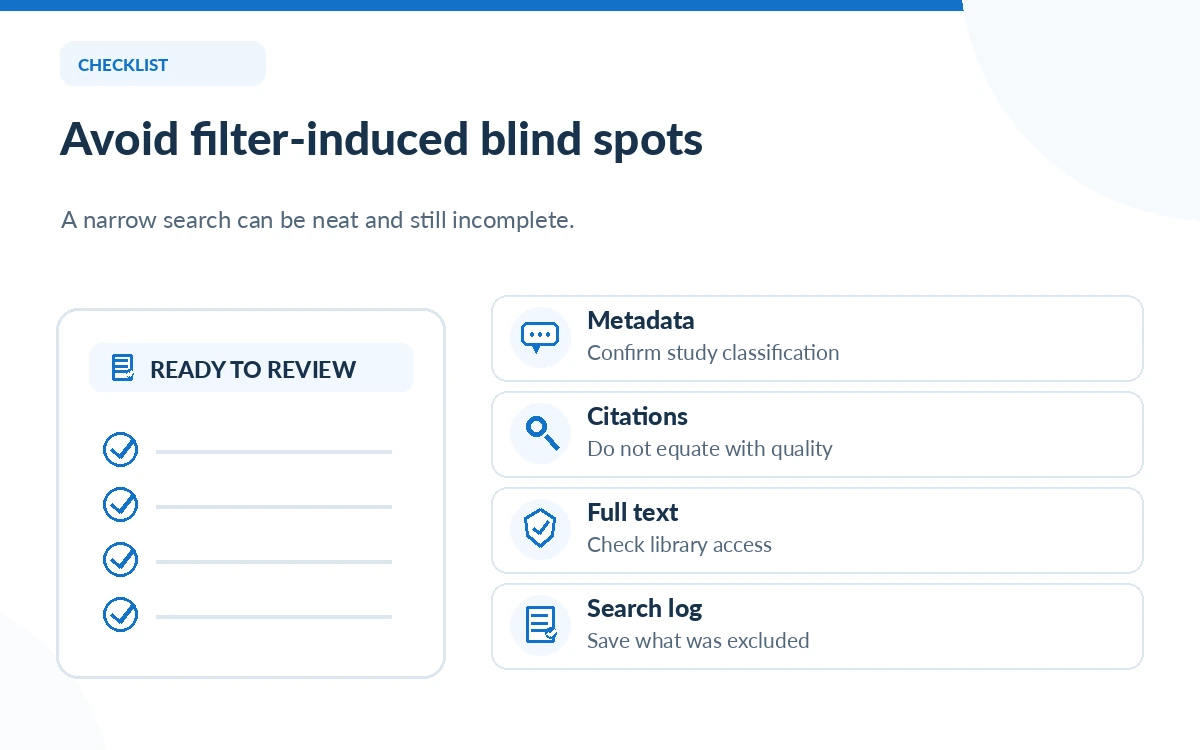
Watch for mislabeled designs in paper metadata. A review article about clinical trials is not itself a randomized trial, and a controlled observational study cannot establish the same causal certainty as random assignment. Open methods sections for a sample of results rather than accepting a filter label as a full risk-of-bias assessment.
Apply population, duration and sample-size filters
Consensus lists filters for human or animal studies, sample size, study duration and several other methodological attributes. These can remove obvious mismatches when a research question requires long-term follow-up or a particular type of participant. Keep the thresholds connected to the question rather than setting arbitrary “high quality” minimums.
A large sample size does not rescue a biased study, and a six-month duration is not automatically superior to a short trial measuring an immediate outcome. Also consider that the database may have missing metadata. A paper absent after filtering may still fit your protocol, so important borderline studies deserve manual attention.
Avoid treating citation counts and journal rank as proof
The filters include citation totals and SJR quartiles for journals. They can assist in locating influential or established literature, but they should not decide whether a result is true. Older work accumulates citations over time; controversial papers may be highly cited because subsequent authors criticize them; new studies may be valuable before they attract attention.
Use open-access and publisher filters for practical access when needed, but document the trade-off. Restricting to freely available full text may exclude important studies available through a library. An honest report distinguishes “not accessible in our search” from “not part of the scientific evidence.”
Use the Consensus Meter cautiously
For certain yes-or-no questions, Consensus shows a Meter that classifies the most relevant retrieved papers as Yes, No, Possibly or Mixed. Its own help center says the meter appears only with enough eligible papers and analyzes a limited group of top results. It is a discovery aid for contrasting positions, not a vote that settles a scientific claim.
Inspect the papers behind each position and verify whether their populations, exposures and measures match your exact question. The vendor notes that classification can sometimes fail to reflect question nuance. When a result seems surprising, correct the question or read the underlying study rather than using a chart percentage as a replacement for appraisal.
Record the search and test its sensitivity
Create a short log with the full query, database/mode, date, selected filters, initial result count and final included papers. Then rerun without one nonessential filter. If several highly relevant papers appear, ask whether your original restrictions were unjustified or whether metadata classification was incomplete.
For a formal systematic review, treat Consensus as a complementary discovery source unless your protocol explicitly validates its coverage. Use the field’s standard databases and independent screening procedures as required. A reproducible search includes exclusions and caveats, not merely a polished AI paragraph that sounds comprehensive.
How We Research
Checked October 26, 2026 using official Advanced Search Filters, How to Search & Best Practices, and Consensus Meter and its documented limitations. The illustrative research questions are editorial examples; we did not run a controlled retrieval benchmark or claim that any filter improves evidence quality by a fixed percentage.
Frequently Asked Questions
Yes. Its study-design filters include randomized controlled trials and other designs. Verify individual methods because metadata and automatic classifications can be imperfect.
No. Citation volume measures attention, not necessarily correctness. It can bias searches toward older papers and overlook newer or undercited but relevant evidence.
A filter may exclude its year, population, access status or misclassified metadata. Remove optional restrictions one at a time and inspect the study directly.
No. Consensus says the Meter typically analyzes 5–20 highly relevant retrieved papers and its classifications can be wrong or miss nuances of the question.
Not automatically. Formal reviews need protocol-defined databases, documented search strategies and independent eligibility checks. Consensus can help discover papers and explore questions alongside those methods.