
Consensus is an academic literature search service with free paper discovery and paid tiers for heavier research synthesis. Its costs are easier to compare when you separate basic paper searches from Pro messages, Deep Reviews, study snapshots and API use. A tool that is inexpensive for quick reading may be poor value for a lab running many deeper reviews every month.
Consensus’s September 2026 subscription guide lists Free, Pro, Deep, Teams and Enterprise. Below are the published US-dollar reference prices and limits as checked October 26, 2026. They are not a personalized quote, and promotions, eligibility discounts, taxes and checkout billing terms should be confirmed before purchase.
Compare the published plans
The Free tier costs $0 and the official guide lists unlimited Papers searches, 10 Pro messages, three Deep Reviews, 10 Study Snapshots and 30 included API/MCP calls per month. The Pro tier is $20 per month when billed monthly, or $144 for a year when billed annually, an advertised equivalent of $12 per month. Pro includes unlimited Pro messages, 15 Deep Reviews per month, unlimited Study Snapshots and 500 API/MCP calls.
The Deep tier is $65 per month or $540 when billed annually, equivalent to $45 per month over the paid year. It includes 200 monthly Deep Reviews and 2,000 API/MCP calls. Teams and Enterprise use organization-specific pricing rather than a single universal sticker price. Consensus says Teams provides centralized billing and user management, with a distinct Deep Review allowance.
Calculate the real yearly spending
For an individual paying month to month, twelve months of Pro at $20 would total $240 if pricing remains unchanged; annual Pro at $144 saves $96 under that assumption. Twelve monthly Deep payments at $65 total $780, compared with $540 for the stated annual option, a $240 difference. These examples are simple price arithmetic, not claims about tax, refunds or automatic renewal behavior.
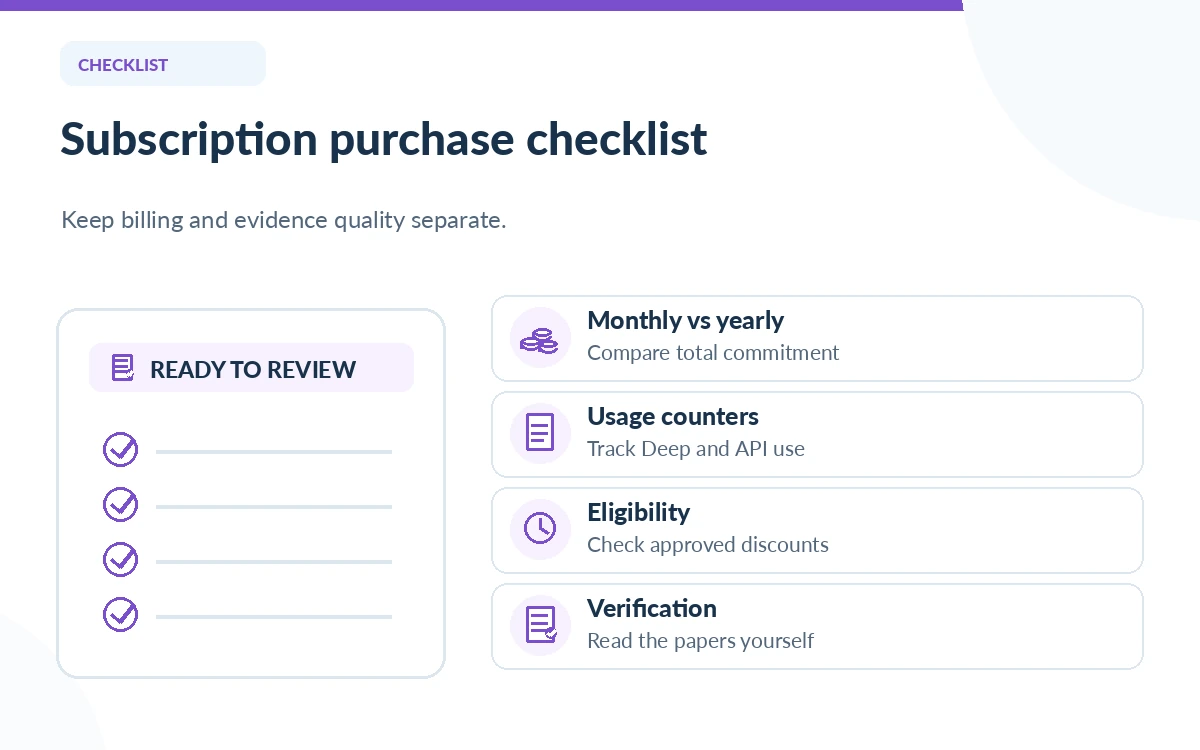
Annual billing is a commitment. A researcher needing advanced reviews for only one semester might prefer monthly billing, even if the annual unit price is lower. Count the expected active months and number of Deep Reviews. A plan that looks cheaper per month can cost more overall if much of its allowance goes unused.

Decide whether the free plan is enough
Free is attractive for identifying studies, checking abstracts and evaluating whether academic search complements a general AI assistant. Unlimited basic Papers searches do not mean unlimited AI synthesis: the guide separates the capped Pro and Deep operations from paper retrieval. Plan your work accordingly, especially if coursework generates bursts of questions before deadlines.
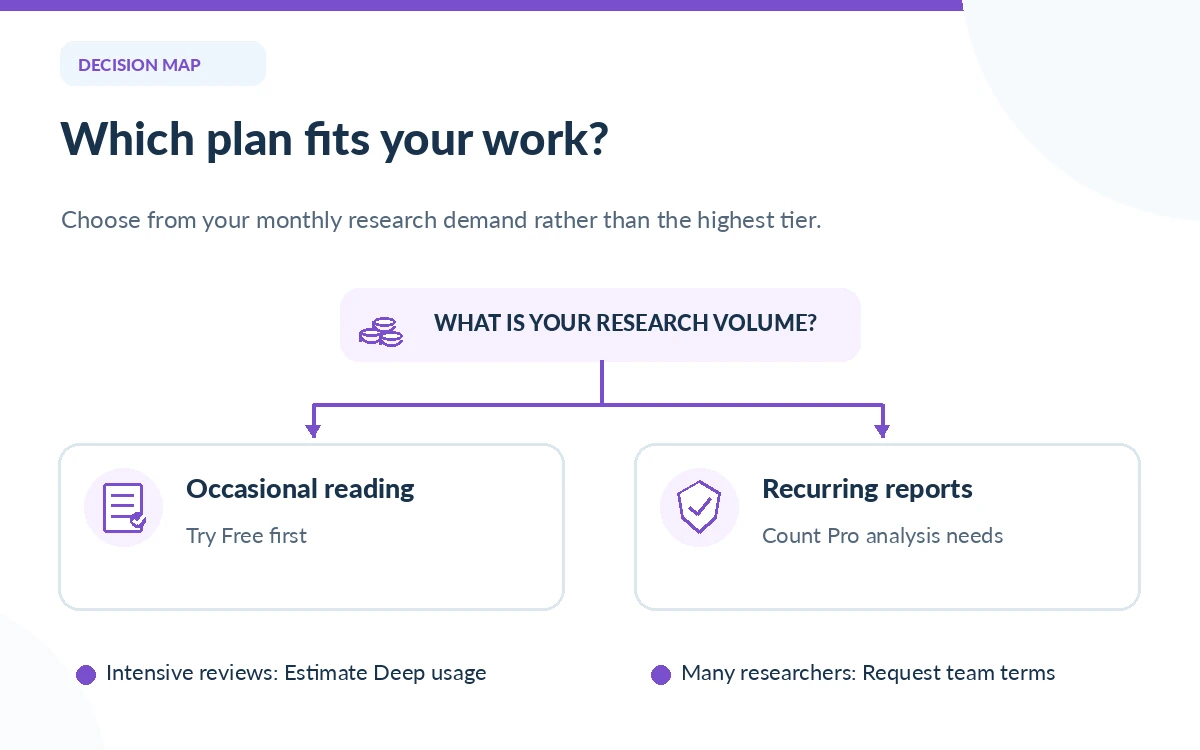
For a student who only needs a few evidence summaries, start with Free and track what actually runs out. Keep a list of questions where advanced synthesis materially changed the reading workflow. If most sessions end after locating and reading original papers, upgrading to Deep simply because it has a larger quota is unlikely to be an efficient purchase.
Pro versus Deep: buy the extra reviews only if they help
Pro’s 15 monthly Deep Reviews can suit a graduate student or analyst who needs periodic long-form literature synthesis alongside routine searches. Deep’s 200 monthly Deep Reviews target substantially heavier activity. Compare the same research question in the depth you actually need, and evaluate the quality of the cited papers; a higher count of paid analyses is not evidence of better answers for every task.
A practical rule is to estimate how many substantive literature questions you will research next month, how often you require comprehensive synthesis, and whether a review must be repeated with different inclusion criteria. If you do not have a realistic path to using the additional monthly allowance, keep Pro or Free and reassess next billing period.
Teams and institutional buying questions
The official Teams description includes centralized billing, individual accounts and 50 Deep Reviews per team member monthly along with 500 API/MCP calls per member. Larger Enterprise arrangements require direct discussions. Before seeking a quote, list active users, expected monthly work, account administration, citation export needs and any procurement or privacy requirements imposed by your university.
Ask whether campus library access already covers Consensus, whether student or clinician eligibility changes the price, and who administers access after a student leaves. Do not assume a faculty discount stacks with an annual offer. Test essential research steps under an authorized account and request written answers for data-handling or support conditions that matter to your organization.
Understand the API and MCP allowance separately
Consensus lists included API and MCP calls alongside subscriptions. These are not the same as unlimited human-facing Papers searches or Pro messages. If you plan to call a research function from an internal tool, record how many requests the workflow generates, how authentication is administered and whether the selected plan covers that use. Confirm current developer terms before deploying an automated integration.
For budgeting, make a table with expected API calls per report, reports per month and any expected burst usage. Multiply to estimate request demand, then compare it with the plan allowance. Do not invent an overage rate: the guide lists included calls, while your account and current documentation govern what happens after the allowance is reached.
Separate research quality from subscription size
A Deep Review can help surface additional research, but it is not a systematic search protocol by itself. Consensus’s own limitations documentation says it retrieves relevant studies and cites sources, while also acknowledging coverage and interpretation limits. Read the original papers and examine study design, sample size, population and contradictory findings.
The lowest-cost viable choice is the one that supports the number of research questions you can responsibly check. Start with a short real-world trial of your own workflow, then compare limits and time saved without claiming a validated productivity gain. Check the official pricing screen immediately before payment because plans are time-sensitive.
How We Research
Pricing and allowances were checked October 26, 2026 against the official Consensus Subscription Plans guide dated September 12, 2026, the live pricing destination, and Consensus responsible-AI limitations. Annual-versus-monthly totals are transparent calculations from the published reference prices; we did not complete a checkout or verify an individual account discount.
Frequently Asked Questions
Yes. The official Free tier has unlimited basic Papers searches and capped advanced operations, including 10 Pro messages and three Deep Reviews per month as listed in September 2026.
The published guide lists $20 per month or $144 per year with annual billing (equivalent to $12 per month). Confirm taxes, discounts, region and checkout details before buying.
No. Its September 2026 plan description lists 200 Deep Reviews per month, versus 15 on Pro. The word Deep describes a tier, not unlimited processing.
The official guide lists included API/MCP calls that differ by tier: 30 for Free, 500 for Pro and 2,000 for Deep per month. Automation and excess-usage terms should be confirmed separately.
Begin with Free if most work is finding and reading papers. Choose Pro only if advanced summaries repeatedly hit relevant limits; consider Deep for consistently heavy review volume, not for its name alone.