
An AI writing assistant is most useful on a long document when it helps manage decisions, not when it tries to produce the entire manuscript in one response. A policy memo, client report or white paper usually has an audience, source set, argument and tone that must remain stable across sections. Asking for “a complete 5,000-word report” hides those constraints and makes invented transitions surprisingly hard to notice.
This guide shows a section-by-section editorial process. It is not another ranking of writing apps: the unique deliverable is a reusable writing packet and review log. The workflow can be adapted to a general assistant or a project workspace. No speed benchmark or automatic factual reliability is claimed.
Decide what the assistant may and may not write
Before opening a chat, classify the deliverable. A first-person executive letter requires the named author’s approval; a technical report requires source-backed statements; and a client proposal requires verified commercial terms. Mark high-risk sections as human-authored or human-reviewed. Avoid uploading confidential client material until the organization has checked its account configuration, permitted data uses and retention rules.
Write one sentence describing the assistant’s job: “Produce section drafts from supplied source notes and identify unanswered questions.” That is safer than “write an authoritative white paper.” Keep authorship, factual verification, legal review and final publication decisions with people. This simple division of labor prevents polished generated prose from being mistaken for verified expertise.
Create a source packet and decision brief
Put five inputs in one packet: the target reader, the document’s purpose, its approved outline, the source bibliography and an example of acceptable voice. Distinguish a quotation from your interpretation. For each reference, record its title, original URL, date and the claims it actually supports. If you have no source for a statistic, label that cell “verification required” rather than asking the model to fill it.
An example for a vendor-neutral buying guide: the audience is a procurement manager, the decision is choosing an evaluation process, the scope excludes product rankings, and the evidence consists of official policies and interview notes. Add forbidden claims such as “guaranteed savings” or “industry-leading security.” Keep this packet versioned, because a silent update to source material can change a later draft.

Use a project space for stable instructions
Claude Projects supports project instructions and shared project knowledge; OpenAI describes similar file-and-instruction organization in ChatGPT Projects. These features can reduce repeated briefing, but a project workspace does not make the included source material correct. Confirm the plan and permissions actually available to your account before standardizing a team workflow.
Set the project instruction to identify absent facts, cite supplied references when possible and preserve the chosen reading level. Upload only approved extracts rather than the entire client drive. Test a short section first to see whether the assistant follows the scope and flags missing evidence. Revise the packet, not only the prompt, when repeated errors point to missing or contradictory background.
Draft one section with a fixed contract
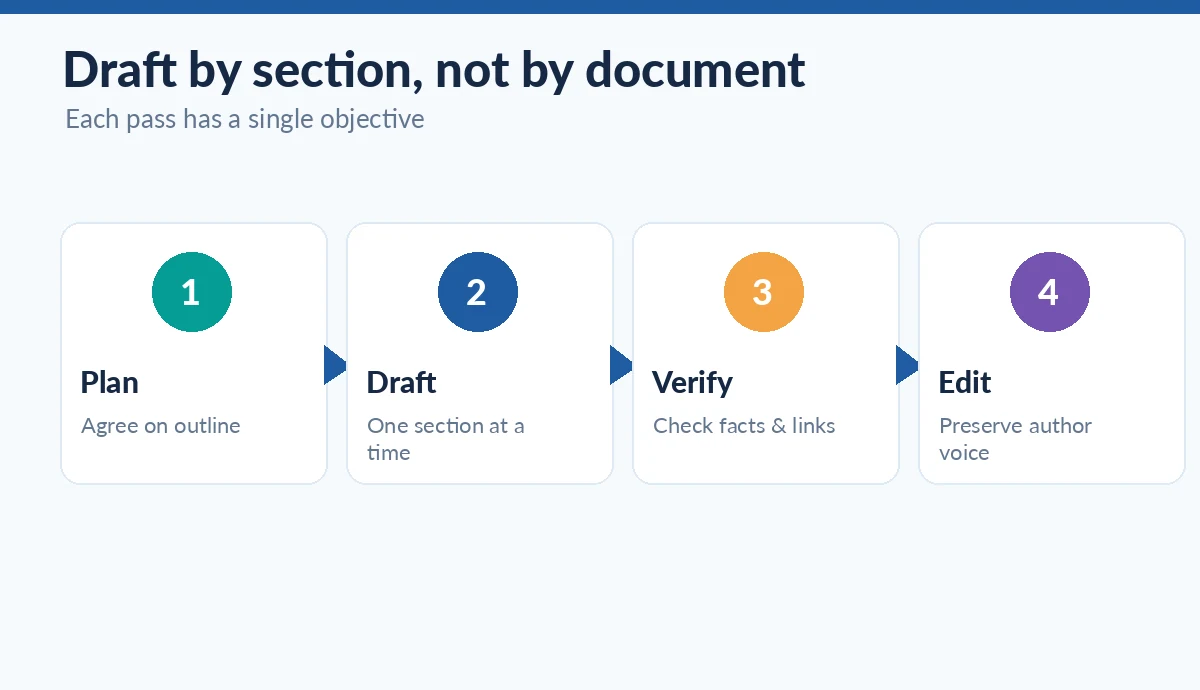
Ask for a section of approximately 250–400 words from named source notes. Require a topic sentence, two specific implications, an explicit limitation and a list of questions for the editor. Include the heading and the paragraph immediately before it so the transition makes sense. A fixed output contract limits the tendency to create repetitive introductions and closing summaries in every section.
For example: “Draft the onboarding-risks section for operations leaders. Use only notes A and C. Explain the failure modes, describe one mitigated workflow, and end with unresolved questions. Do not make up examples or cite unnamed studies.” If the resulting section makes an unsupported assertion, remove it or find a source. Never treat a fabricated citation as a rough placeholder.
Run separate fact and voice passes
First compare each checkable assertion to a primary source. Names, figures, dates, feature access and terms can change; a convincing sentence is not evidence. Create a two-column claim ledger with “supported by source” and “needs revision.” Ask the model to identify claims, but a person must actually open and read the cited material. Only after the fact pass should you run a style pass.
The voice pass asks whether the writing sounds like the intended author. Compare against an approved paragraph, note repeated filler transitions and repair overly formal phrases. Keep technical terms that the audience needs. Do not let an automated “make it human” instruction introduce unsupported anecdotes or remove important caveats simply to improve rhythm.
Track changes across the whole document
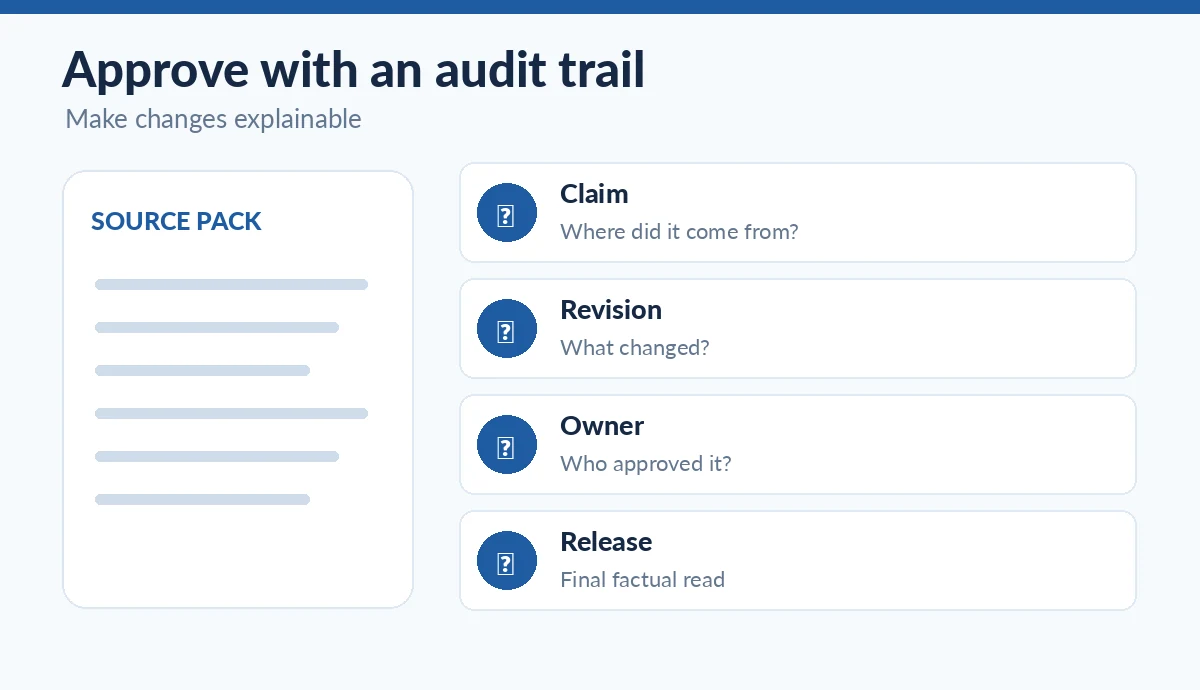
After three or four sections, read the outline and document together. Check for terminology drift: “customer,” “buyer” and “user” may refer to different people. Also check that tables use one definition for each metric and that the introduction promises only what the body delivers. Record each structural decision in a small revision log with the reason and editor responsible.
Use explicit acceptance criteria: every major claim has a source, every section answers a reader question, no source is represented as an independent test, and internal cross-references point to real sections. The output is not done when the tool says “final”; it is done when a responsible editor can explain and defend it.
Choose tools by the handoff they improve
A general writing assistant is sufficient for occasional drafting when the writer already has a strong outline and checks references manually. A project workspace becomes more attractive when repeated assignments need consistent instructions and a shared set of approved documents. An inline editor is better suited to sentence-level corrections than to rebuilding the logic of a long report.
Run a small pilot with one approved report section. Log how much human correction was required, whether citations resolve, and how easily a second editor can reconstruct the reasoning. Compare that cost against the new workflow overhead. If the tool makes draft creation faster but source checking slower, it may not be the right assistant for this job.
How We Research
We reviewed Anthropic’s project setup instructions, OpenAI’s ChatGPT Projects documentation, and OpenAI’s data-controls guidance, alongside established editorial verification practices. We compared documented workflows and failure points; we did not upload client documents, benchmark models, or independently audit vendor privacy guarantees.
Frequently Asked Questions
You can request a broad outline or draft, but section-level drafting makes missing evidence and contradictory assumptions much easier to identify and correct.
Only when your organization has confirmed the account’s access controls, contractual requirements and approved handling of sensitive information. Otherwise use redacted excerpts.
No. A project can organize material, but the editor still needs to check each important claim against the original document and working URL.
Supply an approved writing sample, describe desired rhythm and vocabulary, and reserve a separate style pass after factual review instead of asking for generic “humanization.”
Track human correction effort and the proportion of claims verified against primary sources. Draft speed alone can conceal additional editorial work.