
Claude Code can be paid for through a Claude subscription or billed according to API consumption. These are not interchangeable arrangements. The purchase that makes sense for someone checking code in a terminal twice a week may be wrong for a team running unattended agents through a cloud provider. Start by identifying your login and billing route, not by multiplying the first token price you see.
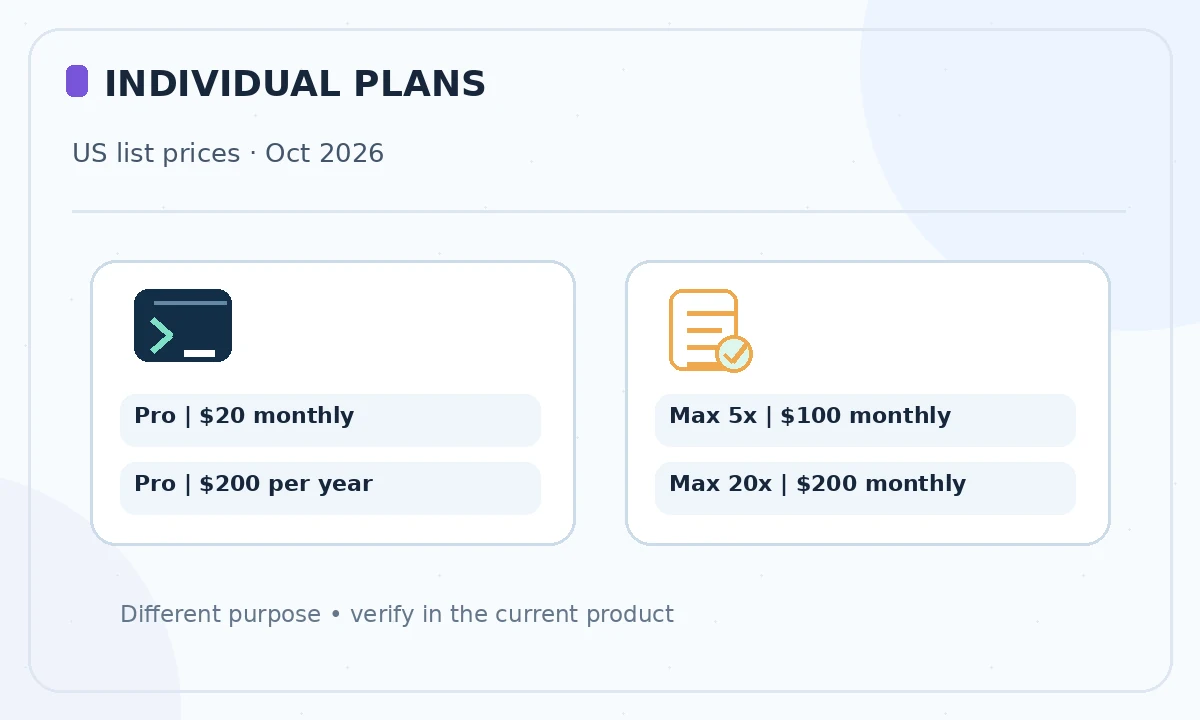
Checked October 26, 2026: Anthropic lists Claude Pro at $20 per month when billed monthly or $200 billed annually. Max starts at $100 per month for a 5x option, with a $200 per month 20x option. Claude Free does not include Claude Code according to the plan matrix. Prices exclude potential taxes and regional differences; capacity labels are usage descriptions, not guaranteed numbers of messages or tasks.
Separate subscription use from API consumption
With Pro or Max, you sign in to Claude Code using a Claude account and consume subscription usage according to plan limits. Anthropic documents that these subscribers can view usage bars in Claude Code. An API account, by contrast, bills the model and token types used by the application. An API balance is not automatically included with your Pro subscription, and paying for Pro does not make Console API requests free.
The first purchasing question is how the tool will be accessed: a developer working interactively in terminal, a company-managed deployment, or a program making API calls. Record each route separately. If your organization uses Bedrock, Vertex AI or another provider, its billing arrangements and regional charges may differ from direct Claude usage.
Compare Pro with Max 5x and Max 20x
Pro is a reasonable entry point for people coding regularly but not continuously. Max 5x is positioned for more frequent sessions, and Max 20x for heavier users. The multipliers describe capacity relative to Pro within the published usage framework; they do not mean a deterministic fivefold or twentyfold number of accepted pull requests. Actual availability can depend on task complexity, context and the current service limits.
If you use Claude mostly for one small edit each evening, pay for more capacity only after observing repeated interruptions. If you keep several long coding sessions open each day, use the in-product usage indicators to determine whether higher capacity changes the work you can finish. For teams, review managed seats and administrative controls rather than sharing an individual Max account.
Understand the API cost equation
For direct API usage, a useful basic estimate is: input tokens divided by one million, multiplied by the model’s input price; plus output tokens divided by one million, multiplied by its output price. Add cache writes, cache reads, extra tools, regional multipliers or other billable features where applicable. Model prices are not uniform. Consult Anthropic’s live model pricing table rather than using one historical “Claude Code rate.”
Here is an intentionally hypothetical calculation, not a vendor quote: suppose a workload uses 1.2 million input tokens priced at $2 per million and 0.3 million output tokens priced at $10 per million. The simplified token subtotal would be $5.40. It excludes caching, tool use and infrastructure. Substitute the actual model-specific rates before budgeting.
Track usage instead of trusting a cost-looking counter
Anthropic’s Claude Code cost documentation distinguishes API users from Pro/Max subscribers. For API sessions, the `/usage` interface can show token statistics; subscription users should look at plan usage bars. A locally calculated dollar value from tokens is not automatically an amount you will be billed for a subscription session. Always reconcile spend with the actual billing dashboard for your chosen route.
For teams, log active coding days, model used, token mix and whether a task used additional context-heavy tools. The vendor cautions that developer costs vary with model choice, codebase and automation. A short pilot across representative tasks is better than extrapolating one clean demo across an entire engineering organization.

Calculate the cost of a useful outcome
Build a worksheet with columns for human review time, direct charges, corrected defects, and whether the change passed its required tests. A successful refactor might need more tokens than a tiny code-completion task but save repeated human work. Conversely, inexpensive token use that produces an incorrect migration is not a bargain. These are evaluation inputs, not fabricated ROI findings.
Use two independent examples: a small local test addition and a repository-wide dependency update with explicit review boundaries. For each, record actual usage under your own account. Estimate a monthly range from representative observations, then set alerts or budgets in the billing system where they are supported.
Reduce avoidable context and token waste
Give Claude Code a bounded file set, describe acceptance conditions and keep unrelated logs out of the prompt. Periodically clean up context rather than replaying full histories when the conversation no longer helps. Anthropic’s cost guide recommends managing context, selecting appropriate models, trimming unnecessary tool overhead and keeping instructions focused. Those are safer first improvements than disabling verification.
Do not cut costs by removing the test suite, bypassing human review or broadening automated permissions to avoid approval prompts. Those shortcuts move expense into outages and security exposure. A cost-control policy should require a stop condition for unexpected dependency changes, secrets access and tasks that spread beyond the stated repository area.

Know when a subscription is the wrong fit
An individual subscription is not an accounting substitute for an application that programmatically calls Claude models. If you need metered production workloads, central billing, service accounts and custom operational controls, investigate the Claude API or an approved enterprise deployment. Conversely, an occasional developer may find a predictable Pro subscription easier to manage than variable consumption charges.
Compare based on workflow ownership. Who can stop a runaway job? Who sees spend? Can the team audit changes and prevent credentials from leaking into prompts? Billing mode is one part of procurement, and the cheapest sticker price does not resolve these governance questions.
Choose the smallest plan that survives a pilot
Run a short real-work pilot with explicit limits: first explore the repository read-only, then make a small testable change, then review an incremental PR. Note the day and time when usage limits interrupt progress. Check whether those interruptions can be avoided by reducing context or splitting tasks without harming code quality.
If Pro consistently meets the workload, keep it. If Max is required, identify whether the higher cost buys meaningful capacity for actual tasks. If the workload is unattended, evaluate API budgeting instead. Re-check Anthropic’s pricing and product terms at purchase time, because all amounts and limits can change.
How We Research
We reviewed the current primary-source documentation as of October 26, 2026: Claude subscription pricing; Claude Code cost management; Claude API pricing; Pro and Max subscription sign-in. We distinguished documented plan features and limits from editorial workflow suggestions, and we compared the intended reader task with the previously published LabFin material. We did not purchase plans, perform product benchmarks, run code or verify an individual account’s entitlements. Where product pages conflict or terms may change, we have identified the uncertainty and recommend confirming checkout or live account details.
Frequently Asked Questions
Anthropic’s current individual plan matrix lists Claude Code on Pro and Max, not Free. Check the live plan table for changes.
Yes. The Pro subscription includes access to Claude Code, with plan usage limits; it does not include general Claude Console API billing.
Anthropic lists Max 5x at $100 per month and Max 20x at $200 per month in its US plan information, before any applicable taxes.
Not necessarily. Anthropic documents a distinction between API session cost calculations and plan usage for Pro or Max subscribers.
Multiply model-specific input and output token counts by their live prices, then add applicable caching, tool, provider and location costs.