
A student preparing to guide visitors around a small astronomy exhibit can recite the eight familiar Moon phases but still believe that Earth’s shadow causes each phase. That is a common conceptual trap: ordinary phases reflect how much of the Moon’s sunlit half is visible from Earth, while an eclipse is a particular alignment event. A quiz that rewards vocabulary alone may fail to reveal the confusion.
ChatGPT Study Mode supports step-by-step explanations, questions, hints, and review of uploaded materials. OpenAI also warns that the mode can make mistakes and does not replace teachers or authoritative course content. This is a lesson-planning workflow, not a claim that an AI tutor has verified a student’s knowledge. The geometry should be checked against a reliable astronomy reference before the student repeats it in public.
Begin with one trustworthy geometry reference
Before starting a chat, choose a reliable diagram of the Sun, Earth, and Moon, such as NASA Space Place’s explanations of phases and eclipses. Read the caption closely. The Moon is illuminated by the Sun; the appearance changes as its position changes relative to Earth. Do not begin with a social media animation whose shadows or viewing angles may be misleading.
Write one learning objective in plain language: I can explain why a quarter Moon is not caused by Earth’s shadow. A second objective can distinguish the usual phase cycle from an unusual eclipse alignment. Keep a source link in your notes so that when a chat answer is fluent but puzzling, you can return to an independent explanation rather than accepting the model’s authority.
Open Study Mode in a regular supported conversation
OpenAI documents study mode in supported ChatGPT experiences on web and mobile. Start a regular chat and select Study where the interface offers it, or use its documented direct entry point. The Study option is not available in Temporary Chats, GPTs, or Projects, according to OpenAI’s current help article. Tools, model access, and file uploads still depend on the account and app.
Tell the assistant your level and the specific misconception: I think the Earth’s shadow causes the crescent Moon. Ask it to use one question at a time and wait for an answer. That is more revealing than requesting a polished lecture immediately. If a file or image is available to attach, use the chosen NASA diagram rather than a source with unclear provenance.
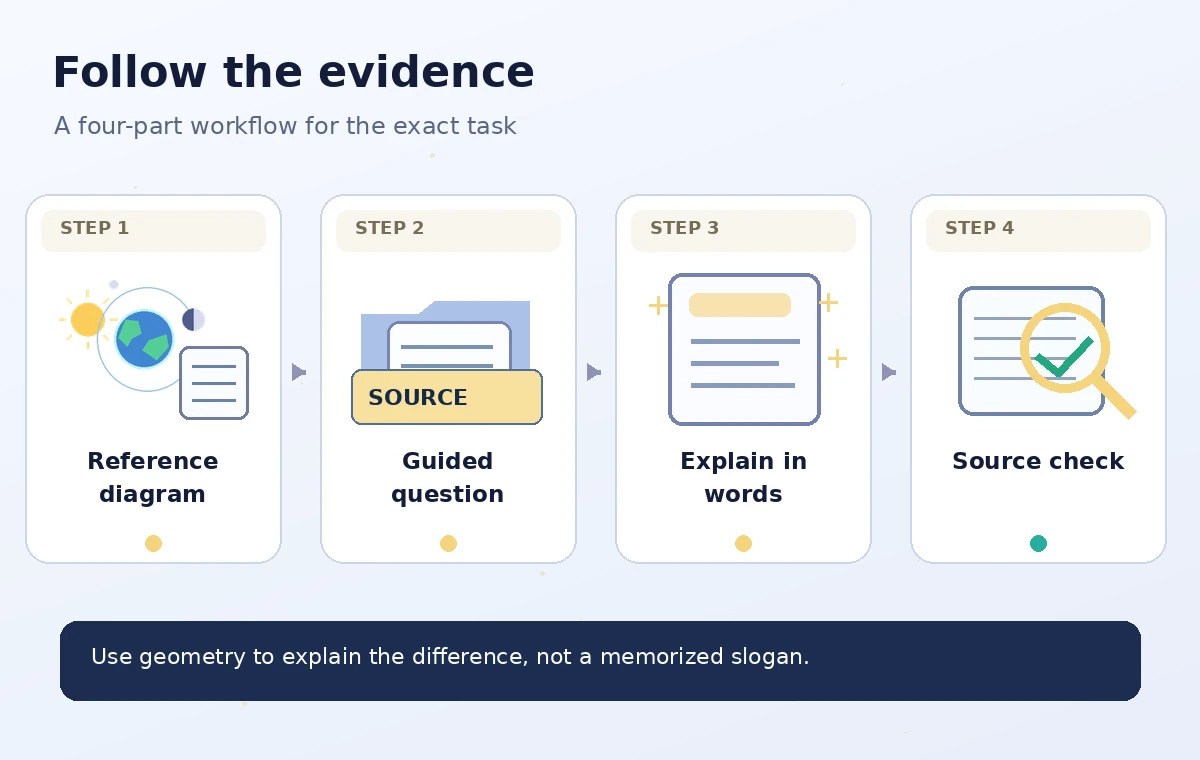
Use predictions to expose the wrong mental model
Ask the tutor to pose a simple test: If Earth’s shadow created every phase, what would we expect to happen during most new and full Moons? Let the learner state a prediction before receiving the explanation. The goal is to notice that eclipses do not accompany every ordinary lunar cycle, which undermines the shadow-based explanation of everyday phases.
A correct learner answer should identify that the Moon’s sunlit portion remains present, while our view of it changes with orbital position. Do not grade an answer solely because it uses words like illumination or orbit. Have the student point to a simple diagram and explain which direction the sunlight comes from. The ability to transfer the explanation to a new position is the stronger sign of understanding.
Compare the two geometries without treating them as identical
Make a side-by-side sketch. For an ordinary quarter phase, illustrate the angle between the Sun, Earth, and Moon that gives a half-illuminated lunar disk from the observer’s viewpoint. For a lunar eclipse, depict the special alignment in which Earth blocks sunlight from reaching the Moon. These are distinct explanations, even though both involve the same three bodies.
If the AI explanation places the Moon in Earth’s shadow during a normal crescent, stop and correct it using the NASA source. A generated diagram is useful only if its light direction and relative positions make sense. The comparison in this article is an instructional sketch; it is not to scale and makes no promise of reproducing an exact celestial event.

Practice a brief explanation without memorizing a script
Ask for a teach-back exercise: explain to a visitor why the Moon can look like a crescent even when there is no eclipse. The learner should say that sunlight lights half the Moon and we see different fractions of that lit half as the Moon orbits Earth. It should not suggest that the Moon changes its own brightness or that Earth’s shadow travels across it every night.
Invite the AI tutor to ask for a different viewpoint or a simple household analogy, but check analogies carefully. A ball and a lamp can model illumination, yet a model that changes the location of the observer without explanation may cause a fresh misconception. When a learner hesitates, ask for one focused hint instead of a full solution; the learner should still do the explanatory work.
Verify the correction with a source-first mini-quiz
Use three questions of increasing difficulty: What causes phases? What makes a lunar eclipse different? Why do we not see an eclipse at every full Moon? Ask the tutor to wait for each response, then compare its feedback with the NASA diagrams. An accepted answer should connect phases to viewpoint and eclipse events to special alignment, rather than merely parroting a phrase.
Have the learner point out the light source and the relevant geometry in each sketch. If the tutor offers an explanation that is uncertain, open the NASA source or ask a teacher for clarification. Study Mode can provide a structured dialogue, but it does not certify exam readiness or turn a generated answer into a scientific reference.
Combine AI Tools With Source Checks
Close with a teach-back and an honest evidence note
The last step is a short written explanation by the student without prompts. It should separate the ordinary phase appearance from the special shadowing of an eclipse and use a diagram with correct light direction. A teacher or exhibit editor can then check it against a trusted source. This gives the student a chance to demonstrate understanding rather than selecting the right option from a list.
Keep a note of which misconception was corrected and which topic still needs practice. Do not publish invented observational dates, eclipse schedules, or claims about the student’s performance. The useful outcome is a better question-and-answer routine that can reveal errors while they are still easy to fix.

How We Research
We checked the following named official pages on November 4, 2026: OpenAI — Using study mode in ChatGPT; NASA Space Place — What Are the Moon’s Phases?; NASA Space Place — Lunar Eclipses and Solar Eclipses. We extracted the documented feature boundaries, interface terminology, eligibility conditions, and sharing or reference limits that apply to this specific workflow. The scenario values and sample wording are hypothetical teaching examples; we did not access a product account, conduct a hands-on test, interview participants, measure outcomes, or verify any fictional approval. We compared each draft step with the source documentation and designed source-by-source human checks for claims the products cannot independently establish. Available controls, licenses, and screen labels may differ by account or rollout, so confirm your own environment before use.
Frequently Asked Questions
OpenAI says the Study option is not available in Projects, GPTs, or Temporary Chats; start a supported regular chat.
Phases reflect how much of the Moon’s sunlit half we see; a lunar eclipse involves the Moon entering Earth’s shadow.
Yes when uploads are supported. Verify that the diagram and any generated explanation agree with a credible source.
No. OpenAI acknowledges mistakes are possible, so important explanations should be checked against authoritative material.
Ask the learner to explain both geometries in their own words and identify the sunlight direction in a simple sketch.