
A popular exhibition title can drown out a vital notice
A museum search box serves exhibits, visitor guides, and safety information. Staff want an exact exhibition title to rank above generic pages that mention the same words only in passing. A scoring profile in Azure AI Search can give stronger weight to matches in a designated title field. But an indiscriminate boost could suppress a conservation warning or accessibility exception that appears in the body of a guide. The task is not simply to make one featured exhibit appear first. It is to improve relevant ranking while preserving retrieval of important less prominent documents. The following example uses fictional documents and a proposed evaluation process, not measured Azure search results.
Separate matching, ranking, and authorization
Azure AI Search searches documents that match a query, then scores and orders candidates according to its ranking machinery. A scoring profile adjusts that ordering using defined nonvector fields or functions. It does not make a document accurate, grant viewing rights, or replace a security filter. Apply institutional rights and embargo restrictions through appropriate application controls and query filtering before presenting results. A title boost that happens to place an approved record first should never be interpreted as a permission decision. Keep those layers visible in architecture reviews: the index supplies searchable fields, the query specifies the search intent and applicable filters, and the presentation layer explains why a result is useful.
Define a weighted title profile in the index schema
Microsoft documents text weights inside a scoringProfiles definition on an index. For a simple catalog, staff could compare a baseline with a profile that assigns more relevance to a searchable exhibitTitle field than to an ordinary description match. The selected field must exist and satisfy the schema requirements for the intended scoring behavior. Adding or adjusting a profile changes relevance configuration, not the underlying authoritative record. Microsoft notes that scoring profiles can be added or modified without rebuilding all indexed documents. Manage the schema change through reviewed configuration, and avoid deploying a new default profile silently to every search surface without baseline comparisons.
Apply the profile on an intentional query
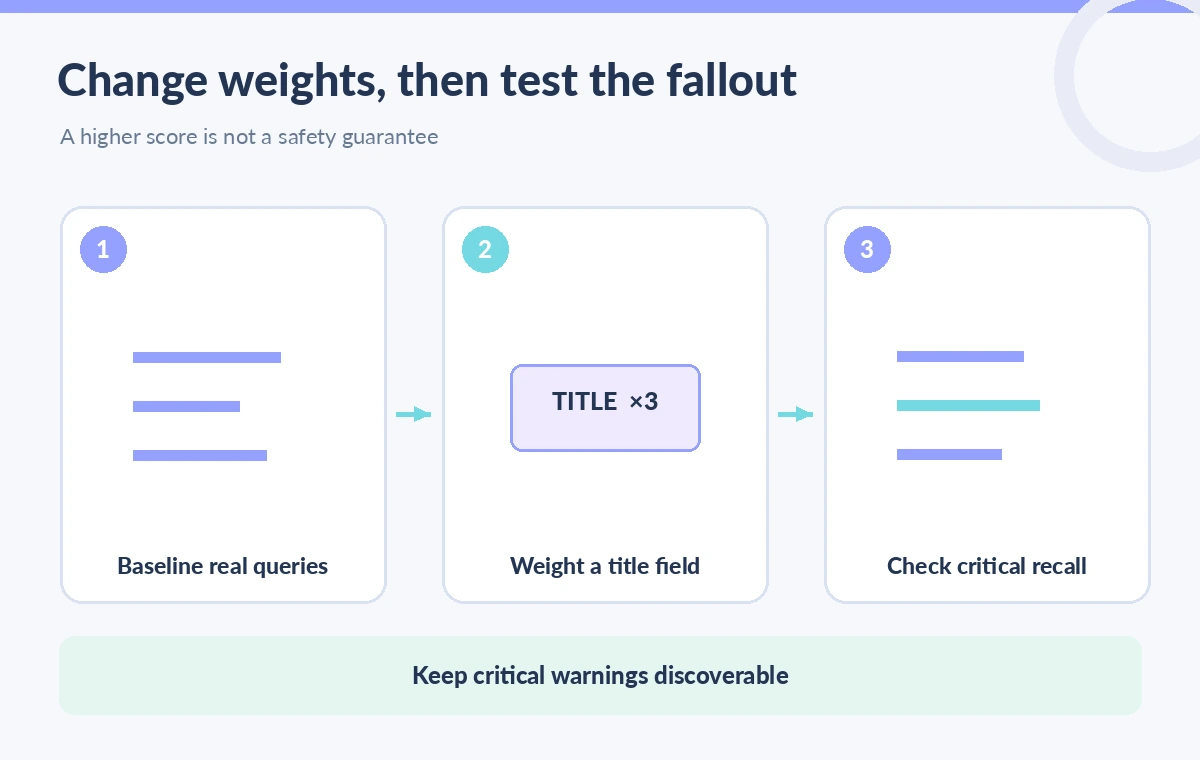
A query can name a particular scoringProfile so that the caller, rather than an accidental global default, controls the experiment. Evaluate it against a fixed collection of realistic approved queries: exact exhibit title, partial title, misspelling, conservation warning, accessible entrance directions, and an ambiguous artifact name. Use the same security filters and candidate corpus for baseline and treatment whenever possible. Capture the query and search configuration in the review record so future investigators can reproduce it. The process diagram emphasizes baseline, title weighting, and safety review as three independent activities. A ranking change is not a measured improvement until the results are judged against relevant user intent.
Use conservative weights and examine displaced results
A stronger field weight can move a document with an exact title match upward even when other pages contain more substantive detail about the question. Microsoft recommends conservative tuning rather than large arbitrary boosts. Review which results move down, not just which desired result moves up. In a museum context, an announcement about an exhibit’s temporary closure might contain the essential current condition in its body text while a permanent exhibit page has the phrase in its title. The comparison illustration shows a conceptual reordering and highlights the need to inspect what got displaced; its bar lengths and order are instructional, not live score measurements.
Understand hybrid and semantic search interactions
Microsoft explains that scoring profiles can participate in keyword, vector, hybrid, and semantic workflows, but the boost logic operates on nonvector content and the order of ranking stages matters. A profile defined for conventional text search should not be assumed to behave identically when hybrid candidates are fused or when a semantic ranker is applied. Preview capabilities and final reranking options may have extra requirements. Before claiming a profile improved a vector-heavy catalog, inspect the specific service API version and search path in use. Keep a separate test record for keyword-only and hybrid cases. Avoid using raw scores from different ranking methods as directly comparable quality metrics.

Protect recall for low-frequency safety questions
Define negative tests before stakeholders approve the title boost. Ask for a rarely searched emergency exit note, an accessibility exception, and a caution buried in conservation instructions. Record whether each required document remains discoverable within the user interface’s practical result window and whether its snippet accurately signals the warning. Use human relevance judgments for critical results and do not let a mean ranking metric conceal a safety failure. If a title boost buries a mandatory advisory, revise the field weights, query strategy, or dedicated alert experience rather than explaining the miss as an acceptable tradeoff. Search should help users find critical information even when its page title is bland.
Control rollout and interpretability
Treat the scoring profile as a versioned search configuration. Document the field names, weights, applied query surfaces, baseline set, expected change, and rollback procedure. A staging index or deliberately scoped query parameter makes it easier to evaluate before enabling the profile widely. Log safe diagnostic metadata rather than visitor questions containing personal details. If a result changes position after a new profile, staff should be able to trace whether it was due to index content, query terms, filters, or scoring choices. Neither the boost nor a higher @search.score proves that the source document is official or current.

Finish with a repeatable relevance review
A useful sign-off names a representative query set, human relevance labels, critical must-find documents, and acceptance rules for regressions. Run it against both configurations and examine the first page of results in the actual visitor interface, not merely an isolated API number. Repeat after major catalog indexing or query changes, because ranking interacts with the surrounding corpus. Staff should also confirm that public rights rules still operate independently of scoring. No such evaluation was executed for this article; the method is a proposed control. The goal is more helpful exhibit discovery without quietly trading away the discoverability of safety and accessibility information.
How We Research
Our primary named official sources were: Microsoft scoring profiles guide; Microsoft relevance and ranking overview; Microsoft query overview. We reviewed Microsoft’s scoring-profile definition and relevance documentation, including nonvector field weights, index requirements, and ranking interactions. We did not create an Azure index, measure relevance scores, or run museum queries. The before-and-after illustration expresses a possible ranking effect, not test output. Readers should verify current deployment-specific documentation and their own permissions before adopting a workflow. Any figures are original instructional diagrams, not actual vendor screenshots or observed results.
Frequently Asked Questions
No. Ranking boosts are not authorization rules; enforce rights and access separately.
Microsoft documents adding or modifying a scoring profile without a full document rebuild.
They can participate in those workflows, but the boost operates on nonvector fields and ranking stage interactions matter.
No. The score reflects ranking behavior, not authenticity, freshness, or legal authority.
Compare the same realistic queries against a baseline and check displaced safety, accessibility, and rights-sensitive results.