
A local-history archive maintains several editions of a handling guide. Searchers often type ‘how to clean a photo sleeve,’ and an older document has the most repeated keyword matches even though the newer approved edition changes the conservation recommendation. Azure AI Search scoring profiles can adjust ranking based on weighted fields or properties such as freshness. A boost can make the right source easier to find, but it cannot make a retired instruction approved or enforce who is allowed to see a private record.
Separate eligibility from relevance at the start
Create two decisions for every document: whether it may appear to this user, and how strongly it matches the question. The first requires a filter and permission model using indexed metadata such as status, access group and approved revision. The second can use text relevance, semantic ranking and scoring profiles. Never let a high keyword score or freshness bonus promote an embargoed document across a permissions boundary.
For a hypothetical archive, label manuals APPROVED, SUPERSEDED or DRAFT and include a stable series identifier, current approval date and version. Decide whether a public query can see only APPROVED guides. Curators can have a different review view, but that view should still distinguish draft content prominently. This prevents the ranking experiment from becoming a silent change in public access policy.
Understand what scoring profiles can change
Microsoft documents scoring profiles for boosting or suppressing matching records using weighted text fields and functions for supported metadata, including freshness, distance, numeric magnitude and tags. A profile is defined in the index and named on a query through the scoringProfile parameter. Adding or changing a profile does not require rebuilding indexed content, but relevant schema properties and data types must support the selected functions.

Scoring behavior differs among plain keyword, vector, hybrid and semantic pipelines. A score is not a certificate of factual correctness, and a late-stage boost does not mean a source is authoritative. Keep the retrieval mode, profile name and query parameters in the test record. Do not teach editors to interpret raw @search.score values as directly comparable across unrelated query types or index versions.
Create an auditable ranking fixture
Invent a three-document collection for testing: a current approved handling note with fewer exact query words, a superseded manual with many matches, and an approved but unrelated photo catalog. Put publication and approval dates in distinct fields so a newly uploaded old document does not masquerade as newly approved guidance. Record the intended result ordering before tuning the index; then evaluate the actual output when a test environment is available.
Include real user paraphrases in a future test set, for example ‘storage sleeve’, ‘plastic envelope’ and ‘photo enclosure’. A relevance boost should not be relied upon to solve synonym handling or a missing searchable field. Test a separate exact part code search where freshness is less important than the identifier. The goal is to know when scoring profiles help and when another retrieval control is the correct tool.
Tune fields conservatively and document the choice
Start by weighting the approved title and subject fields when a query directly matches them. Consider a limited freshness function on a meaningful review date for topics where policies change. The Microsoft guide suggests starting with restrained boost values rather than making one metadata property dominate. Validate eligible field types and the filterable requirement for scoring functions; a function attached to the wrong field may fail to apply.
Do not copy a large numerical weight from another institution or claim universal optimal settings. Write down which business question each boost represents. A ‘preferred language’ tag might legitimately help a multilingual visitor; a curator’s personal favorite guide should not outrank safety and current approval. Add one controlled change at a time so a regression can be attributed to a specific rule.
Compare ranking changes to actual source eligibility
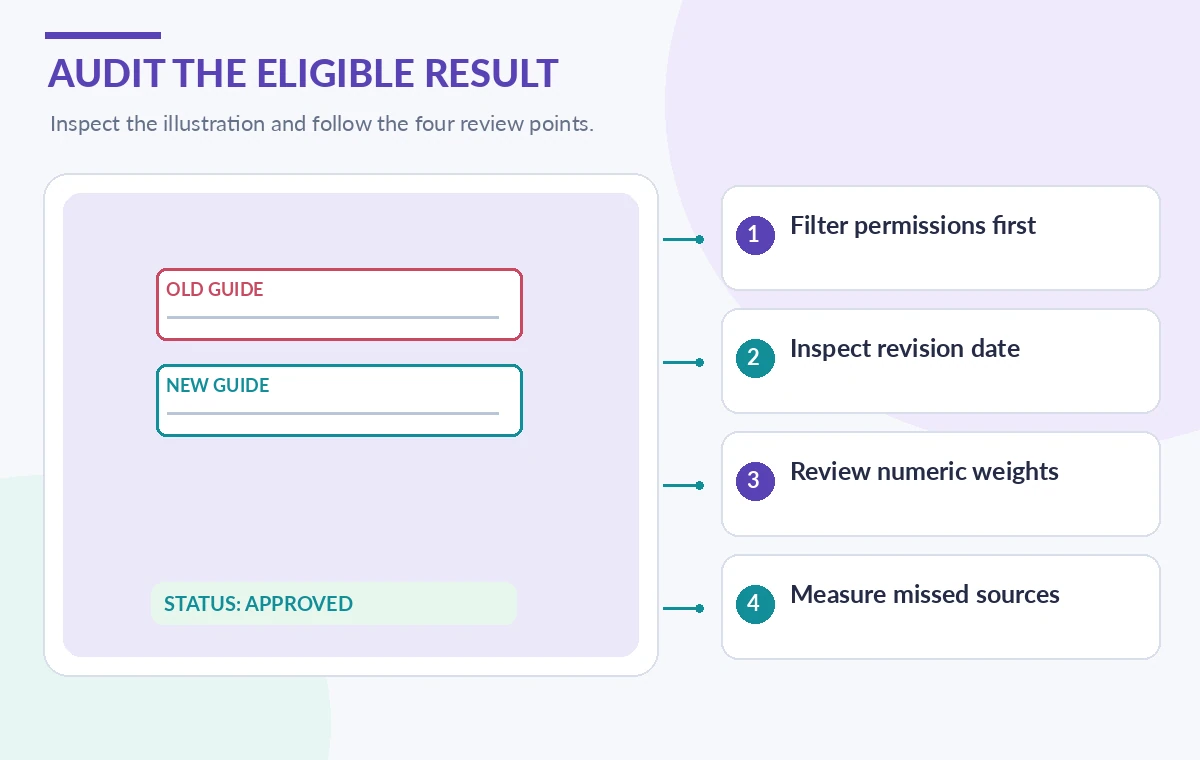
A useful illustration has three states. First, keyword ranking places a retired guide near the top. Second, a freshness profile might alter candidate order but still cannot exclude the retired guide. Third, a hard APPROVED filter removes the retired record and the profile orders only eligible results. These states must be visibly different; a green badge on an unfiltered result would mislead the reviewer.

Run each test query against the same index snapshot and compare the top document IDs with prewritten human expectations. Inspect both missed current manuals and incorrectly elevated irrelevant sources. A boost that raises an approved document but pushes an exact technical match out of view may be harmful. Use a source-page comparison and a reviewer sign-off rather than a chart of invented relevance scores.
Account for hybrid and semantic behavior
Azure AI Search can combine text and vector retrieval with reciprocal rank fusion, and ranking may receive additional stages. Scoring profiles can influence supported nonvector scoring signals, but the exact placement and interaction vary with the query pipeline and API version. Read the current Microsoft ranking documentation before designing a one-size-fits-all sequence diagram. Separate observed order in a test from assumptions about internal model reasoning.
When semantic reranking is enabled, inspect which of the candidate documents it evaluates and whether any extra boosted score is available for the selected API version. Never claim a profile repairs an absent document, stale indexer, wrong access filter or broken source citation. These are ingestion and governance problems. If the source itself is retired, update the index metadata or remove the item under policy rather than trying to bury it with a low score.
Evaluate with difficult archive queries
Construct an evaluation set of known questions that include ambiguous names, exact inventory codes, older wording and recent policy exceptions. Reviewers should score whether the top sources are permitted, current, pertinent and properly cited. Track the number of disallowed results as a strict zero-tolerance access failure, distinct from normal relevance metrics such as whether the useful source appears in the top five.
Repeat tests after adding new manuals, changing approval dates or enabling another retrieval mode. Watch for a particularly subtle failure: the retrieved guide is current but its quoted paragraph is an older policy reproduced as an example. Human reviewers should verify the answer’s interpretation, not just the document’s status. No benchmark numbers are asserted here; the process describes what a team should measure.
Release a relevance policy with rollback
Version the index schema, scoring profile definition, permission-filter logic and test set together. Give staff a straightforward rollback if a ranking adjustment hides important instructions. The interface should show title, edition, approval date and source location so a reader can detect mismatches. Display a fallback contact when no eligible manual answers a safety question.
A scoring profile is one adjustable relevance tool within an evidence-driven search system. Used carefully, it helps approved guides surface sooner; used carelessly, it creates a convincing ranking without solving authority or confidentiality. Keep access controls and final source validation outside the score calculation.
How We Research
For our November 2026 editorial review, we consulted the named official developer sources: Microsoft: Add scoring profiles; Microsoft: Relevance and ranking overview. We compared documented feature scope, parameters, supported inputs, workflow boundaries and important failure cases with a hypothetical, nonproduction museum or library scenario. We did not run paid API calls, access personal visitor records, independently benchmark model quality, conduct a real deployment, capture vendor interface screenshots or verify a particular institution’s permissions. All figures are original conceptual instructional drawings, not live results. Readers should verify current documentation, plan limits, regional availability, prices and applicable data policies before a trial.
Frequently Asked Questions
No. Use correct security and metadata filters to establish eligibility before relevance ranking.
Microsoft documents adding or changing scoring profiles without rebuilding indexed content, although schema and compatible fields matter.
No. Exact IDs, subject fit and approved status can matter more; tune against actual user questions.
They can participate in supported retrieval pipelines, but effects depend on the pipeline and API version.
No. Compare reviewed source IDs and relevance on a controlled test set instead.