
The visitor guide that moves between search positions
A museum website lets visitors search a collection of restoration guides. Staff notice that a guide matching an uncommon conservation term appears near the top in one check and lower in another, even though its text has not changed. Ranking differences can have several causes: replicas, index updates, query settings, scoring profiles, or semantic reranking. One diagnostic dimension is whether the engine uses local or global term statistics when scoring. This hypothetical example does not establish that shard scoring is responsible for any particular ranking shift. The key is to isolate one cause at a time before making changes to a public catalog that visitors rely on for factual guidance.
What scoringStatistics controls in Azure AI Search
Microsoft’s Search Documents REST reference defines scoringStatistics as a setting that decides whether document-frequency statistics are calculated locally or globally. The default is local, which favors lower latency. Setting it to global aggregates scoring statistics globally before scoring for more consistent relevance calculations, with the tradeoff that queries may take longer. This option affects how a query is scored; it is not a security filter, a freshness guarantee, or an instruction to return a particular document. It also does not turn a search result into evidence that a conservation procedure is safe. Learn what score type your query uses before comparing numbers across requests.
Record a reproducible query fixture
Choose a small set of visitor queries with known relevant source documents, including exact exhibit titles, rare technical terms, and common spelling variations. Freeze the intended query text, filters, fields, API version, and index snapshot as far as your test process allows. Record a human-reviewed relevance judgment for each source. Avoid relying on a single top result, because a ranking change is meaningful only in context. Include a stable identifier, title, and access class in the evaluation table. The process diagram shows query preparation, mode comparison, and human review rather than simulated numerical scoring results that have never been measured.

Compare local and global without changing other variables
For a controlled test, send the same supported Search Documents query with scoringStatistics set first to local and then to global. Keep search terms, filters, selected fields, paging, and ranking configuration consistent. Capture document identifiers and their observed order, along with latency, request identifiers, and any relevant service diagnostic information. Repeat at a small, operationally reasonable cadence rather than treating a single request as proof. Because live indexes and load conditions can change, mark test timestamps and note updates in progress. A global setting may improve consistency for term-statistic differences, but a ranking problem caused by access filters or an out-of-date index needs a different solution.
Separate score consistency from result completeness
Global statistics can produce more comparable term-frequency-based scoring, but they do not guarantee the catalog returns every relevant passage. Fields that are not searchable, filters that exclude a collection, spelling mismatches, and pagination can still hide documents. In a visitor safety context, an omitted warning may be more consequential than the relative position of two otherwise good guides. Add a completeness check based on known must-find documents. If a source is missing, inspect indexing and filters before tuning score weights. Likewise, global scoring does not certify that a document is authoritative, current, or legally approved for public display.
Visualize why distributed statistics matter
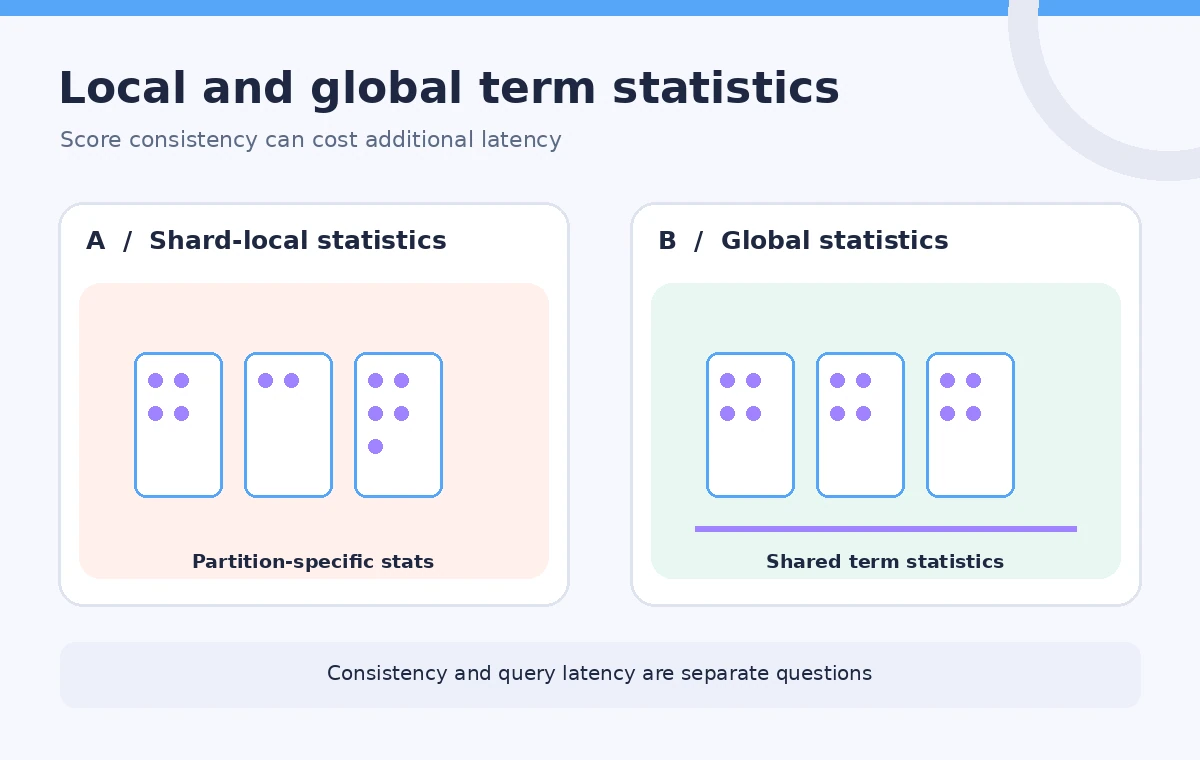
Imagine two index partitions containing different proportions of the same rare term. A local scoring calculation may evaluate how unusual that term is within its own partition, while global statistics draw on a broader set of documents. That can affect relative relevance scores even when the query text is identical. The illustration compares these concepts without numeric scores or a claim that Azure returned any particular ranking in a live test. Exact ranking behavior depends on the query path, current index, and any additional ranking stages. The purpose of the visual is to show the diagnostic question, not to predict every result position.
Check the latency and service budget tradeoff
Global aggregation introduces additional work, so Microsoft warns that it can increase query latency. Compare percentile latency, request load, and error rates in the environment that will serve visitors, not only a developer laptop on an idle index. A small editorial search tool that values diagnostic consistency may tolerate extra latency; a heavily used public kiosk might not. Avoid making any promised performance estimate without measurement. If the only goal is offline relevance evaluation, global statistics can be an experiment rather than a permanent production default. Document what is being optimized and decide how much variance is acceptable.
Account for semantic and hybrid ranking stages
Azure AI Search supports several ranking paths, including traditional text relevance, vector retrieval, hybrid results, and semantic reranking. The final order may reflect multiple scoring stages rather than only one document-frequency calculation. Do not assume that every observed change in a hybrid or semantic query comes from scoringStatistics. Examine the documented relevance pipeline for the exact query design and compare appropriate score fields. If a semantic caption appears plausible but omits the museum’s source citation, that is a content verification problem, not a local-versus-global statistics problem. Separate retrieval experiments from decisions about public claims.

Choose a mode with evidence, not a slogan
A sensible release note states which queries were compared, whether local and global produced materially different rankings, how the application measured relevance, and what latency tradeoff was observed. Keep the configuration change reversible and monitor real query patterns after rollout. Staff should still inspect the underlying catalog record before publishing a safety instruction or date. If global statistics do not resolve a known miss, return to indexing, query fields, or filtering investigations rather than piling on unrelated settings. The goal is transparent, testable relevance, with a documented reason for the chosen scoring mode.
How We Research
Our primary sources were Azure AI Search Search Documents REST reference; Azure AI Search relevance and ranking overview. We checked the versioned Microsoft Search Documents reference for scoringStatistics local and global values and used the relevance overview to separate scoring from other ranking stages. No real index was queried, no ranking results were observed, and no latency measurement was performed. Readers should verify the cited product documentation, feature availability, and their own account configuration before deploying anything. The schematics explain the decision process rather than reproduce vendor screens or claim measured outcomes.
Frequently Asked Questions
The REST reference lists local as the default for lower-latency scoring.
To aggregate scoring statistics across the index for more consistent document-frequency-based scoring.
No. It may improve score consistency but cannot fix incorrect filters, missing documents, or poor query design.
Yes. Microsoft explicitly notes that global statistics can increase query latency.
No. Authorization and query filters must be designed and validated independently.