
Replicated does not mean conflict-free
A museum operates a traveling-exhibition loan register from two regional offices. The registrar in one region marks an object returned; a second office, working from an older view, marks the same record still on loan. DynamoDB global tables can replicate item updates across AWS Regions, but the consistency mode matters. In multi-Region eventual consistency (MREC), concurrent writes to the same item can be reconciled using last-writer-wins based on an internal timestamp. Both replicas may converge while one business-relevant edit is no longer the winning item state. A technically healthy replication pipeline therefore does not establish that the museum’s latest approved loan status survived.
Understand the consistency mode first
Read the actual global table configuration before assuming every workload behaves like MREC. AWS documents both MREC and multi-Region strong consistency (MRSC), with different constraints and semantics. This guide focuses on MREC’s concurrent-write risk rather than claiming that every global table uses exactly the same reconciliation logic. Document the regions involved, the table’s selected mode, permitted write paths, and whether the application uses region-local strongly consistent reads. A strong read in one region does not automatically prove that an update made in another has already arrived under MREC. Engineers should explain these boundaries to operations staff without implying an uptime guarantee or a fixed replication interval.
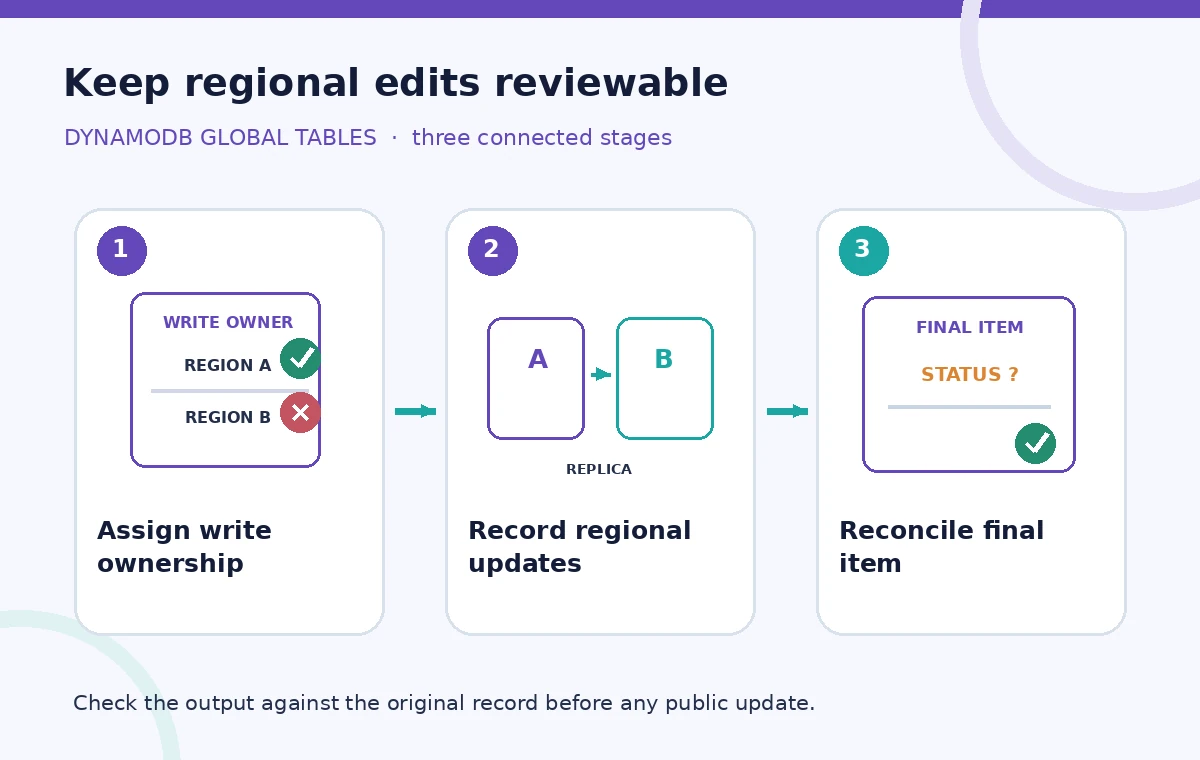
Give each object a clear write owner
The simplest defense against conflicting writes to a museum loan item is to designate one authority for status changes. The public exhibition site may read replicated data, while the registrar’s protected service handles changes in its assigned region. IAM policies and application routing can constrain regional write paths. If a multi-region active-writing design is required, consider a record-level owner or a workflow that queues contested actions for deliberate reconciliation. Do not assume a conditional update evaluated in one region can atomically prevent another region’s concurrent update. An accession number is an identity; a signed return receipt or staff approval record is the business evidence for the state change.
Track evidence separately from the mutable item
A mutable status field such as on loan, returned, or condition review is convenient for dashboards, but it should not be the only audit trail. Preserve a separate immutable event or approved-document record with the object ID, action, authorized operator, timestamp, and supporting loan paperwork. Choose retention and access controls appropriate for donor and borrower confidentiality. If two regional updates collide, the event history can reveal the losing action without depending on whichever value eventually appears in the item. Do not claim that DynamoDB’s internal conflict timestamp is a substitute for a registrar-approved event ordering. The database reconciles data; the museum reconciles meaning.
Recognize three different record states
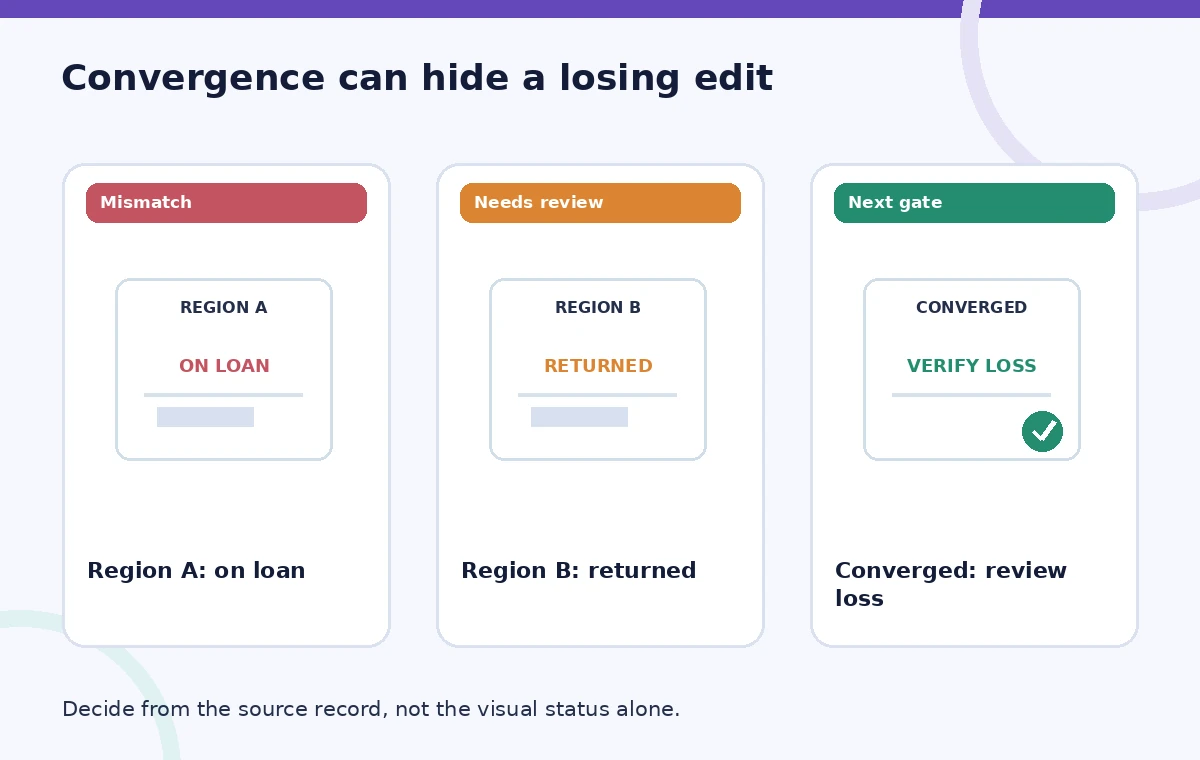
For a fictional object M-204, region A receives a physical return confirmation and writes returned while region B writes an extension from a stale screen. The displays may temporarily disagree; after propagation, they converge on the update selected by MREC conflict resolution. The resulting agreement is a storage state, not evidence that the correct business decision won. A separate staff review may need to reapply a verified status with the associated documents. The conceptual illustration contrasts two competing regional statuses with the converged item; it makes no claim to measure real replication timing or reveal which example would win in production.
Monitor lag without turning averages into promises
AWS describes ReplicationLatency metrics for regional pairs and notes that there is no service-level agreement on the value. An average can conceal sporadic delays that matter for a specific loan record. Monitor both trends and exceptional lag where the tooling makes that possible, and alert on unusual replication behavior. A slow region should not be allowed to produce an irreversible public status from a stale record without a freshness check. Specify what happens to editing when one region is disconnected: queue changes, shift writes to a designated authority, or place the affected records on hold. The right decision depends on organizational policy, not an arbitrary dashboard threshold.
Design a conflict-resolution queue
Build a review process for cases where overlapping edits are possible or detected by the application. Compare the independent source events, the current item in each region, and the most recent signed loan evidence. A reviewer should resolve the business status and record why it was chosen. If a correction is needed, write it through the approved path and verify replication again. Do not simply choose the highest client timestamp: workstation clocks can be wrong, and last-writer-wins refers to a database mechanism rather than official museum priority. A conflict queue should have an owner, a response target, and an audit trail that survives staff turnover.
Test interruptions with synthetic loan records
Use staging replicas and invented object IDs to exercise near-simultaneous updates, a delayed writer, an isolated region, and recovery after replication resumes. Confirm which application paths can write, what public readers display during disagreement, and whether a losing business action remains available for review. Do not infer service reliability from one successful test; record actual outcomes without presenting them as universal rates. Include testing of read-only replicas and a conflict hold state. Evaluate whether staff can locate the authoritative source document even when the currently stored item has already converged. Avoid production loan records or donor identities in public test environments.
Limit information exposed across regions
Multi-region replication can affect where collection and borrower metadata is stored. Before adding a replica, review applicable institutional requirements for personal data, sensitive provenance, storage residency, and access logging. Replicate only what the application should hold, and separate public-facing collection descriptions from confidential loan contracts. AWS global tables replicate all table items in the configured replication set rather than using a field-level museum permission filter. If different jurisdictions need different records, design separate data boundaries rather than relying on a UI field being hidden. Availability goals must be evaluated alongside privacy and curatorial authority.
Publish only a reviewed loan status
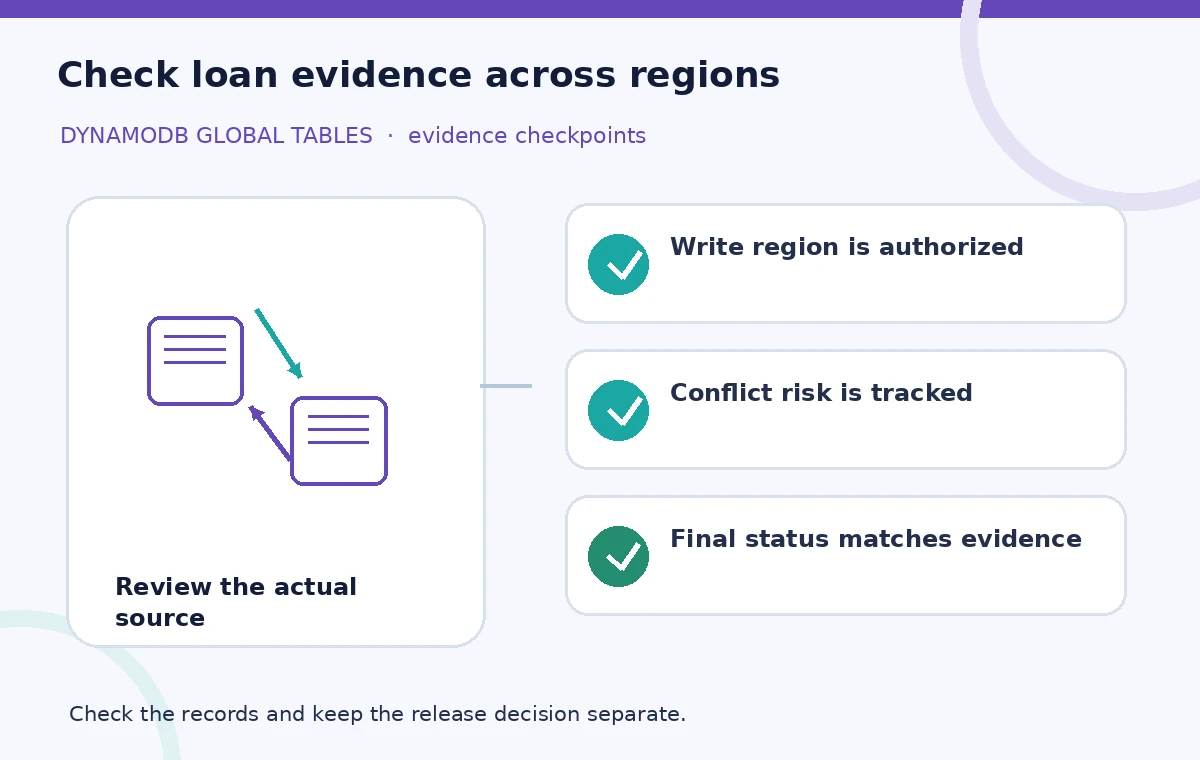
A reliable publication gate confirms the accession identity, approved source evidence, authorized status owner, and absence of unresolved conflicts. For the public catalog, a neutral status such as update under review is preferable to confidently announcing returned when a second office has disputed the change. Record the resolution and verify that the intended value is visible in the consuming region before updating public pages. MREC last-writer-wins is a database convergence rule, not a museum decision policy. Keeping those concepts separate protects provenance, loans, and the credibility of the visitor-facing catalog.
How We Research
We reviewed these named official references: AWS DynamoDB global tables behavior; AWS Global Tables design considerations. We checked the documented feature, relevant configuration fields, and important stated limitations against a hypothetical museum or archive task. We did not run live production APIs, use real patron or loan records, perform a security penetration test, or measure accuracy, latency, search rank, or costs. The accompanying diagrams are explanatory models, not captured application screenshots or measured results. Verify current documentation, account-specific availability, and permissions before implementation; confirm all public-facing decisions with authorized staff and primary evidence.
Frequently Asked Questions
No. AWS documents both MREC and MRSC. The last-writer-wins concurrent-update discussion here specifically concerns MREC.
No. It is an internal conflict-reconciliation method and does not validate museum approval or source evidence.
Not under MREC when the latest update originated elsewhere; propagation and regional read semantics matter.
No. AWS states there is no SLA on replication latency; monitor and design for unusual delays.
Compare the source events and signed paperwork, use an authorized reviewer, document the decision, and verify the corrected replicated state.