
Design the pledge as an operation, not a click
A museum donor might click Submit once and see a spinner because the network timed out. A volunteer may then press the same button again, creating a second request. Whether two pledges appear depends on the server-side write contract, not on what the browser shows. Give each intended pledge a durable, application-generated operation ID and keep the donor’s approval text outside telemetry. Decide which records must change together: the pledge record, a ledger summary, and perhaps an audit receipt. The example here uses invented identifiers and amounts. No live financial account, payment network, or donor data has been tested.
Use TransactWriteItems for an atomic group
DynamoDB TransactWriteItems can combine conditional checks, puts, updates, and deletes across items, with the documented limits that all involved tables must be in the same AWS account and Region and that one transaction cannot operate on the same item twice. The API accepts up to 100 transaction action entries. Atomicity means the grouped changes succeed together or fail together under the service’s transaction rules; it does not replace accounting review or a payment processor. For a pledge workflow, consider writing a canonical pledge item and a bookkeeping item in the same transaction, each with appropriate conditions. Separate payment authorization from this illustrative ledger design.
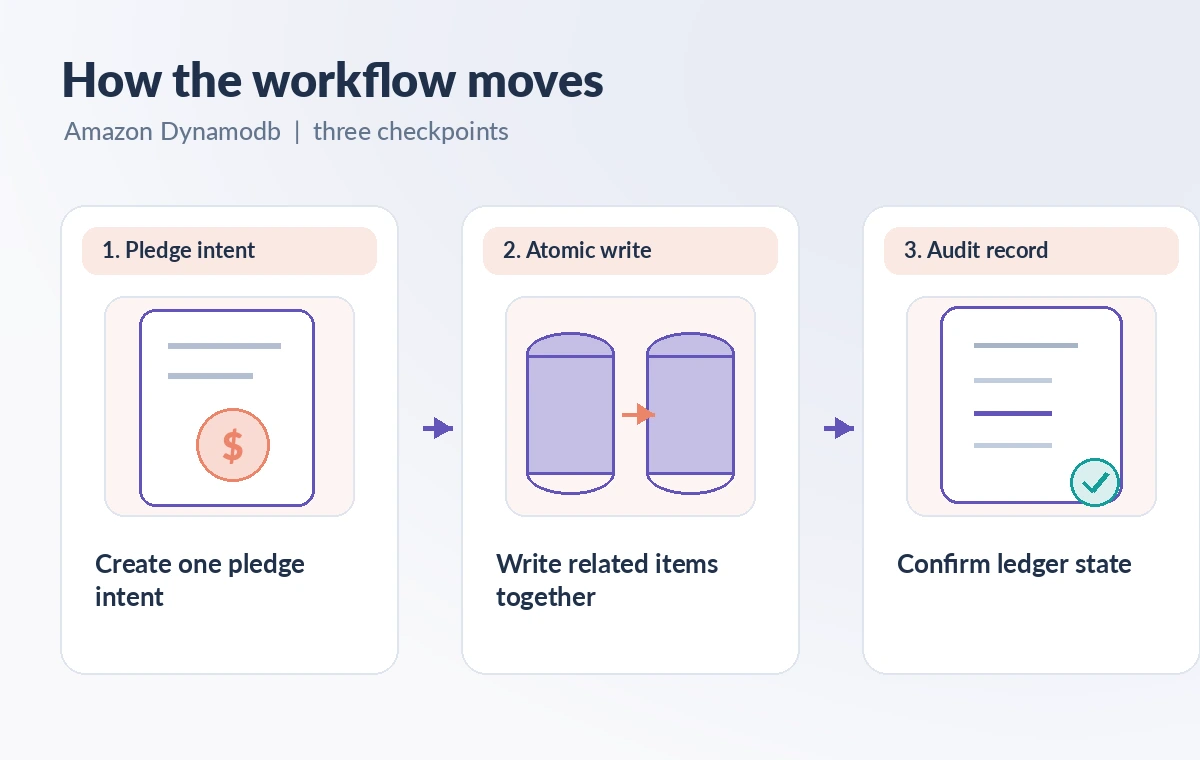
Keep ClientRequestToken stable for the same intent
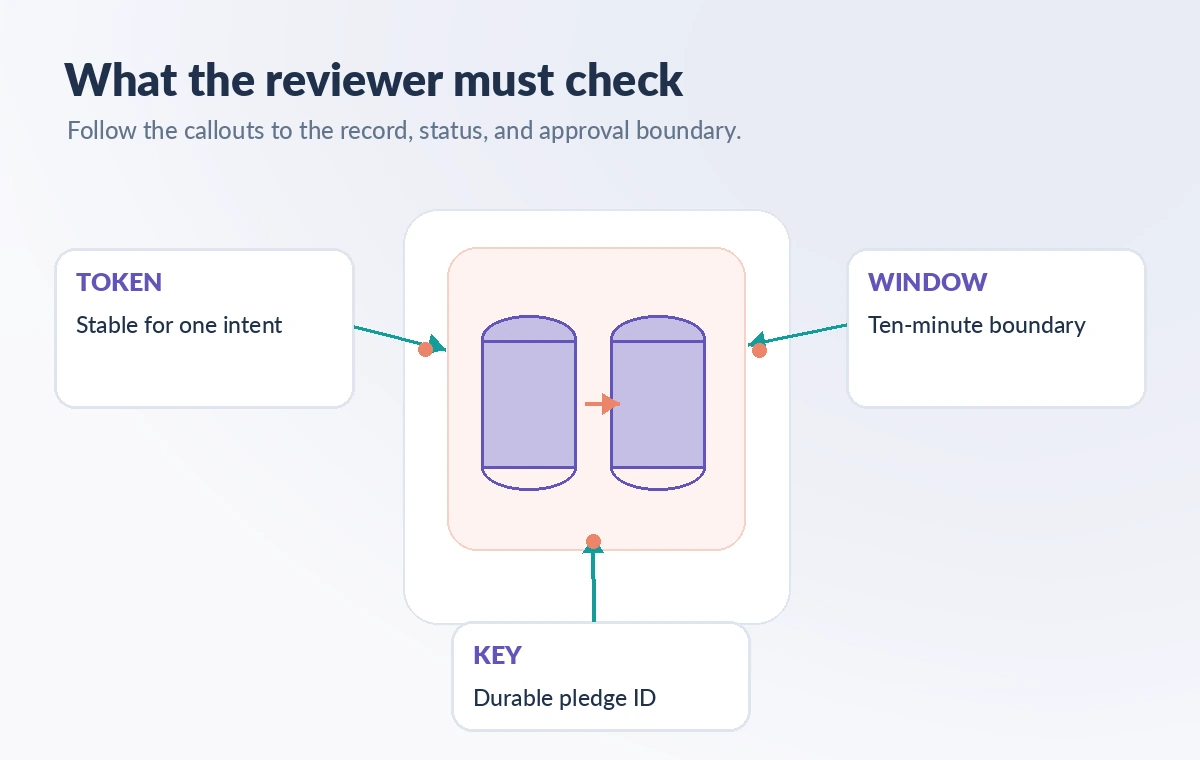
The API’s ClientRequestToken provides a time-limited idempotency guarantee for identical TransactWriteItems requests. Derive or assign the token once when the server accepts a new pledge intent, and reuse it only while retrying exactly that operation. Persist the mapping between application pledge ID and request token in a protected store rather than regenerating a random token on each HTTP retry. A changed donation amount, recipient fund, or authorization status is a new operation requiring explicit review. Store only the minimum necessary metadata, with access controls appropriate for financial records. Never print real account details in diagnostics.
Understand the ten-minute rule and mismatch exception
AWS documents a ten-minute window following completion of the first tokened transaction. Inside that period, an identical retry using the token has the same write effect as one call. If another request uses that token with different parameters during the window, DynamoDB returns IdempotentParameterMismatch. After the window expires, reusing the token is treated as a new request and therefore is not a long-term duplicate shield. Engineers should not implement a retry queue that assumes the token permanently identifies a donation. A separate unique pledge record and conditional creation logic are needed for protection beyond the short request-idempotency period.
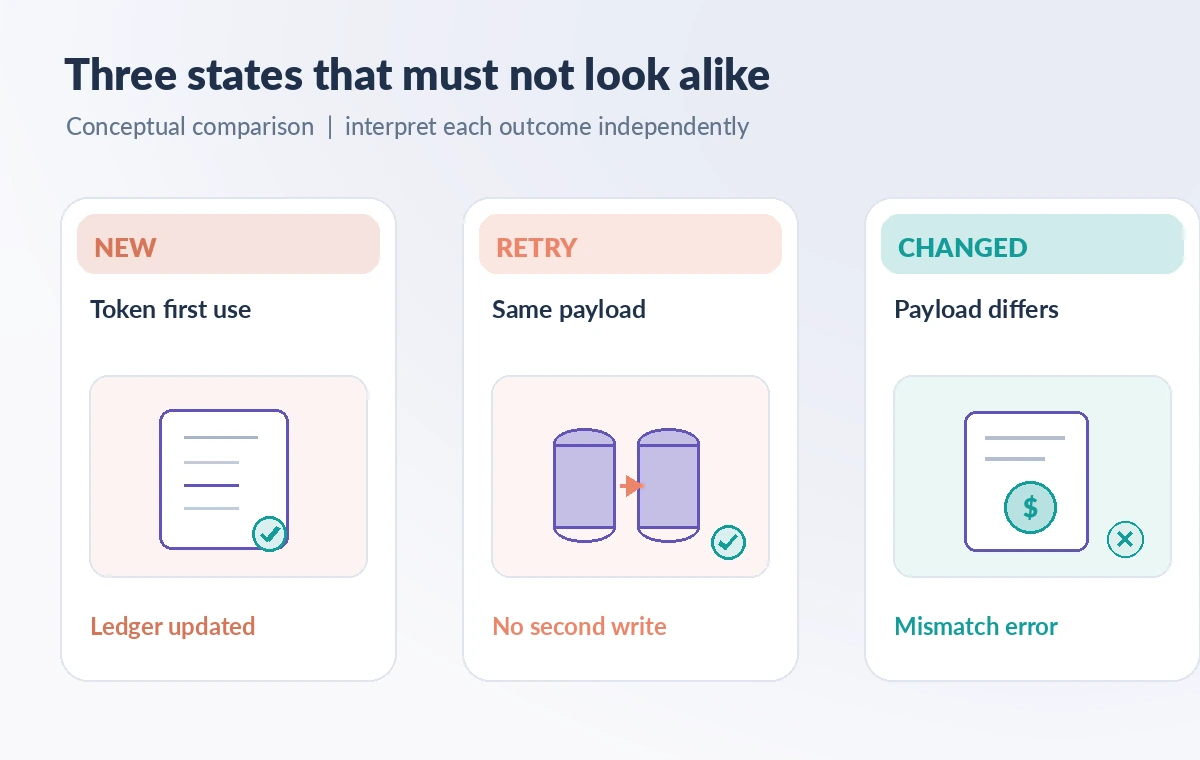
Compare the first call, safe retry, and changed retry
Consider three conceptual panels: first, the ledger receives pledge P-41 and the transaction reports success. Second, a network response is lost and the same token and parameters are retried inside the window; there is no second ledger write. Third, an operator changes the amount but reuses the token; the service rejects the changed request rather than pretending it matches the original. The panels are instructional, not captures of a production database. UI labels must distinguish a failed acknowledgement from a failed transaction. If the response is ambiguous, check the durable pledge record before anyone submits a new transaction.
Enforce a unique business key beyond request retries
ClientRequestToken handles a narrow technical retry window. An institution also needs a durable business invariant, such as one pledge-intent key per approval event, enforced with a condition expression that prevents overwriting an existing item. The database condition should reject duplicates regardless of whether a retry arrives minutes, hours, or days later. If the donor intentionally creates a second pledge, issue a new unique intent ID rather than recycling the old key. Keep revisions and cancellations as explicit audited events. A matching donor name or email address is not a valid deduplication key, because one person can legitimately make multiple pledges.
Handle an ambiguous timeout without blind resubmission
A client timeout can occur after DynamoDB commits the transaction but before the caller receives its response. The correct recovery path is to inspect the known pledge identifier or query the operation ledger, not immediately issue a new request with a different token. If the original operation is still within the token window, an identical retry may be safe under the documented guarantee, subject to the normal service errors and retry guidance. When a transaction is already in progress, follow SDK and API recommendations for backoff. If evidence conflicts, mark the case pending human reconciliation and avoid sending duplicate donor receipts.
Distinguish cancellation from inadequate approval
A TransactionCanceledException can arise from failed conditions, conflicts, or other transaction constraints. Preserve cancellation details for authorized diagnostics, but do not treat every cancellation as proof that no donor intended to pledge. Equally, an atomic database write cannot establish consent to charge a card, verify restricted-fund terms, or confirm a charitable contribution. Those requirements belong to separate user approval and finance processes. Test expected failures such as an already-existing pledge key, changed request parameters, temporary throttling, and unauthorized access. Each scenario should have a visible staff resolution path rather than a blanket retry loop.
Stage a reconciliation drill using fictional records
Build an authorized test fixture with synthetic pledge IDs and two ledger items. Simulate a successful transaction, an identical near-term retry, a changed-parameter retry, and a delayed duplicate after the documented window. Check that the final business ledger still reflects exactly the intended commitments because of the durable uniqueness constraint, not only because of ClientRequestToken. Capture the request schema version, token mapping, cancellation status, and reviewer disposition. Do not claim measured throughput or cost from this guide. Before implementation, review current AWS limits and institutional finance controls with both engineering and accounting owners.
How We Research
We examined the named primary references for the applicable API semantics and limits: DynamoDB TransactWriteItems API, DynamoDB transactions explained, DynamoDB condition expressions. We compared documented options with an illustrative, fictional institutional workflow and marked failure states separately from editorial approval. No live cloud account, customer records, paid API measurements, production workload, or real service screenshots were used. Examples and diagrams are conceptual and do not represent observed accuracy, latency, cost, or compliance outcomes. Before deployment, check current regional availability, SDK and API versions, security obligations, billing, and institutional rules, then run authorized tests and obtain human signoff.
Frequently Asked Questions
AWS documents ten minutes after the initial transaction completes. The token alone is not a permanent deduplication key.
Within the documented window, DynamoDB raises IdempotentParameterMismatch rather than accepting a changed transaction as an identical retry.
No. It is a database transaction API. Payment consent, processing, and accounting controls must be handled separately.
Yes. A response may be lost after a commit. Query the durable business record before initiating a new operation.
Use a durable unique pledge-intent key with conditional writes and reconciliation; do not rely on the short token window alone.