
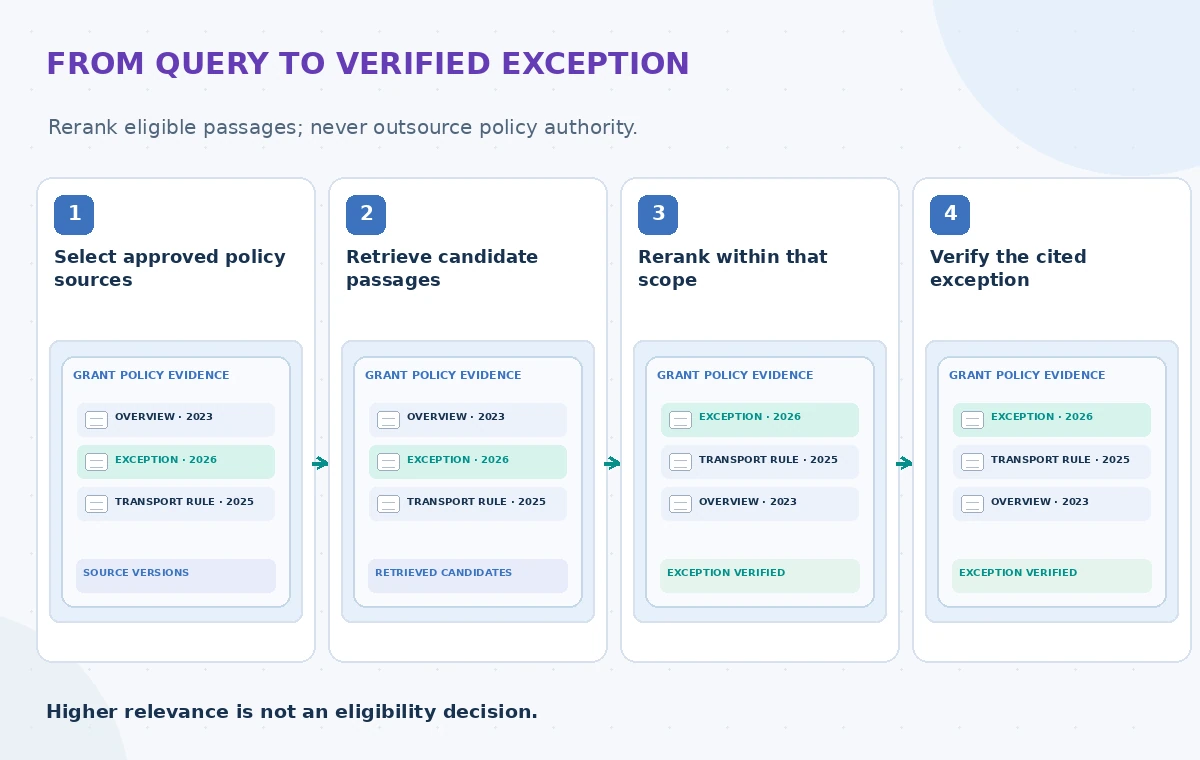
A hypothetical community grant program has two versions of its eligibility guidance. A broad search for ‘transport assistance’ may surface a familiar overview before the current exception that excludes reimbursements requested after an event. Amazon Bedrock Knowledge Bases can apply a reranker to candidate text chunks, potentially bringing more relevant evidence nearer the top. That is a ranking operation, not a verification of the policy, a permission check, or an eligibility decision. This guide shows how an editor could design and audit that workflow using fictional records rather than claiming a live Bedrock test.
Separate source authority from semantic relevance
Start with the actual governing policy, its revision date, effective period, attachments and approval owner. A reranker cannot infer which document is legally operative simply because two passages discuss the same grant. Keep a source manifest linking the policy title, stable revision ID, publication status and embargo classification. For a hypothetical reimbursement query, include the old overview as a deliberate negative control and the current exception as the evidence the review must not omit.
Ask a policy owner to identify the authoritative clause before experimenting with rankings. A grant page may mention an exception in a footnote while a more readable FAQ repeats a superseded rule. If the source system stores both, preserve their relationship instead of silently deleting history. The search interface should identify superseded material as such and avoid converting an apparent similarity score into an administrative approval.
Retrieve only candidates the requester may see
Amazon Bedrock documents both Retrieve, which returns source items, and RetrieveAndGenerate, which couples retrieval to model generation. In a workflow where exceptions matter, inspect Retrieve output before asking a model to summarize it. Configure the knowledge base and metadata filters for the user’s access scope; the reranker should receive only chunks already eligible for that requester. A result must not become visible merely because the model believes it is relevant.
The examples use two fictional grants and synthetic query text. Run an authorization matrix covering public guidance, staff-only notes and archived drafts. Be careful about cached snippets, source titles and citation previews as well as full paragraphs. If a private passage is missing from the search results, verify that the application selected the correct source permissions rather than attributing that result to reranking alone.
Add the reranking stage with explicit configuration
AWS supports reranking directly through the Rerank operation and as a retrieval configuration in Knowledge Bases. For custom knowledge bases, the documented vector search configuration can specify a reranking model, optional fields and how many reranked results to return. Confirm the exact API configuration and supported models for your region and account. AWS also documents a managed-knowledge-base path with different retrieval settings, so avoid copying a custom configuration into the managed mode.
Record the reranker model identifier, source revision, candidate count and returned count in protected evaluation notes. AWS notes that a request for more reranked results than retrieved candidates cannot create extra candidates. Do not advertise a fixed improvement percentage without running a representative ground-truth evaluation. Reranking adds another paid model step and may affect cost, latency and response length.
Compare passage order without faking a benchmark
Draw the first view as an old general transport policy at rank one with the current late-request exception below the fold. Draw the second as the same candidate set after reranking, with the exception moved nearer the top. Draw the final state as a reviewer opening the full, current clause and citing its source. This is a conceptual comparison, not actual output or a measured model ranking. Avoid artificial scores such as ‘98% correct.’
A source chunk may be relevant yet incomplete: the following paragraph could define ‘request date,’ an appendix could limit the exception by location, or an approved amendment might override it. Inspect surrounding text and source links after reranking. A correct item at rank one is not sufficient if the generated answer omits a disqualifying condition. Review both retrieval quality and answer fidelity separately.
Keep guardrails and relevance controls distinct
AWS notes that guardrails applied to retrieval-and-generation inputs and generated responses do not automatically scan retrieved references. Treat sensitive-source exclusion as a data access design problem, not a topic filter or safety model feature. Confirm whether the model is allowed to read private applicant narratives before sending them into retrieval. A reranker will not redact a private bank account or identify an incorrect permission label in an archive.

If a public search result cites a restricted appendix, stop the release and investigate indexing, tenant routing and metadata filters before adjusting reranking prompts. Keep sensitive examples synthetic for public tests. Escalate uncertain eligibility language to a human administrator; the application should be able to say that a policy exception needs review rather than confidently accept or deny an applicant.
Build a small adversarial query set
Prepare prompts that mention common terms shared across policy generations: reimbursement, deadline, transport, accessibility, emergency and discretionary exception. Label the clause each query should retrieve and any required caveat. Add counterexamples, such as an obsolete policy with an almost identical heading, a current appendix with different dates, and a request from a user lacking staff permissions. Evaluate whether the system returns evidence from the right revision.
Reviewers can compare a baseline ordering with reranked ordering using the same candidate set, the same filters and an agreed relevance rubric. A changed index or newly added document confounds the comparison. Record missed exceptions and wrong-version citations by query instead of aggregating them into a marketing claim. The editorial gate should ask whether the answer survives inspection of the full governing text.
Control permissions, costs and failure cases
AWS lists model-access and IAM requirements for reranking; the needed actions vary with whether the application calls Rerank, Retrieve or RetrieveAndGenerate. Set least privilege and review any cross-service invocation permission before enabling a new model. Confirm pricing, supported regions, quotas and fallback behavior at deployment time. A reranker unavailable in one environment should cause an explicit fallback or a review hold, not a silent claim that the answer used the new model.

Plan how to report timeouts, empty source sets and access errors. Preserve a trace ID and approved source identifiers without storing private grant applications in broad telemetry. If a timeout occurs after an index update, check whether it completed before replaying the operation. Retries can duplicate writes or costs unless controlled. Do not allow a degraded retrieval path to bypass the mandatory policy-review check.
Release only answers that preserve exceptions
The final proof should display the current policy title, revision date, relevant exception, surrounding conditions and a link to the exact source. Ask a reviewer whether the answer would mislead a person about deadlines or eligibility. A summary that reads smoothly but drops the late-request exclusion fails. Publish a human-reviewed correction when the policy changes and invalidate any cached answer that cites the former revision.
We have not run Bedrock models against actual grant files here. The diagrams are hypothetical descriptions, not AWS console screenshots or claims of accuracy. The useful success condition is narrower than ‘the answer sounds better’: authorized evidence is retrieved, the operative exception remains visible, and a person can reproduce the conclusion from the cited governing document.
How We Research
For this November 2026 article, we examined three named official references: AWS: Improve relevance with reranker models; AWS: Retrieve and generate with a knowledge base; AWS: Permissions for reranking. We compared documented configuration, request behavior and limitations with a fictional nonprofit use case. The resulting narrative and diagrams are an editorial design exercise. We did not use real records, invoke vendor services, test accuracy, time API responses, conduct a security audit, or obtain actual publication rights. An implementation should recheck model, region, account, IAM, costs, privacy law, source status and the organization’s approval policy before processing any real material.
Frequently Asked Questions
No. Filter and authorize source candidates before reranking; relevance is not a security boundary.
No. A reviewer must check the operative policy revision and context.
No additional passages appear merely because the requested reranked count exceeds the retrieved candidate count.
No. AWS distinguishes input and generated response guardrails from handling of retrieved references.
No. Scores rank relative relevance; they are not ground-truth eligibility probabilities.