
A Citation Is a Starting Point, Not an Attribution Decision
Imagine a volunteer drafting a visitor label for a donated ceramic bowl. The knowledge base returns a persuasive paragraph describing its maker, date and village, complete with a citation. The catalog card, however, says the maker is unknown and the village was merely the donor’s residence. The citation is useful because an editor can follow it back to a specific source passage. It is not proof that the generated sentence interpreted that passage correctly.
The safe goal is modest: identify the exact retrieved material behind each public claim, compare it against an approved collection record and hold conflicting statements. Keep the label’s writing quality separate from the status of the evidence. A smooth sentence with the wrong attribution is still wrong, and an older source page can be quoted accurately while being superseded by the most recent catalog revision.
Understand What RetrieveAndGenerate Returns
Amazon Bedrock Knowledge Bases offers Retrieve to return relevant source chunks and RetrieveAndGenerate to combine retrieval with a language-model response. AWS documents citations associated with generated material, including retrieved references to source chunks. Those references help explain where an answer may have come from; they do not independently verify the contents or guarantee that every sentence is supported. The application’s own checks remain necessary.
For a hypothetical museum workflow, retain the citation text, the reference location when available, the data source revision and the generated assertion being reviewed. Do not presume a reference to an image means a human curator inspected it. Model output may blend details from separate passages or fail to mention uncertainty; the reviewer needs an evidence table rather than a single green “cited” marker.
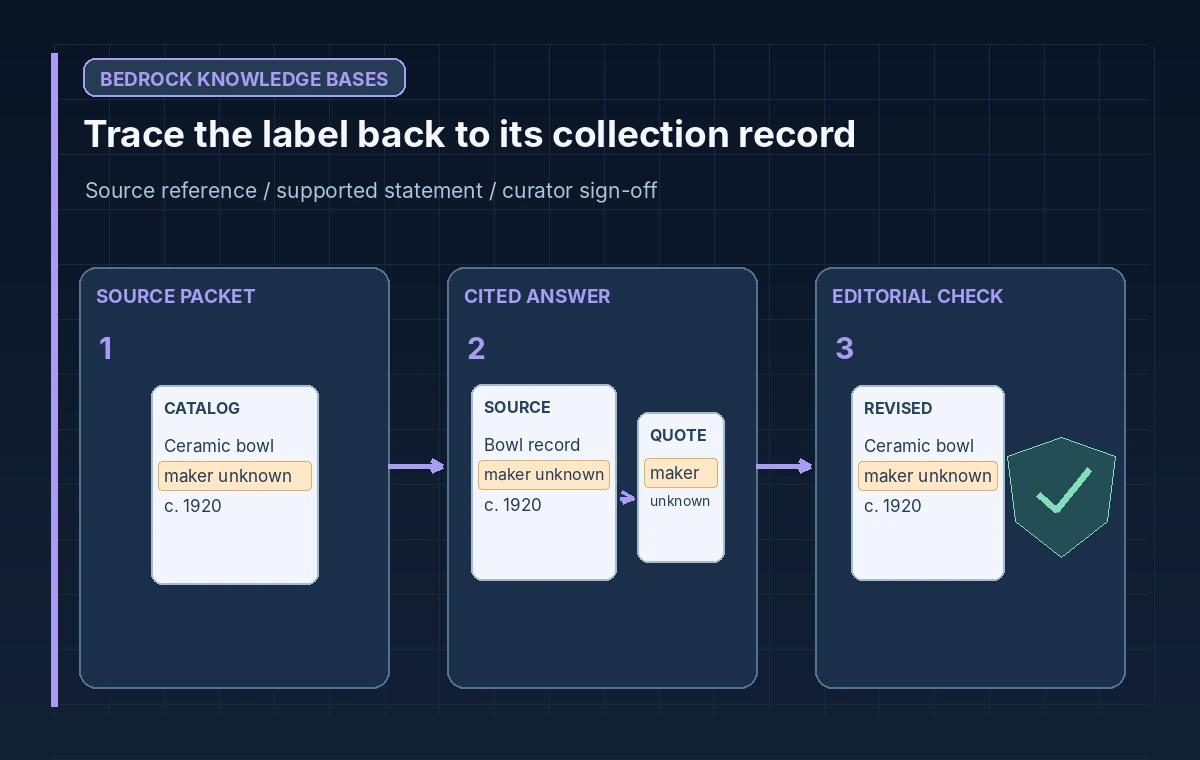
Curate the Source Packet Before Indexing
Start with approved catalog records, accession sheets, documented corrections and carefully scoped exhibition notes. Attach stable object IDs, date-of-revision fields and public-use status outside the generated prose. A donor’s private address may be present in a historical card but should not be treated as material for a visitor-facing label. Check what the index can retrieve and who is authorized to see it before any prompt is submitted.
Prefer a controlled educational dataset with invented bowl IDs while validating the review workflow. If two records disagree about a date, preserve both and mark the conflict. Do not silently resolve it by choosing whichever text the model paraphrases most confidently. The underlying collection policy should specify which source is authoritative for each field and when a curator must make the final call.
Map Every Material Claim to Its Evidence
Split a proposed label into factual claims: material, maker, date, place, donor and permitted quotation. For each claim, ask the reviewer to open the cited chunk and its surrounding source record. A match should be judged at the level of meaning, not shared keywords. “Collected near Rose Creek” does not establish “made in Rose Creek,” even when those place names appear in the same paragraph.
Document one of three outcomes: supported, contradicted or unresolved. An absent citation does not automatically mean the claim is false, but it means the automated path cannot approve it. A citation attached to a paragraph may not support every clause in that paragraph. A publication gate should prohibit unsupported facts from entering the final exhibit label until an authorized editor has checked them.
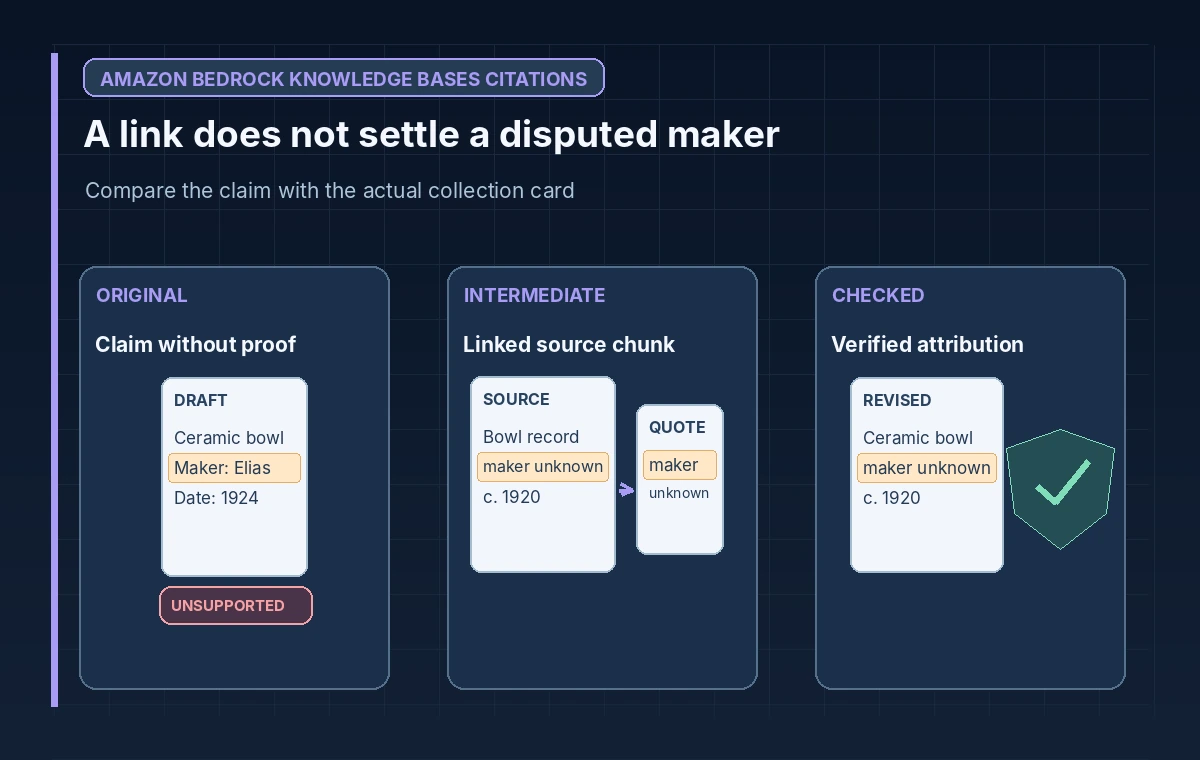
Compare Three Evidence States Visually
A useful training diagram shows a polished label with an unsupported maker, a response that links the sentence to a specific source chunk, and a reviewed label that replaces the incorrect assertion with a verified uncertainty statement. The artwork is illustrative; it should never be described as the output of a measured Bedrock benchmark. The key visual difference is the status of the claim, not merely whether a hyperlink appears.
For example, the intermediate state might cite an inventory note saying “maker not recorded.” The correct reviewed label should preserve that uncertainty instead of calling the link a source for a named artist. Keep the source text and the final editorial wording distinct so a reader can understand the correction without assuming the model performed historical research beyond the indexed records.

Handle Revisions, Restricted Records and Retrieval Gaps
When catalog records change, recheck which version of each reference was indexed. A cited source from an earlier revision can become misleading after a curatorial correction. Maintain a change log and re-review published copy that depends on a superseded record. Likewise, a retrieval result is not a complete inventory of all relevant documents; a missing chunk does not prove that contradictory evidence is absent.
Apply access restrictions before revealing retrieved content to users. The model’s choice of a relevant source is not an authorization mechanism. If restricted donor correspondence is accidentally retrievable, fix the underlying permissions and ingestion rules; hiding the resulting text in a final prompt is not enough. Review error paths so an unavailable index yields a clear incomplete-research status rather than an invented attribution.
Test With Difficult Museum Cases
Prepare a small set of cleared or fabricated scenarios: unknown maker, conflicting dates, an outdated accession note, a private donor line and an image with no documented reuse permission. For each scenario, record the expected citation behavior and the exact claim that should be held for review. Inspect both the retrieved references and the final label; a reasonable-sounding label can fail the evidence test.
Test what happens when no relevant source is returned, when an unrelated source shares a keyword and when two records use different names for the same item. Do not fabricate precision or accuracy scores for this exercise. An editor can still create a useful documented acceptance checklist without claiming that an external API was run or that source attribution succeeded under real production conditions.
Release Only After a Human Provenance Gate
A release checklist should include object ID, source revision, claim-by-claim citations, access policy, image rights, reviewer initials and the approved final wording. Publish the checked label rather than the raw model response. Keep a reversible record of what changed when a catalog correction arrives, and link the public text to the authoritative collection system rather than to a transient generation session.
Bedrock citations can reduce the work of finding candidate sources, but they cannot grant copyright permissions, resolve uncertain dates or substitute for curatorial sign-off. The strongest outcome is a traceable explanation of why a statement was accepted or held. That makes the assistant valuable without presenting automated retrieval as historical proof.
How We Research
We reviewed the following official developer documentation on November 8, 2026: AWS Bedrock: Retrieving information using knowledge bases; AWS Bedrock: RetrieveAndGenerate API; AWS Bedrock: Retrieve API. We compared the documented parameters, data flow and stated limitations with this hypothetical editorial scenario. The diagrams are original instructional illustrations, not real vendor screenshots or outputs. We did not submit private archive material, run a production API evaluation, measure tool accuracy, obtain legal consent, or test a live service configuration. Product behavior, access rules, quotas and supported settings may change; confirm the latest documentation and your organization’s policies before deployment.
Frequently Asked Questions
AWS documents source references in generated responses. Review the cited content and the claim it is supposed to support; the presence of a reference does not verify accuracy.
Yes. The referenced record may have been revised or superseded. Compare its version to the current authoritative catalog entry.
Not by itself. Enforce permissions in the data and application architecture before restricted source text can be surfaced.
Hold the label and correct the unsupported assertion. A contradiction is not resolved by adding more citation formatting.
No. They are hypothetical diagrams that explain an editorial review process without claiming an API evaluation.