
AI marketing attribution is useful only when the underlying measurement is consistent. A natural-language summary cannot repair a malformed URL, a missing key event, or a channel definition that changes between campaigns. This guide focuses on the instrumentation layer: write a UTM taxonomy, connect it to a defined GA4 key event, verify one test journey, then let AI help classify unexpected data patterns. It does not promise true incremental lift or a reliable answer to which channel “caused” a sale. Your practical output is a tag specification and a diagnostic checklist a marketer can hand to an analyst.
Separate tracking, reporting, and causal impact
Attribution reports describe how configured analytics systems assign credit to observable interactions. Incrementality asks a harder question: what would have happened without a campaign? Do not use these interchangeably. First identify the measurable business outcome—qualified form submission, demo booking, or completed checkout—and the channel decisions the report must support. Write down the conversion event owner, measurement window, and known missing data before building a dashboard.
AI can summarize traffic patterns or suggest hypotheses, but it cannot infer missing consented data or a counterfactual from ordinary event logs. If paid search appears to rise as email falls, seasonality, budget changes, and changing source labels may explain the pattern. Treat model explanations as questions for investigation. A trustworthy report explicitly states the observed metric, the configured attribution lens, and the uncertainty that remains.
Define your UTM dictionary before adding links
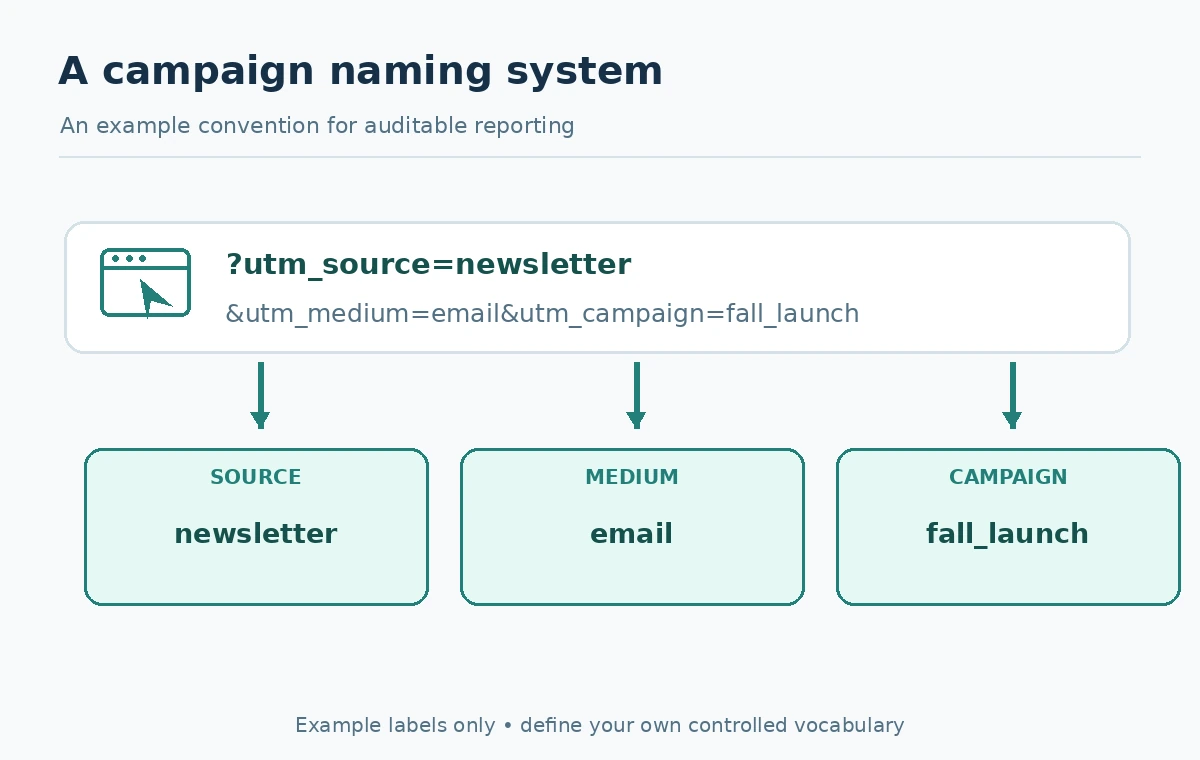
Google Analytics supports manual tagging with parameters including `utm_source`, `utm_medium`, `utm_campaign`, `utm_content`, and `utm_term`, as shown in Google’s traffic-source documentation. Make a dictionary that states accepted values. For example, use lowercase `newsletter` consistently for a source, `email` for its medium, and `fall_launch` for a campaign. This is a suggested convention, not a Google-mandated naming scheme. Give every generated campaign URL an owner and destination.
Do not independently type UTM values into every creative. Generate URLs from approved fields and validate that required parameters are present and consistently spelled. The example `?utm_source=newsletter&utm_medium=email&utm_campaign=fall_launch` is illustrative; use an actual campaign identifier for production. Check URL encoding, redirects, duplicate query strings, and whether page navigation preserves landing attribution. Avoid personal data such as full email addresses in link parameters.

Account for automatic tags and channel rules
Google’s documentation distinguishes automatic advertising-platform tagging from manual UTM tagging and warns that combinations affect reported dimensions. Before changing tag policy for Google Ads or another linked platform, inspect its auto-tagging and integration settings. A marketer who overwrites system-provided identifiers while “standardizing” links may create worse data than before. Keep a record of the campaign URL exactly as served in the ad or email, not merely the draft in a spreadsheet.
Map source and medium labels to the reporting dimension your team will actually read. Compare session acquisition, user acquisition, and manually tagged dimensions carefully: they answer different questions. The goal is not to force every view to show identical numbers, but to ensure that the intended source appears where the documented dimension definition says it should. If a value shows up as Unassigned, investigate the tagging first.
Choose and verify the GA4 key event
A business event is not a random pageview. In GA4, identify the event that represents the outcome, verify that it fires, and mark it as a key event using the property controls described by Google Analytics. For a demo request, that might be a successful form-submission event rather than a button click. The exact trigger and event naming depend on the site’s instrumentation. Confirm the event’s deduplication and counting assumptions with the implementation owner.
Test using a controlled journey and inspect DebugView or available realtime diagnostics before interpreting reports. Google warns that some reporting updates take time; don’t declare a broken installation because the standard dashboard is not instantaneous. Document which event is expected, the time it happened, the landing URL, and whether it appeared in the correct property. Avoid copying live customer identifiers into your AI diagnostic prompts.
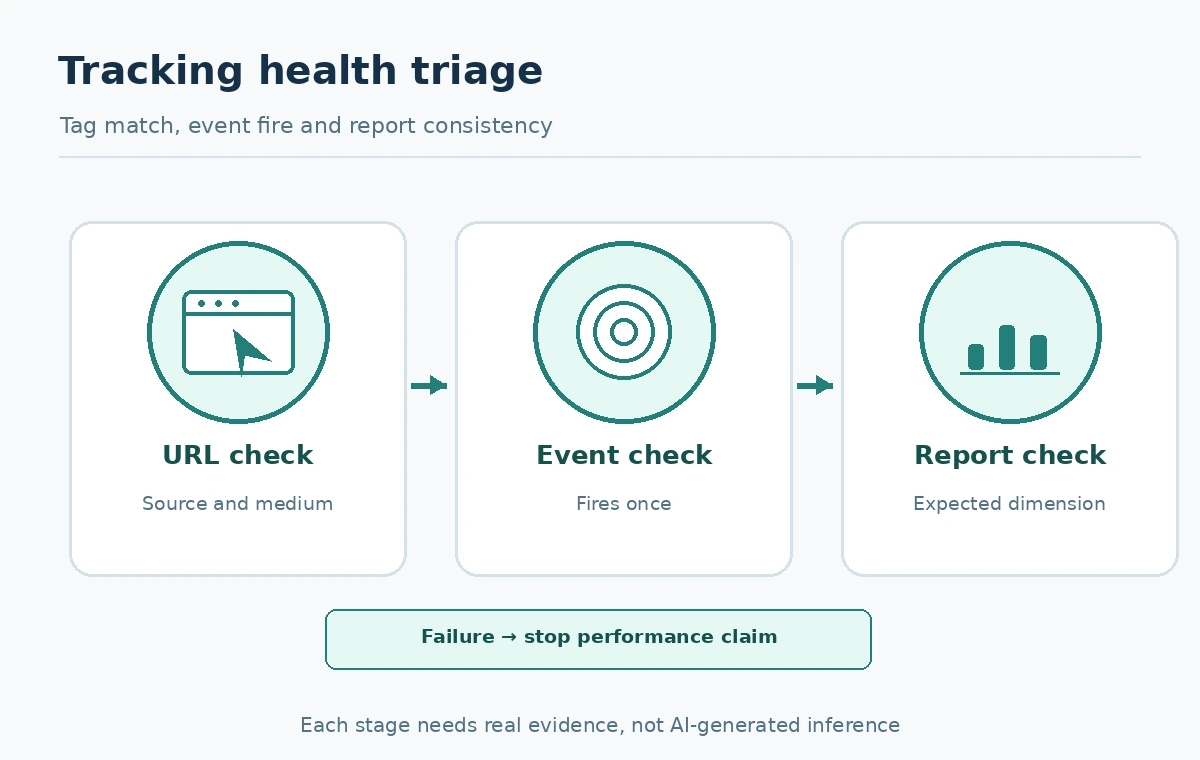
Create a three-stage data quality gate
Stage one checks the URL: valid destination, required parameters, canonical values, and preserved redirect behavior. Stage two checks instrumentation: one intended business action triggers the correct event, without duplicate firing. Stage three checks reporting: source and medium appear in the expected GA4 dimension and the key event is visible for the test conditions. A failed stage should prevent claims about campaign performance until it is reconciled.
Write a worksheet row as Campaign; Landing URL; Source; Medium; Key Event; Test ID; URL Pass; Event Pass; Report Pass; Owner; Notes. Store a redacted test ID that cannot identify an individual visitor. You can use a model to explain an error message or group failures by symptom. It should not turn a missing value into a guessed conversion or quietly change the approved naming convention.
Ask AI to triage anomalies, not award credit
Give the assistant aggregates that your policies allow: campaign, date, source, medium, sessions, and key-event counts, plus a dictionary explaining dimensions and known instrumentation changes. A focused prompt is: “Identify campaign names with inconsistent capitalization, abrupt missing-key-event patterns, or unexpected medium values. List verification steps; do not infer causation.” Demand that the output cites the exact rows or queries behind its observations.
Useful exceptions include `Email` versus `email`, two naming formats for the same promotion, a sudden change after a redirect deployment, or an event count that exceeds a plausible business process. A model may flag these, but the analyst must verify them in source logs or GA4. A traffic spike is not automatically fraud, success, or a model hallucination. Attach the result of each confirmed investigation to the original measurement ticket.
Read attribution reports with explicit limits
Google’s key-event reporting guidance covers reporting and debugging tools and attributes credit through paths and attribution models. When presenting results, include the attribution perspective, date range, event definition, and any filtering. Compare like periods when possible and state when campaigns, consent policies or tracking deployment changed. Avoid converting one report’s assigned credit into a universal performance claim.
For investment decisions, pair platform analytics with downstream outcomes such as CRM-qualified leads, return orders, or an experiment designed for incrementality when appropriate. Deduplicated business outcomes can disagree with GA4 event counts for legitimate reasons. The correct response is a reconciliation note, not forcing the numbers to match. Maintain a human interpretation layer for high-stakes budget changes and label AI-generated narratives as draft analysis.
Operate a change log and monthly audit
Tracking conventions become fragile when several agencies and internal teams publish links. Assign an owner for each source value and event. Require a quick QA review when a campaign changes destination, when an analytics property is migrated, or when a product flow changes. The change log should state the old value, new value, reason, date, expected reporting impact, and validation evidence.
Once a month, sample campaign links across channels and run the three-stage check. Preserve examples of confirmed failures and fixes; they make better training material for an AI assistant than vague requests to “improve attribution.” The process scales when people can answer a straightforward question for each reported number: what counted, where it came from, and what did the team verify?
How We Research
On October 27, 2026, we checked the following named primary-source materials: GA4 manual tagging and traffic source dimensions, Google Analytics key events, GA4 key event reporting. This article is an editorial workflow and source-based product description, not a claim of completed hands-on benchmarks, access to customer accounts, observed test results, or guaranteed outcomes. Examples, numerical placeholders and proposed test cases are instructional; readers must verify their own real values. Plan access, permissions, AI settings, availability and documentation change. Recheck product sources and consult appropriate administrators before making account or customer-facing changes.
Frequently Asked Questions
AI can suggest likely explanations but cannot reconstruct reliably uncollected source fields. Label any imputation clearly and keep it separate from observed data.
Not necessarily. A key event can represent a form or signup; revenue requires appropriate purchase or other monetary records and validation.
Not without reviewing the platform integration and Google’s documented interaction between automatic and manual tagging. Blind changes can alter reporting.
Confirm destination and UTM values, execute one authorized test event, and verify the expected source dimension and key event in diagnostics or reports.
An attribution report assigns observational credit under configured rules; causal incrementality generally needs a separate measurement design.