
An AI chatbot is a conversational interface: you ask a question in everyday language and software responds. That simple definition hides several very different systems. A scripted support widget can match a refund keyword; a general-purpose generative assistant can draft a letter; a connected service agent may be allowed to look up an order. Only the last one can potentially change real-world records, and even that requires an authorized integration.
This guide is a map of the category, not another list ranking the biggest brands. The useful question is not whether a chatbot sounds human. It is whether it knows the right facts, shows its evidence, stays within the authority you gave it, and can admit when a human should take over.
Three kinds of chatbot, three different promises
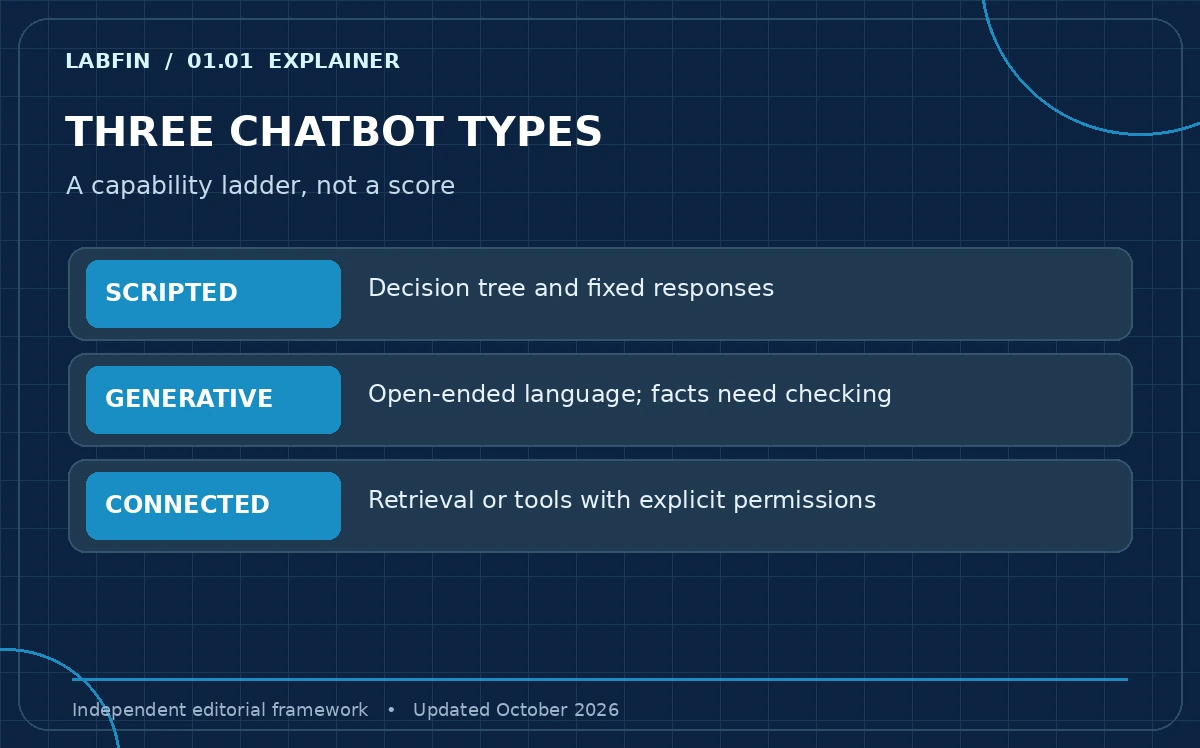
Rule-based bots follow defined options and are predictable inside a narrow decision tree. Generative chatbots use a language model to compose new answers; they handle varied phrasing, but may invent details. Tool-connected assistants combine a model with search, document retrieval or actions. A friendly interface alone does not prove that the third capability exists.
Consider a store return. A rules bot might display the returns policy. A generative model might explain the policy in plain English. A connected agent could retrieve the specific purchase, but should ask permission before submitting a return. These are different levels of responsibility, not upgrades on a single accuracy scale.
What happens between your message and the reply
Your words enter an application, which may assemble conversation history, instructions, retrieved passages and a request to a language model. The model then generates a response. Some products also issue a web search or call a business system before composing an answer. The chat window rarely reveals all of those steps, so a polished response is not evidence that fresh information was consulted.
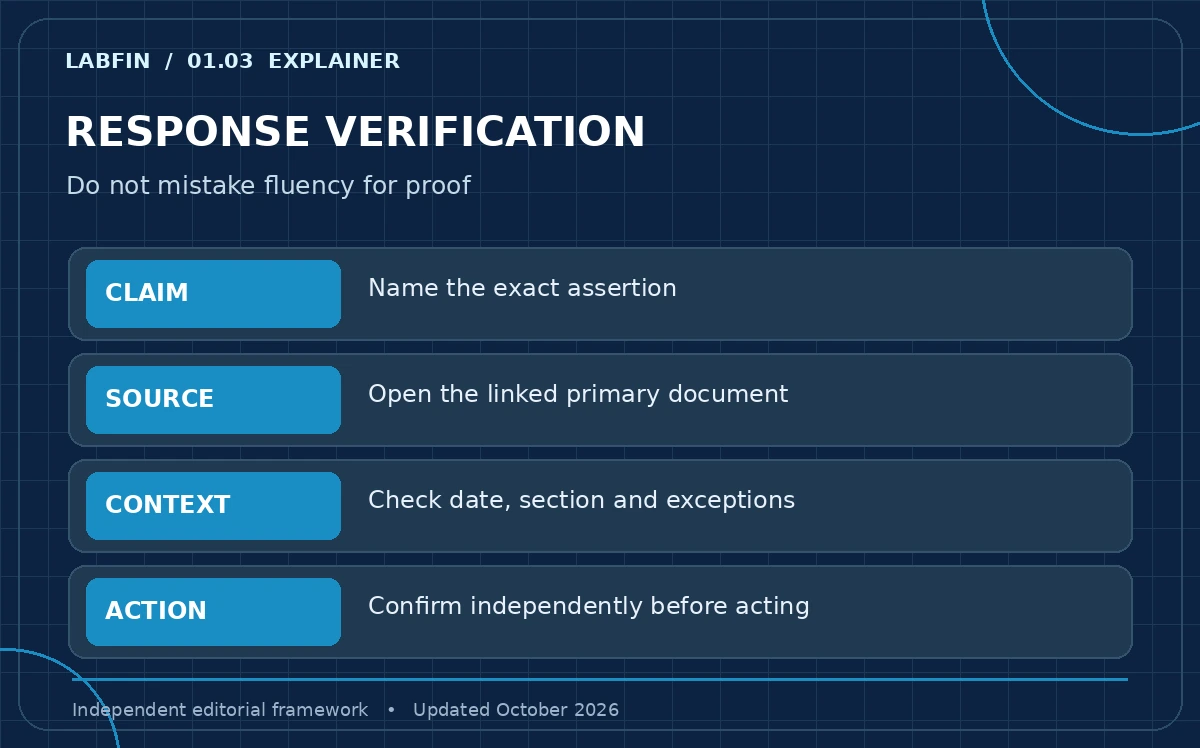
The first practical test is to ask for the origin of a specific claim. Can the product provide an accessible source, quote the relevant section accurately and separate that from its own inference? A citation is a helpful starting point, not a guarantee: open the source and check that it actually supports the sentence.
Where an AI chatbot earns its place
The clearest wins are transformations of material you already have: explain a complicated paragraph, restructure notes into a checklist, compare two drafts or brainstorm alternative headlines. You can check those outputs against your original material. A second useful job is creating a first-pass research plan, especially when the bot can show live sources that you can inspect yourself.
For an everyday example, paste a public product manual and ask for a step-by-step setup checklist with section references. Reject steps unsupported by the manual. For a less suitable job, do not ask an ordinary consumer chatbot to decide whether an unfamiliar charge is fraudulent and then act on your bank account without independent verification.
Where chatbot answers commonly go wrong
A confident answer can be stale, ungrounded or subtly incomplete. A model may blend two versions of a policy, cite a page that discusses the subject but not the specific figure, or treat a quoted document as a command. A retrieved document helps with freshness only when the correct version was indexed and the system actually used it.
Watch for answers that conceal uncertainty. Try an intentionally unanswerable question about a private document the assistant cannot access. A trustworthy workflow ends with a clear limitation or a request for the relevant file, rather than invented facts. This is an editorial screening method, not a measured benchmark of any named chatbot.
A practical checklist before you rely on a bot
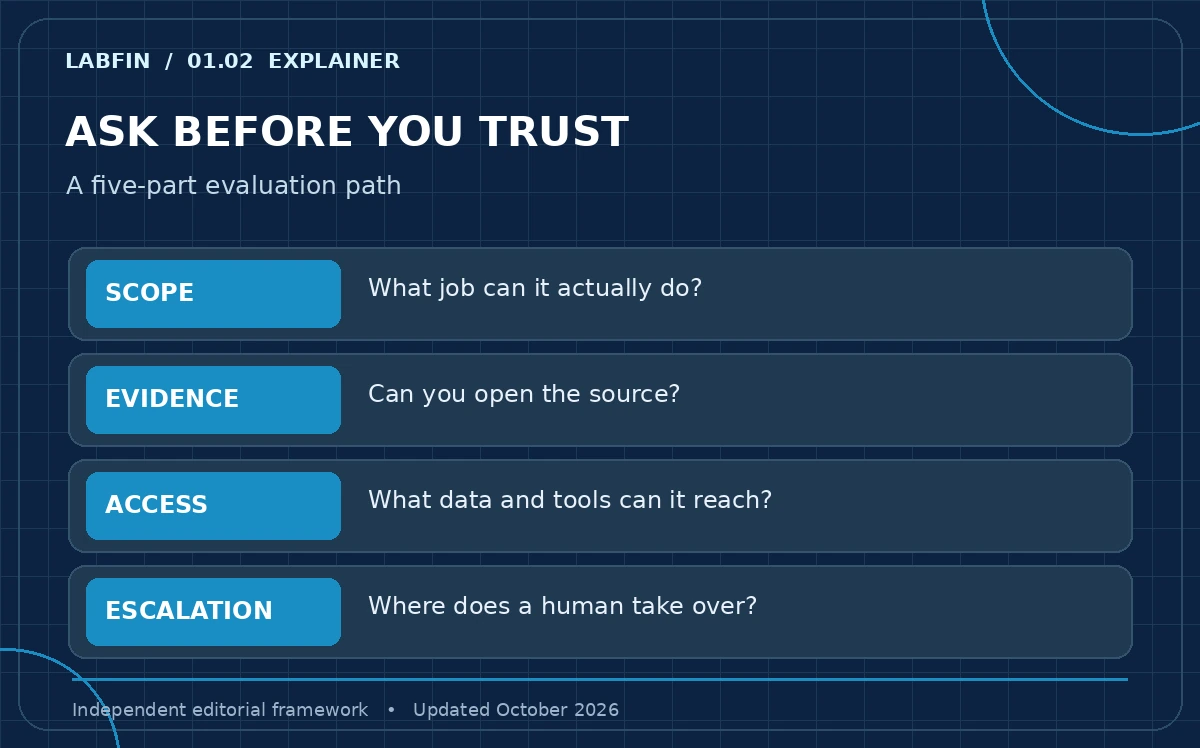
Start with scope: is it general conversation, a document assistant, a website support bot or an agent allowed to act? Next inspect sources: can it retrieve current documents and expose them? Then test control: can you restrict file access, disable connected tools and require confirmation before irreversible operations? Finally verify the escape hatch: how do you get a person when the answer is wrong?
Give each candidate the same five prompts using non-sensitive data: a short summary, a policy question with a supplied source, a question whose answer is absent, a correction after feedback and a request that should be refused or escalated. Record what happened. Do not convert these observations into public accuracy percentages unless you have a repeatable, disclosed evaluation.
Privacy is a setting, not a marketing adjective
Chat history, model training, memory, connected apps and business retention rules are separate decisions. OpenAI documents separate controls for ChatGPT model training and memory. Google likewise explains activity retention and connected-app behavior for Gemini. Changing one switch does not necessarily erase a previous chat or data already shared with another service.
For personal work, remove names, account identifiers and confidential attachments before trying a tool. For team use, ask the provider to document who can see transcripts, how exports and deletion work, and whether workspace content trains models by default. A consumer free plan is not automatically appropriate for customer records.
Chatbot versus assistant versus agent
These words overlap in marketing. For a useful distinction, a chatbot is how you converse; an assistant aims to help accomplish a personal or business task; an agent may plan steps and invoke tools. An agent can still operate through a chat window, and a bot can still be very good without autonomy.
Rate the product by what actions it can actually perform with your account, not its label. If it says it scheduled an appointment, check the calendar entry. If it says it summarized a contract, inspect the extracted clauses. A confirmation message is only a claim until the destination system shows the result.
How to pick your next step without buying five apps
If you mainly want everyday answers and writing help, begin with a general chatbot on its available free tier and evaluate the workflow before subscribing. If you require a researched answer, insist on verifiable sources. If the job is routine customer support, define escalation and policy ownership first. If the job is automation, map the permissions and failure modes before connecting accounts.
This prevents a familiar mistake: purchasing an expensive plan to solve a process problem. Write one sentence describing the task, its source of truth, what mistakes would cost and the minimum acceptable result. That gives you a concrete basis for choosing a service and revisiting the choice when its features or policies change.
How We Research
We reviewed Zendesk’s overview of chatbot types and service use cases, OpenAI’s current memory documentation, Google’s Gemini privacy hub (updated October 23, 2026), and the OWASP LLM application risks. We separated capabilities documented by providers from our own evaluation checklist. We did not run private model benchmarks, promise universal accuracy or assume all products expose the same account controls.
Frequently Asked Questions
No. ChatGPT is one specific product. AI chatbot is a broader category that also includes generative assistants, scripted support widgets and systems connected to business databases.
Not necessarily. Web search depends on the product, feature availability, user settings and permissions. Ask for source links and verify that the linked page contains the reported information.
Not by default across all services. Review conversation retention, model-training choices, memory settings, connected-app access and your organization’s policies before sharing sensitive information.
No. Traditional scripted and rules-based chatbots can return predefined answers without a generative language model. Many modern chatbots use a combination of both approaches.
When the user requests a person, the issue is sensitive or high-impact, required data is missing, or the system cannot ground its answer in an authoritative source. The handoff path should be easy to find.